Crown-Indigenous Relations and Northern Affairs Canada's 2025-26 Departmental Results Report
Table of contents
Note: Crown-Indigenous Relations and Northern Affairs Canada (CIRNAC) used its generative Artificial Intelligence (AI) tool (Co-Pilot, CANChat and GCtranslate) to support the development of content in this report. A human has reviewed and validated all AI-generated content.
Copyright information
© His Majesty the King in Right of Canada, as represented by the Minister of Crown-Indigenous Relations and the Minister of Northern and Arctic Affairs and Minister responsible for the Canadian Northern Economic Development Agency, 2026
Catalogue Number: R1-111E-PDF
ISSN: 2561-990X
Aussi disponible en français sous le titre : Rapport sur les résultats ministériels 2025–2026
At a glance
This departmental results report details CIRNAC's actual accomplishments against the plans, priorities and expected results outlined in its 2025–26 Departmental Plan.
These results align with the priorities outlined in the May 21, 2025, mandate letter from the Prime Minister, as well as with CIRNAC's vision, mission, raison d'être and operating context.
Key priorities
CIRNAC identified the following key priorities for 2025–26:
- Acknowledge and redress past harms;
- Affirm and respect Indigenous rights, and support self-determination;
- Lead the Government of Canada's work in the North and Arctic.
Highlights
CIRNAC is committed to working together with First Nations, Inuit, Métis, and Modern Treaty Self-Governing partners to support their goals of self-determination. The United Nations Declaration on the Rights of Indigenous Peoples continues to guide this work. The department is also committed to supporting Indigenous-led efforts to grow a strong, prosperous North and Arctic and improving the quality of life of Northerners.
- Total actual spending (including internal services): $9,209,830,377
- Total full-time equivalent staff (including internal services): 1,744
For detailed information on CIRNAC's total spending and human resources, read the Spending and human resources section of this report.
Summary of Results
The following provides a summary of the results the department achieved in 2025–26 under its "core responsibilities" (its main areas of activity).
Core responsibility 1: Crown-Indigenous Relations
Actual spending: $7,984,623,099
Actual human resources: 864
To support results under Crown-Indigenous Relations, CIRNAC:
- collaborated with Indigenous partners through bilateral mechanisms;
- advanced and implemented the Truth and Reconciliation Commission's Calls to Action under CIRNAC's responsibility, and supported the coordination of Calls to Action across the federal government;
- engaged with Indigenous women's and 2SLGBTQI+ organizations, and supported initiatives included in the Missing and Murdered Indigenous Women, Girls, and 2SLGBTQQIA+ People National Action Plan;
- supported family members and Survivors of missing and murdered Indigenous women, girls, Two-Spirit and gender-diverse people in their healing journey;
- assisted the Department of Justice in implementing the United Nations Declaration on the Rights of Indigenous Peoples Act Action Plan;
- accelerated specific claims resolution, as well as the resolution of litigation and the negotiation of settlement agreements;
- supported the timely processing of additions to reserve requests and continued working on redesigning the Additions to Reserve Policy;
- enhanced the First Nations Fiscal Management Act regime to ensure the regime continued to meet the needs of First Nations governments in collaboration with the four First Nations fiscal institutions;
- continued collaborating with First Nations partners to develop a modern solution for land registration and supported the development of the First Nations Land Governance Registry;
- supported Indigenous groups' capacity to participate in recognition of rights and self-determination discussion tables, and long-term planning and investment cycles;
- increased the number of Treaties, agreements and other constructive arrangements that realize self-determination and advance reconciliation, as well as support their management and implementation;
- continued to develop the commitments outlined in Canada's Collaborative Modern Treaty Implementation Policy;
- implemented the requirements of the Cabinet Directive on the Federal Approach to Modern Treaty Implementation;
- implemented the requirements of the Cabinet Directive of the Inuit Nunangat Policy;
- worked with Self-Governing Indigenous governments to implement their education sectoral agreements, and continued to advance collaborative work to define the gap in other critical areas;
- worked with Indigenous partners to address pressing housing needs and improve the quality of housing for Inuit, Métis, Modern Treaty and Self-Governing First Nations, and northern Indigenous partners.
For more information on CIRNAC's activities related to Crown-Indigenous Relations, read the "Results – what we achieved" section of this report.
Core responsibility 2: Northern Affairs
Actual spending: $1,102,688,224
Actual human resources: 377
To support results under Northern Affairs, CIRNAC:
- advanced the Nunavut lands and resources devolution;
- continued discussions with partners to define additional regional governance approaches for Canada's Arctic and Northern Policy Framework (ANPF);
- assessed and advanced solutions to respond to Canada's critical housing needs in the North;
- supported food security in isolated and northern communities;
- continued to invest in northern post-secondary education;
- helped northern and Indigenous communities transition from diesel to clean, renewable and reliable energy;
- supported climate change adaptation projects and climate monitoring projects;
- continued to engage Northerners and scientists in research and monitoring related to long-range contaminants in the North;
- continued to manage its portfolio of approximately 150 northern contaminated sites;
- promoted the northern and Arctic resources economy while protecting the environment through impact assessment, land use planning and conservation initiatives;
- invested in Indigenous and regulatory system readiness to support the Canadian Critical Minerals Strategy and advance major projects in the North;
- worked with partners to conduct marine research, harvest studies, and environmental monitoring.
For more information on CIRNAC's activities related to Northern Affairs, read the "Results – what we achieved" section of this report.
From the Ministers

I'm pleased to present the 2025–26 Departmental Results Report for Crown-Indigenous Relations and Northern Affairs Canada, alongside the Minister of Northern and Arctic Affairs, the Honourable Rebecca Chartrand. This report highlights the results achieved through partnership with Indigenous Peoples and governments this past year.
In 2025–26, Survivors and the Government of Canada reached important milestones through negotiation and collaboration, including the Hardy Indian Hospital settlement. Similar to other Indigenous Childhood Claims Litigation settlements, the settlement includes individual compensation and funding to support healing, wellness, education, language and culture and dedicated funding to support research and commemoration.
We also worked with Indigenous partners to advance self-determination through Modern Treaties, Self -Government agreements, and stronger Treaty implementation. This included progress on several Modern Treaties in British Columbia and the signing of the Final Self-Government Agreement with Tłegǫ́hłı̨ Got'įnę,the Government of the Northwest Territories, and support for the Commissioner for Modern Treaty Implementation Act (Bill C-10) as it advanced through Parliament, helping strengthen Modern Treaty implementation through the establishment of a Modern Treaty Commissioner.
This past year, we also finalized 57 additions to reserve, increasing First Nations land bases by 66,378 acres. These additions to reserve create the conditions for long-term prosperity by increasing the land available to communities to pursue priorities from housing and cultural spaces to commercial development.
In 2025–26, we resolved 31 specific claims worth $2.7 billion to address longstanding grievances and support First Nations in building their own economic futures. This included the Rouge River Valley Tract Claim Settlement with the Mississaugas of the Credit First Nation and Ontario. Resolving specific claims also strengthens local and regional economies. Recent analysis shows that approximately $1.7 billion in specific claims settlements supports more than 7,000 jobs, generates $469 million in labour income, and contributes $740 million to Canada's GDP.
We also continued working with First Nations-led institutions, including the First Nations Finance Authority, on Special Purpose Vehicles, to expand access to affordable capital and support Indigenous equity ownership in major projects.
As Canada advances major infrastructure and economic development opportunities, we continue to strengthen our relationships with national Indigenous organizations and Indigenous governments. Through engagement on the Building Canada Act, we supported discussions at the First Nations Major Projects Summit, the Inuit-Crown Partnership Committee meeting, the Métis Major Projects Summit, and nine regional engagement sessions. We also provided additional resources, including the opening of three new consultation hubs to support communities participation in consultations on projects that affect their lands, waters, and futures.
I want to thank Indigenous leaders and partners, Elders, youth, organizations, provincial and territorial governments, and public servants whose dedication made this progress possible.
Together, we are building a stronger and more prosperous future founded on respect, partnership, and shared success.
______________________________________________
The Honourable Rebecca Alty, P.C., M.P.
Minister of Crown-Indigenous Relations

I am pleased to present the 2025–26 Departmental Results Report for Northern and Arctic Affairs.
Across the North, communities, Indigenous partners, governments, and organizations are driving ambitious solutions grounded in their knowledge, experience, and priorities. This report reflects progress achieved through an approach that recognizes northern leadership and places northern voices at the center of decision-making, helping to ensure that policies, programs, and investments respond to regional realities and support sustainable development and resilient communities.
As geopolitical and environmental changes continue to reshape the Arctic, we have advanced Arctic sovereignty and security priorities through strengthened partnerships with territorial and Indigenous governments and organizations. A strong, prosperous, and well-connected North remains the foundation of Arctic sovereignty.
In 2025–26, we made significant strides in advancing Canada's Northern and Arctic resource economy while safeguarding the environment. By supporting Indigenous participation in major project assessments, improving the efficiency and transparency of regulatory processes, and strengthening collaboration with territorial and Indigenous governments and co-management boards, we are helping create the conditions for sustainable economic growth that benefits northern communities. Supported by a $25.5 million investment in Budget 2025, these efforts are enabling responsible development across the North by strengthening regulatory systems that support investment, economic participation, and environmental stewardship. We also continued to invest in northern post-secondary education, including through support for the Dechinta Centre for Research and Learning, whose co-developed programming is strengthening community well-being and contributing to higher community productivity. We also worked with Inuit Tapiriit Kanatami and federal partners to advance the development of an Inuit Nunangat University, a transformative step toward strengthening Inuit-led post-secondary education across Inuit Nunangat.
Northern communities are applying their knowledge and experience to respond to a changing climate and evolving energy needs. Over the past year, communities advanced 275 climate adaptation and monitoring projects rooted in local priorities, strengthening understanding of climate impacts and informing responses that reflect local circumstances. In addition, 71 clean energy projects across the North and Inuit Nunangat are helping improve energy reliability and reduce reliance on diesel.
Community-led approaches are improving food security across the North. This progress was highlighted at the March 2026 Food Sovereignty Summit, where Indigenous and northern partners came together to share innovative, community-driven solutions that strengthen northern food systems and economies. Over the past 12 months, more than 40 million kilograms of food and essential items were shipped to eligible northern and isolated communities with support from Nutrition North Canada's subsidy. The Harvesters Support Grant and Community Food Programs Fund supported over 15,000 traditional hunters and harvesters, contributed to more than 700 new food-sharing initiatives, and helped over 400 community hunts and harvests take place in 112 remote northern communities, strengthening access to culturally appropriate foods and supporting harvesting practices.
This past year, we also continued to advance the implementation of the Nunavut Lands and Resources Devolution Agreement, paving the way for the transfer of land and resource management responsibilities to Nunavut in 2027. At the same time, we reinforced partnerships through the structures in place to advance Canada's Arctic and Northern Policy Framework, supporting northern and Indigenous voices as they continue to guide federal action in the region.
I am inspired by the progress made in 2025–26 and grateful for the leadership, knowledge, and dedication of the many partners who made this possible. Through investments in human security, including northern infrastructure, community resilience, governance capacity, and economic development, we are helping strengthen Canada's presence across the Arctic while ensuring that northern and Indigenous communities play a central role in shaping the region's future. Together, we are building a stronger, more prosperous, and more sustainable North that reflects northern and Indigenous priorities across the region.
______________________________________________
The Honourable Rebecca Chartrand, P.C., M.P.
Minister of Northern and Arctic Affairs and Minister responsible for the Canadian Northern Economic Development Agency
Results: What we achieved
Core responsibilities and internal services
Core responsibility 1: Crown-Indigenous Relations
In this section
Description
This core responsibility aims to support Indigenous organizations, individuals, communities and governments in advancing reconciliation and self-determination through strengthening Crown-Indigenous relationships based on respect, cooperation, partnership, the affirmation and implementation of Indigenous rights.
Quality of life impacts
This core responsibility contributes to the "Good Governance" domain of the Quality of Life Framework for Canada and, more specifically, to "Indigenous Self-Determination" and "Discrimination and Unfair Treatment", through all the activities mentioned in the core responsibility description.
Progress on results
This section details the department's performance against its targets for each departmental result under Core responsibility 1: Crown-Indigenous Relations.
Table 1: Past injustices are recognized and resolved
Table 1 shows the target, the date to achieve the target and the actual result for each indicator under Past injustices are recognized and resolved in the last three fiscal years.
| Departmental Result Indicators | Target | Date to achieve target | Actual Results |
|---|---|---|---|
| Number of specific claims resolved by the department | 35 | March 31, 2026 |
|
| Number of additions to reserves completed | 70 | March 31, 2026 |
|
| Percentage of former residential schools for which investigation work has been conductedTable note c | 86% | March 31, 2026 |
|
| Percentage of Truth and Reconciliation Commission Calls to Action that are implementedTable note e | 100% | March 31, 2026 |
|
|
|||
Table 2: Indigenous Peoples advance their institutional structures and governance
Table 2 shows the target, the date to achieve the target and actual result for each indicator under Indigenous Peoples advance their institutional structures and governance in the last three fiscal years.
| Departmental Result Indicators | Target | Date to achieve target | Actual Result |
|---|---|---|---|
| Percentage of First Nations that have opted into an Indian Act alternative | 75.9% | March 31, 2026 |
|
| Percentage of First Nations that assert jurisdiction over fiscal management | 65% | March 31, 2026 |
|
| Percentage of First Nations that assert jurisdiction over land management | 21.1% | March 31, 2026 |
|
| Percentage of Indigenous groups that have enhanced their governance capacity | 5% | March 31, 2026 |
|
|
|||
Table 3: Indigenous Peoples determine their political, economic, social and cultural development
Table 3 shows the target, the date to achieve the target and actual result for each indicator under Indigenous Peoples determine their political, economic, social and cultural development in the last three fiscal years.
| Departmental Result Indicators | Target | Date to achieve target | Actual Result |
|---|---|---|---|
| Annual number of priorities identified through the permanent bilateral mechanisms that result in policies, funding or legislation | 8 | March 31, 2026 |
|
| Percentage of Indigenous People that have reached preliminary types of co-developed agreements | 92% | March 31, 2026 |
|
| Number of Treaties, Self-Government Agreements and other constructive arrangements that have been concludedTable note b | 94 | March 31, 2026 |
|
| Percentage of Indigenous People with whom Treaties, Self-Government Agreements and other constructive arrangements have been concludedTable note b | 45% | March 31, 2026 |
|
|
|||
Table 4: Indigenous Peoples strengthen their socio-economic conditions and well-being
Table 4 shows the target, the date to achieve the target and actual result for each indicator under Indigenous Peoples strengthen their socio-economic conditions and well-being in the last three fiscal years.
| Departmental Result Indicators | Target | Date to achieve target | Actual Result |
|---|---|---|---|
| Average Community Well-Being Index score for Modern Treaty and Self-Government agreement holders | 64Table note a | March 31, 2029 |
|
| Percentage of Indigenous groups with concluded arrangements demonstrating an increase in the Community Well-Being Index score | 60%Table note a | March 31, 2029 |
|
| Percentage of First Nations schools associated with a sectoral education agreement that provides culturally-based curriculum | 95% | March 31, 2026 |
|
| Number of missing and murdered Indigenous women and girls family members and Survivors who have received supports from a culturally-relevant provider for their healing journey | 350 | March 31, 2026 |
|
|
|||
The Results section of the Infographic for CIRNAC on GC Infobase provides additional information on results and performance related to its program inventory.
Details on results
The following section describes the results for Crown-Indigenous Relations in 2025–26 compared with the planned results set out in CIRNAC's departmental plan for the year.
Past injustices are recognized and resolved
Results achieved
Assimilation policies and practices have led to the denial of Indigenous rights. To resolve grievances, Canada remains committed to pursuing dialogue, partnerships and negotiation as positive means of advancing reconciliation. This is an ongoing process which requires affirmation of rights, acknowledgement of past wrongs, understanding of the colonial history of Canada and collaboration with Indigenous Peoples to co-develop solutions.
Specific claims deal with past wrongs against First Nations. The Government of Canada works with First Nations to resolve outstanding specific claims through negotiated settlements. In 2025–26, CIRNAC advanced efforts to resolve specific claims in support of reconciliation. The department resolved 31 claims and will continue working to improve the Specific Claims process, consistent with the United Nations Declaration on the Rights of Indigenous Peoples Act.
CIRNAC partners with the Department of Justice to manage the resolution of litigation, including negotiating settlement agreements outside of the courts or supporting litigation through the court system. This is done in accordance with the Attorney General of Canada's Directive on Civil Litigation Involving Indigenous Peoples, taking into consideration the United Nations Declaration (UN Declaration) on the Rights of Indigenous Peoples, and contributes to the development of Indigenous jurisprudence. In 2025-26, CIRNAC supported the Department of Justice in managing 120 active claims in litigation related to section 35 constitutional rights and historical grievances. CIRNAC continued to ensure federal interests were represented in all litigation processes for which it was the client, including protection of private property rights and the responsible management of contingent liability.
Notably, in 2025-26, the Government of Canada, in collaboration with the Government of Ontario and the Mississaugas of the Credit First Nation negotiated and signed a settlement to resolve the Mississaugas of the Credit's Rouge River Valley Tract Claim, which alleges unextinguished title to approximately 128,697 acres along the north shore of Lake Ontario. The final agreement, executed by all parties in October 2025, provides a total settlement of $183.4M for past losses dating back to the late 18th century. The settlement marks an important step toward reconciliation and a renewed Treaty relationship, creating new opportunities for the Mississaugas of the Credit to advance their priorities and foster a more prosperous future for their community.
This fiscal year, CIRNAC advanced efforts to resolve Indigenous childhood claims litigation outside of the courts, where possible, in support of healing and reconciliation. The department worked with class counsel, the Department of Justice, and third-party administrators to continue the implementation of the Sixties Scoop, McLean (Federal Indian Day Schools), Gottfriedson (Residential Schools Day Scholars), and Percival (Federal Boarding Homes) settlement agreements, ensuring Survivors receive compensation for harms suffered.
On June 24, 2025, the Federal Court approved the Hardy (Federal Indian Hospitals) Settlement Agreement which will provide compensation to those admitted to one of 33 Federal Indian Hospitals between 1936 and 1981 who experienced abuse. The claims process opened on January 27, 2026, and claimants have until July 27, 2028, to submit a claim. Further, an Agreement-in-Principle was reached to resolve a class action concerning the Île-à-la-Crosse Boarding School.
Additions to reserves (ATR) are parcels of land added to an existing reserve land of a First Nation or that create a new reserve, in a rural or urban setting. In 2025–26, CIRNAC worked in collaboration with First Nation partners to advance the redesign of the ATR Policy and support the timely processing of ATR requests. Resulting from First Nation-led engagement completed in 2024-25, the department analyzed and summarized over one thousand recommendations for the ATR Policy and process received from First Nations and First Nation organizations in the published Additions to Reserve Policy Redesign: Insights from Engagement Report. Additionally, CIRNAC completed an extensive qualitative analysis of recommendations provided by First Nations over nearly two decades and published the results in the Pathways to Additions to Reserve Policy Reform: First Nation Voices in Action. Recommendations will be reflected in the redesigned "Setting Apart Lands as Reserve" policy that will be released by the end of 2026. With a strong emphasis on recommendations provided by First Nations and First Nation organizations, CIRNAC shared the draft co-developed policy with First Nations across Canada to validate how their input has been incorporated and to gather final feedback on the policy redesign. Additionally, in collaboration with Indigenous Services Canada (ISC), CIRNAC approved 57 additions to reserve and reserve creation submissions this fiscal year.
The Government of Canada continued working towards implementation of the 94 Calls to Action delivered by the Truth and Reconciliation Commission. As of March 2026, over 85% of the 76 Calls to Action involving federal responsibility are either implemented or well underway. For example, in 2025-26, CIRNAC supported the establishment and early operations of the National Council for Reconciliation (the Council), which was incorporated in March 2025 as an independent, Indigenous-led not-for-profit organization. Established in response to Calls to Action 53, the Council's purpose is to advance reconciliation between Indigenous and non-Indigenous peoples in Canada. During the year, CIRNAC provided $1.5M in contribution funding to support the Council's early operations, as well as $65M for its endowment fund, representing the first of two installments, with the second to take place in April 2026. In September 2025, in accordance with the National Council for Reconciliation Act, the Minister of Crown-Indigenous Relations and the Council jointly developed and signed a protocol governing the disclosure of information required for the Council to fulfill its mandate. The Act also requires the Minister to provide the Council with an annual report on the indicators identified in Call to Action 55. The inaugural report was submitted to the Council on October 1, 2025.
CIRNAC continued to implement Calls to Action 72 to 76 related to Missing Children and Burial Information. In 2025-26, CIRNAC provided $3.6M in sustainability funding to support continuing efforts of the National Centre for Truth and Reconciliation (NCTR), including to implement Call to Action 72 (National Residential School Student Death Register and public-facing Memorial Register) and Call to Action 73 (National Residential School Online Cemeteries and Burial Sites Register).
The NCTR is a key element of the Residential Schools Legacy Program, preserving the history and experiences of Residential School Survivors, supporting research, and promoting reconciliation efforts across Canada. The NCTR makes information available to families and Survivors on student deaths and burial places, improving access to information, and supporting ongoing efforts to address missing or deceased children from residential schools.
On October 1, 2025, Residential School Survivors gathered on Parliament Hill to raise the Survivors' Flag and honor the memory of Indigenous children who were forcibly separated from their families and communities and sent to Residential Schools. The flag was raised to remind all Canadians of the ongoing commitment to reconciliation and the responsibility to acknowledge the past and work toward a better future. The event, organized collaboratively between the National Centre for Truth and Reconciliation and CIRNAC was a testament to the resilience of Survivors and the collective journey toward healing and reconciliation.
To advance Calls to Action 74 to 76, CIRNAC continued supporting community-led initiatives centered on the needs of Survivors to locate, document, and memorialize undocumented burial sites and graves associated with the 140 residential schools included in the Indian Residential Schools Settlement Agreement (IRSSA).
Since the Fund's launch in June 2021, CIRNAC received 196 formal requests for funding from Indigenous communities and organizations through the Residential Schools Missing Children Community Support Fund. There have been 166 agreements put in place, providing over $284.2M to community-led initiatives for Calls to Action 74-76. This support includes 76 community-led investigations at 89 of the 145 former residential schools. Of these, 155 communities (94%) are conducting research/knowledge gathering, 131 (79%) are working on memorialization/commemoration projects, and 88 (53%) are undertaking technical fieldwork investigations. Advancing initial research, knowledge-gathering, and engagement activities will help inform subsequent fieldwork investigations, including surveys and mapping, ground-penetrating radar, archeological assessments, and on-site ceremonies. This included supporting initiatives to honour families' wishes to identify and repatriate children's remains. In October 2025, in a second case since the creation of the program, the remains of a child who was sent to the Fort Resolution (St. Joseph's) residential school in the 1940s were identified and repatriated to her home community to be re-interred next to her mother. CIRNAC is committed to continuing support to Survivors, families, and communities as they continue to uncover the truth of what happened to children who attended residential schools and to honour their memories.
Indigenous Peoples advance their institutional structures and governance
Results achieved
The development of Indigenous-led institutions and governance is an essential step towards Indigenous self-determination. It is a fundamental principle of the UN Declaration on the Rights of Indigenous Peoples. In 2025-26, CIRNAC continued to advance implementation of the United Nations Declaration on the Rights of Indigenous Peoples Act and the UN Declaration Act Action Plan 2023-28, including work to support Indigenous self-determination, participation in decision-making, and the implementation of rights-based and distinctions-based approaches to federal policy development. This included continued work to support Indigenous participation in federal decision-making, including through consultation and cooperation tools and approaches that help federal officials better understand Indigenous rights, interests, and priorities.
CIRNAC also continued work with Inuit partners to support implementation of the Inuit Nunangat Policy and associated Cabinet Directive, and with Modern Treaty and Self-Governing partners on priorities related to implementation, accountability, and federal coordination. In 2025-26, Canada reintroduced legislation to establish a Commissioner for Modern Treaty Implementation. This work supports Modern Treaty partners' long-standing priorities around oversight, accountability, and improved implementation of Modern Treaties.
Moreover, the Framework Agreement on First Nation Land Management enables participating communities to withdraw their lands from the land management provisions of the Indian Act, and to implement First Nation governance and laws with respect to their land, resources and environment. In 2025–26, CIRNAC worked with First Nation partners, including the Lands Advisory Board and the First Nations Land Management Resource Centre, to advance the development of the First Nation Land Governance Registry. This work contributes to a First Nation-led approach to land registration under the Framework Agreement on First Nation Land Management. Key progress includes the completion of the Registry software platform development, along with its testing and ongoing refinement, prior to its anticipated implementation in late 2026-27. CIRNAC also took steps toward the planned implementation of the Registry including co-development of the required legislative, regulatory, and Framework Agreement amendments to support First Nation self-determination over their land records and interests.
Building on these governance initiatives, CIRNAC also advanced fiscal management reforms through the First Nations Fiscal Management Act. In 2025–26, CIRNAC completed co-development work with the First Nations Financial Management Board, the First Nations Tax Commission, the First Nations Finance Authority, Modern Treaty First Nations, and the Province of British Columbia on regulations (passed in October 2025) that adapt the First Nations Fiscal Management Act to enable self-governing groups to access the pooled-borrowing regime under the Act. As committed in Budget 2025, CIRNAC worked closely with the fiscal institutions to co-develop legislative amendments to the First Nations Fiscal Management Act to enable the First Nation Finance Authority to lend to Indigenous "Special Purpose Vehicles" seeking equity participation in economic and resource development projects.
To support Indigenous groups that participate in the Indigenous Recognition of Rights and Self-Determination (RIRSD) table discussions, CIRNAC continued to provide support under the Enhanced Capacity Building funding stream. In accordance with co-developed work plans, this funding facilitates negotiations to undertake rights and self-determination preparedness activities prior to the implementation of agreements. In 2025-26, seven percent (7%) of Indigenous partners supported under the RIRSD table discussions received additional resources to enhance their governance capacity, based on their stages of negotiation.
In 2025-26, CIRNAC supported boards and organizations (institutions of public governance), committees, and other management bodies established under Modern Treaties to deliver on their mandates. These boards and committees are responsible for many regulatory decisions related to land, water, and the environment. In addition to core operational funding, CIRNAC supported these organizations through increased board renumeration, implementation committees, engagement on the preliminary screening of development proposals, and financial support for priority initiatives. These organizations provide important services, such as conducting environmental impact assessments and impact reviews, as well as issuing water licenses and land use permits. By enabling these functions, the organizations help parties to Modern Treaties plan and manage land, water, wildlife, renewable resources, and other resources across the country.
The department also supported the advancement of Indigenous institutions and governance through the implementation and amendment of Modern Treaties, Self-Government Agreements, and other constructive arrangements. For example, institutional and governance developments occurred within the Anishinabek Nation Governance Agreement through an amendment. Following the successful First Nations-led Community Approval Processes and the approval by B'Maakonigan and the Government of Canada, Aundeck Omni Kaning and Sheshegwaning were added as new parties to the agreement on April 1, 2025. As a result of joining the agreement, these First Nations become accountable to their citizens on matters of governance and law-making, and can make their own governance decisions in a culturally relevant manner.
CIRNAC, alongside Public Safety Canada and the Department of Justice, also supported important changes to Indigenous justice and policing in 2025-26. For example, through a complementary agreement signed in May 2025 between Canada, Quebec, and the Naskapi Nation of Kawawachikamach, the Northeastern Québec Agreement was amended to modernize the Naskapi Police authority, aligning it with current policing practices. In September 2025, the Trʼondëk Hwëchʼin, the Government of Canada, and the Government of Yukon signed the Trʼondëk Hwëchʼin Framework Agreement, which established the structure, guiding principles, and negotiation process to ultimately reach a Trʼondëk Hwëchʼin Administration of Justice Agreement. Together, these milestones mark important steps contributing toward strengthening Indigenous institutions to advance Indigenous-led approaches to justice and policing.
In January 2026, Canada, Québec and two Cree Modern Treaty partners, Waskaganish and Waswanipi, signed territorial reconfiguration agreements. These agreements will enable modifications to land categories within the James Bay and Northern Québec Agreement, tailoring the framework under which these communities manage their land.
The Collaborative Fiscal Policy Development Process continues to operate through regular working group meetings and periodic plenary discussions with senior officials. Current areas of focus include advancing the completed expenditure need models for infrastructure and language revitalization, developing a lands expenditure needs approach, exploring newer areas such as economic development and housing, and conducting a five-year review of Canada's Collaborative Self-Government Fiscal Policy. The Collaborative Fiscal Policy Development Process has also expanded in 2026 to include participation from K'ómoks, Kitselas and Kitsumkalum First Nations, whose communities successfully ratified Modern Treaties in 2025. CIRNAC also continues to work with the Métis partners to co-develop an adaptation of the Policy to meet the needs of Métis governments, which will further support the advancement of Métis self-government.
On June 27, 2025, the Athabasca Denesųłiné Final Agreement and Ghotelnene K'odtįneh Dene Final Agreement, two Modern Treaties that address harvesting, land, and resource management related rights in the Northwest Territories and Nunavut, were successfully ratified by the respective communities. While there are a number of steps that the parties must undertake before enabling legislation is introduced in Parliament to bring the Agreements into effect, successful community ratification marks a major milestone in the negotiations.
On September 18, 2025, the Tlegohli Got'ine Government Inc., the Government of Canada, and the Government of Northwest Territories signed the Final Self-Government Agreement for the Tłegǫ́hłı̨ Got'įnę. This marks an important milestone that will recognize their inherent right to govern themselves and make decisions based on their community's priorities. Enabling legislation is required to bring the Agreement into effect, at which point it will support the Tłegǫ́hłı̨ Got'įnę in making their own laws; preserving and protecting their language and culture; delivering programs and services, including education and healthcare; and electing their own leadership.
Finally, CIRNAC continued to develop a plan for a strategic approach to reform First Nation citizenship and membership, as part of broader efforts to transition away from the Indian Act and support self-determination.
Indigenous Peoples determine their political, economic, social and cultural development
Results achieved
The Government of Canada is committed to renewing relationships with Indigenous Peoples based on the affirmation and implementation of their inherent right to self-determination, including the right to self-government. This will allow Indigenous Peoples to determine their political, economic, social and cultural development.
In 2025-26, CIRNAC continued to advance bilateral relationships with national Indigenous organizations to identify shared priorities and support ongoing collaboration. This included supporting the Prime Minister and Ministers in engaging with Indigenous governments and organizations on the implementation of the Building Canada Act and major projects:
- The First Nations Major Projects Summit (in July 2025) brought together more than 430 First Nations Chiefs and leaders;
- Discussions with Inuit Treaty Organizations (in July 2025) took place as part of an Inuit-Crown Partnership Committee (ICPC) meeting;
- The Métis Major Projects Summit (in August 2025) convened seven of eight Métis governments and organizations.
These meetings informed future engagement on economic reconciliation, partnerships, and major project development. Additionally, as a follow up to the First Nations Major Projects Summit, CIRNAC supported the Major Projects Office to hold nine regional virtual engagement sessions between October and December 2025. These sessions were hosted by federal Ministers and attended by over 310 First Nations leaders and representatives, furthering discuss the Building Canada Act and major projects.
The ICPC held two Leaders meetings between Ministers and Inuit leadership in 2025-26. Discussions focused on implementation of the Building Canada Act in partnership with Inuit; infrastructure and major projects; Arctic sovereignty, security and defence; and key social and economic priorities in Inuit Nunangat, including housing, the Inuit Child First Initiative, tuberculosis elimination, and Inuit Nunangat University. This work was supported by ongoing engagement between federal and Inuit officials, through senior officials meetings, to prepare for and advance outcomes from these Leaders' meetings.
Respecting the approach of how National Indigenous Organizations wish to engage with the department, meetings with First Nations, Inuit, Métis and Modern Treaty and Self-Governing partners were held throughout 2025-26. CIRNAC continued to engage with partners though regular bilateral meetings at a senior official levels to discuss priorities and find areas of commonality that could inform joint-priorities.
In 2025–26, CIRNAC collaborated with the Native Women's Association of Canada (NWAC), Pauktuutit Inuit Women of Canada, and Les Femmes Michif Otipemisiwak (LMFO) to advance whole-of-government relationship agreements and assess the effectiveness of existing commitments. Pauktuutit expanded Inuit women's participation in national and international policy forums, contributed to UN Declaration and Indigenous Justice Strategy processes, and advanced work on poverty reduction, food security, and safe shelters. NWAC strengthened governance renewal, enhanced GBA Plus capacity, and supported national engagement efforts across federal policy and technical tables. LFMO advanced Métis-specific policy development, renewed governance structures, expanded community engagement through national gatherings and policy forums, and progressed work on a Métis-specific MMIWG2S+ database. Collectively, these efforts deepened relationship-building, supported distinctions-based leadership, and ensured that whole-of-government agreements remain responsive to the evolving priorities and well-being of Indigenous women and 2SLGBTQI+ people.
The fourth annual National Indigenous-Federal-Provincial-Territorial meeting on Missing and Murdered Indigenous Women, Girls and 2SLGBTQI+ People was held in hybrid form in Ottawa in February 2026. Topics discussed included addressing human trafficking, exploring a Red Dress Alert, and developing stronger safety, prevention, and mitigation measures in the context of major projects and their impacts on Indigenous women, girls and 2SLGBTQI+ People.
In June 2025, the department published the fourth Federal Pathway Annual Progress Report. This report provides an overview of work completed to date, including progress towards the Calls for Justice, to address the immediate and long-term needs of Indigenous women, girls and 2SLGBTQI+ People, ensuring they live free from violence. A total of 21 federal departments participated in its development. Additionally, in October 2025, the department launched an updated online reporting tool to track federal progress on the Calls for Justice outlined in the 2024–25 Annual Progress Report.
In 2025–26, CIRNAC funded 12 projects across the country under the Indigenous‑Led Data Research Projects Program. These multi‑year initiatives advanced distinctions‑based and identity‑specific data methodologies to address long‑standing gaps in how safety, harm, and justice are measured for First Nations, Inuit, and Métis women, girls, and 2SLGBTQI+ People. For example, Pauktuutit Inuit Women of Canada advanced Inuit Count, an Inuit‑specific, gender‑based data strategy to improve methodologies for missing and murdered Inuit women, girls, and 2SLGBTQI+ Inuit, including the development of qualitative distinctions‑based indicators and Inuit‑defined measures of safety. Treaty 8 First Nations in Alberta continued a three-year study, to better understand violence against First Nations women, girls and 2SLGBTQQIA+ People, including their experiences seeking help, the services available to them, and how First Nations collect and share data with other jurisdictions. The Manitoba Inuit Association advanced Inuit‑centred data sovereignty by developing sustainable, community‑driven tools and methodologies to address data gaps affecting Inuit in Manitoba. LFMO engaged governmental data holders to extract and improve Métis‑specific data using culturally competent, distinctions‑based approaches. Together, these projects strengthened Indigenous data sovereignty and improved the quality, inclusivity, and cultural relevance of data used to inform federal policy and decision‑making.
Modern Treaties, Self-Government Agreements and other constructive arrangements are the foundations for transformative change that move us away from colonial systems of administration and governance. The adoption of new financial policies to support section 35 negotiations continued to demonstrate positive results, highlighted by the community ratifications of the Kitselas Treaty and the Kitsumkalum Treaty in British Columbia. Once implemented, these agreements and the K'omoks Treaty will constitute the first three Modern Treaties concluded under the British Columbia Treaty Commission process since 2016. On February 12, 2026, federal implementing legislation, Bill C-21 (Red River Métis Self-Government Recognition and Implementation Treaty Act), was introduced in Parliament. If passed, Bill C-21 will, upon royal assent, give legal force and effect to the Red River Métis Self-Government Recognition and Implementation Treaty.
CIRNAC has continued working directly with Self-Governing and Modern Treaty partners to build stronger Nation-to-Nation, Inuit-Crown, and government-to-government relationships. Key to this work has been ensuring the meaningful implementation of Modern Treaties, stand-alone self-government arrangements, and sectoral education agreements. In 2025-26, CIRNAC maintained responsive relationships with Modern Treaty and Self-Governing partners, provided efficient funding management, and continued to support Indigenous self-determination and community development work. The department also successfully provided access to stable and ongoing funding to tailor self-government and Modern Treaty partners' programs and services to meet their political, economic, social, and cultural needs.
In 2025-26, CIRNAC continued to advance implementation of Canada's Collaborative Modern Treaty Implementation Policy. This included ongoing development work on dispute resolution and exploratory discussions on modernizing agreements to ensure they remain aligned with evolving federal laws and policies. Indigenous partners were engaged through agreement-specific bilateral and trilateral tables. Throughout 2025-26, CIRNAC, the Department of Justice, and the Canada School of Public Service continued to support federal awareness and understanding of Modern Treaties through courses, job aids, and training on the UN Declaration on the Rights of Indigenous Peoples and the UN Declaration on the Rights of Indigenous Peoples Act.
Through the Deputy Ministers' Oversight Committee on Modern Treaty Implementation, Deputy Ministers engaged with Indigenous Modern Treaty partners, advanced discussions on cross-cutting implementation issues, and promoted a coordinated federal approach to fulfilling Treaty obligations. In 2025-26, the Intergovernmental Policy Circle (IPC) experienced increased activity as federal engagement on economic initiatives intensified. Through the IPC, Indigenous Modern Treaty partners, self-government partners, and federal officials advanced discussions on major projects, economic prosperity, fiscal policy, and other shared priorities. Since Spring 2025, officials have engaged with more than 500 public servants from over 20 federal departments and agencies to address cross-cutting challenges and promote approaches that reflect the legal, fiscal, and governance distinctions of modern treaties and self-government arrangements.
CIRNAC continued to support the legislative process of Bill C-10: An Act Respecting the Commissioner for Modern Treaty Implementation, a proposed independent oversight mechanism to help hold the federal government accountable for its Modern Treaty commitments and obligations. Following the prorogation of Parliament in January 2025, Bill C-77 was reintroduced in its original form as Bill C-10 on September 25, 2025. The Bill successfully advanced through first and second reading in the House of Commons. It was then considered by the Standing Committee on Indigenous and Northern Affairs, where it passed without amendment and where all witnesses, including Indigenous Modern Treaty partners, spoke in support of the legislation. CIRNAC will continue to support this Bill as it is considered by Parliament.
This fiscal year, CIRNAC, in partnership with the other Principals to the British Columbia Treaty negotiations process (the First Nations Summit and the Province of British Columbia), continued advancing implementation of the co-developed Recognition and Reconciliation of Rights Policy for Treaty Negotiations in British Columbia. The parties made progress on a joint implementation plan for the Policy, outlining actions that Canada, British Columbia, the First Nations Summit, and participating First Nations will take to address implementation challenges, including joint guidelines, training, and other deliverables. In October 2025, the Principals issued an updated letter of instruction clarifying the British Columbia Treaty Commission's key roles and responsibilities, including its role in encouraging negotiations consistent with the Policy.
In 2025-26, the Government of Canada, British Columbia, and Tla'amin Nation worked together to successfully amend the Tla'amin Treaty through Treaty Amendment #4. The amendment resulted in the integration of specific Tla'amin language terms within the Treaty and associated appendices. For example, the Tla'amin Final Agreement title has been amended to "ʔaʔǰɩnxʷegəs", translating to "a good relationship with someone" in ʔayʔaǰuθəm (Tla'amin language). The incorporation of Indigenous terminology follows the precedent of other Modern Treaties' inclusion of traditional language terms. It also aligns with Canada's Collaborative Modern Treaty Implementation Policy, the UN Declaration on the Rights of Indigenous Peoples Act, the Indigenous Languages Act, the Official Languages Act, and the Truth and Reconciliation Commission's Calls to Action 13 and 14. Through these changes, CIRNAC directly supported the Indigenous right to self-determination— the inherent right to freely determine their political, economic, social, and cultural development, to govern their internal affairs, and, more specifically, to preserve and promote their languages.
In support of building one Canadian economy and expediting nation-building projects in partnerships with Indigenous Peoples, CIRNAC has continued to support a whole-of-government approach to consultation and accommodation through guidance, advice, and tools for federal officials. In 2025-26, CIRNAC provided guidance and advice to over 37 federal departments and agencies as they worked to fulfill the Crown's legal duty to consult, and where appropriate, accommodate, Indigenous Peoples whose potential or asserted Aboriginal or Treaty rights may be impacted by a federal activity. To further support federal officials in consultation and engagement activities, the department provided training and learning events on the duty to consult, resulting in approximately 856 federal public servants trained over the last fiscal year. CIRNAC also provided tailored advice and guidance on over 116 projects nationally, including projects subject to the Impact Assessment Act, Canada Energy Regulator Act, Nuclear Safety and Control Act, and Building Canada Act, as well as major projects subject to the northern regulatory regime as defined in Yukon Environmental and Socio-economic Assessment Act, Mackenzie Valley Resource Management Act, and Nunavut Planning and Project Assessment Act.
Furthermore, CIRNAC has experienced greater involvement in major projects, including providing advice and guidance to support federal funding decisions to shovel-ready projects through the First and Last Miles Fund (formerly the Critical Minerals Infrastructure Fund). In addition, CIRNAC is working closely with federal departments, agencies, and Crown Corporations on fulfilling the legal duty to consult while advancing Indigenous relationships and partnerships on projects, such as providing direct support to the Major Project Office.
Budget 2023 provided $11.4M over three years, starting in 2023-24, for CIRNAC to engage with Indigenous Peoples to renew the guidelines for federal officials to fulfill the Crown's Duty to Consult. The final phase of regional engagement concluded in December 2025. In 2025-26, input was received from 379 Indigenous participants from 251 communities and organizations across 12 in-person sessions and five virtual sessions. Renewing the guidelines is essential to support federal officials in meaningfully meeting the Duty to Consult by providing more clarity on how the government can ensure an effective and efficient whole-of-government approach to consultation and accommodation, based on partnerships and collaborative relationships.
Budget 2025 provided $10.1M over three years, beginning in 2025-26, to maintain the Federal Initiative on Consultation to support the meaningful participation of Indigenous groups in consultation processes. This funding also includes three new resource centres to advance projects of national interest under the Building Canada Act. In 2025-26, CIRNAC supported the implementation of eight consultation resource centres and 13 consultation protocols, with an additional five protocols in active co-development. Collectively, these mechanisms provide consultation capacity support to more than 400 Indigenous governments, communities, and organizations in Canada.
Finally, the department continued to make ongoing content updates to the Aboriginal and Treaty Rights Information System (ATRIS), which houses information pertaining to potential or established Aboriginal or Treaty rights to support federal departments, and others in engaging and consulting with Indigenous partners. This included the addition of a dataset displaying Major Projects and Transformative Strategies referred to the Major Projects Office, strengthening the system's ability to support informed consultation by providing consolidated spatial context on major projects and overlapping Indigenous rights and interests. Further system enhancements were implemented to improve overall usability and intuitiveness, making it easier for users to navigate, access, and interpret information within the platform. Additionally, in support of amplifying Indigenous voices and facilitating the sharing of Indigenous-led information, five community and organization profiles in ATRIS were co-developed or co-validated with Indigenous partners in 2025-26 to advance Indigenous data sovereignty and support.
Indigenous Peoples strengthen their socio-economic conditions and well-being
Results achieved
The Government of Canada is committed to supporting Indigenous Peoples in achieving self-determination, which will lead to improved socio-economic conditions and well-being.
The Community Well-Being (CWB) Index is a method of assessing socio-economic well-being in Canadian communities. Various indicators are derived from Statistics Canada's Census of Population and combined to give each community a well-being score. Results for the CWB among Modern Treaty and Self-Government Agreement Holders remain stable over the reporting period. These findings are unchanged from those reported in 2023–24 and 2024–25, as they continue to rely on 2021 Census data. While this stability suggests no decline in outcomes, it also limits the ability to assess whether current investments and implementation efforts are driving measurable improvements. Updated data based on the 2026 Census will be required to determine future progress.
For this reporting period, the average CWB score remains on target at 64, indicating that overall well-being outcomes are being maintained at the expected level. However, the percentage of Indigenous groups with concluded arrangements demonstrating an increase in their CWB score remains below target at 57, highlighting a persistent gap in improvements at the community level.
In 2025-26, CIRNAC advanced efforts to update the 2015 Cabinet Directive on the Federal Approach to Modern Treaty Implementation by focusing on five key areas: clarifying federal roles and responsibilities, including Deputy Head accountabilities; establishing clearer expectations for early engagement, coordination, and decision-making across federal departments and agencies; promoting Modern Treaty education and awareness within the federal public service; strengthening mechanisms to identify and resolve implementation issues; and enhancing transparency and accountability through improved record-keeping, oversight, and information sharing with central agencies and oversight bodies.
Canada has collaborated with education sectoral self-government agreement partners, who exercise full jurisdictional control over education. These agreements enable self-governing partners to establish and control their education systems and institutions, providing services that better reflect student needs and provide culturally-appropriate education. Effective implementation of these agreements is integral to advancing reconciliation, self-determination, and improved socio-economic outcomes for communities across Canada.
In 2025-26, CIRNAC worked with self-governing partners to administer Budget 2024 education infrastructure investments, school food programming, and continued fiscal agreements, supporting the implementation of education sectoral self-government agreements and improved student outcomes in participating communities. This included delivering education programs through sectoral agreements in British Columbia, Ontario, and Nova Scotia. To support these efforts, CIRNAC, ISC, British Columbia, the First Nations Education Steering Committee, and the First Nations Education Authority established an Oversight Committee to monitor implementation under the Education Jurisdiction Framework Agreement. Additionally, Canada negotiated and executed amended and renewed education jurisdiction funding agreements with the seven participating First Nations in BC to address implementation challenges and achieve greater consistency across all BC agreements.
CIRNAC, through the First Nations Education Steering Committee (FNESC), has continued to work with Indigenous Peoples toward reducing socio-economic inequities between Indigenous and non-Indigenous populations and amongst Indigenous men, women, and gender-diverse people. The program offered by FNESC continues to gain the attention of First Nations communities in British Columbia. In 2025-26, 15 First Nations expressed interest in pursuing opportunities to advance control of their communities' educational jurisdiction through FNESC. Discussions with these First Nations remain ongoing. Additionally, CIRNAC is negotiating a sectoral agreement with Nishnawbe Aski Nation to support a First Nations-led education system in northern Ontario.
In 2025-26, CIRNAC collaborated with Indigenous partners to accelerate opportunities that unlock greater security and prosperity in their communities through building more homes and community infrastructure. Access to safe and affordable housing is critical to improving health and social outcomes for Modern Treaty partners and contributes to strengthening community development. Budget 2023 announced $4B in funding over seven years for the Urban, Rural and Northern (URN) Indigenous-led Housing Strategy. In 2025-26, CIRNAC collaborated with Inuit, Métis and Modern Treaty and Self-Governing partners to administer funding through amendments to their fiscal arrangements, resulting in $80M investment to implement this strategy.
From 2018-19 to 2024-25, the funding provided to six Métis organizations (Métis Nation of Ontario, Manitoba Métis Federation, Métis Nation-Saskatchewan, Otipemisiwak Métis Government, Métis Nation British Columbia and Metis Settlements General Council) has enabled them to construct or purchase 2,025 housing units, provide down payment assistance to 2,809 households, renovate 7,918 units, and provide rent subsidies to 12,049 families. Similarly, the funding provided to Inuit Tapiriit Kanatami and the four Inuit Treaty Organizations has enabled them to construct 640 housing units and repair 580 existing units. Funding for CIRNAC's housing initiatives is designed to respect self-determination, providing Indigenous partners with flexibility to plan and adjust based on regional needs, construction seasons, and materials delivery windows. However, the timeframe for partner reporting does not align with TBS reporting cycles, leaving insufficient time for CIRNAC to analyze data. As a result, 2025-26 results will be reported in 2026-27.
This fiscal year, CIRNAC funded 12 projects across the country, inclusive of all distinctions, under the Support for the Wellbeing of Families and Survivors of Missing and Murdered Indigenous Women, Girls and 2SLGBTQQIA+ People Contribution Program. Projects funded under this program empowered families and survivors of MMIWG and 2SLGBTQI+ People to find healing in ways meaningful to them. Many projects centered on commemoration and collective healing, supporting communities, families, and Survivors in honouring their loved ones through memorial feasts, celebrations of life and legacy, and healing gatherings, as well as the creation of lasting commemorative items. These efforts were complemented by written, online, and in-person resources to help families navigate available supports, along with programming tailored to the needs of children and youth affected by these losses. Other projects strengthened the support infrastructure available to families and Survivors, establishing resource centres and navigator services that connect them to culturally relevant care. These investments are building more reliable and accessible systems of support, including the capacity to respond swiftly in moments of crisis, such as when a family member goes missing.
The Red Dress Alert provides notification when an Indigenous woman, girl, Two-Spirit, or gender-diverse person goes missing so they can be brought home safely. In 2025-26, CIRNAC worked with Manitoba and Giganawenimaanaanig to continue advancing the Red Dress Alert Pilot Project. During this time, Giganawenimaanaanig released a final engagement report (PDF) and outlined a recommended path forward for consideration by both levels of government (PDF).
Finally, compensation associated with the resolution of historical grievances enables Indigenous People to seize socio-economic opportunities and improve their well-being, namely through job creation and increased labour income. In 2025–26, CIRNAC continued to advance the resolution of historical grievances to support improved socio-economic outcomes for Indigenous Peoples.
Since 2015, CIRNAC has resolved 397 specific claims and provided $20.8B in compensation to First Nations. These settlements support and contribute to increased economic opportunities, job creation, and improved community well-being. A CIRNAC-commissioned study based on a sample of 20 First Nations with recently settled claims found that 50% of settlement funds were invested or saved, 31% contributed to service expansion or economic development, and 15% were distributed as individual payments. Based on economic modeling, the study estimated that $1.7B in settlement compensation (the average yearly amount between 2019-20 and 2023-24) generates more than 7,000 jobs, $469M in labour income, and $740M in gross domestic product growth for communities and neighbouring regions.
Key risks
In 2025–26, CIRNAC worked to reduce risks related to managing complex relationships, driving transformative change, and supporting sustainable Indigenous self-determination. This was achieved by strengthening governance, improving coordination between governments, advancing rights-based agreements, and increasing Indigenous participation in decision-making.
To improve coordination on Indigenous rights issues, CIRNAC enhanced whole-of-government governance and engagement mechanisms. Through forums like the Deputy Ministers' Oversight Committee, the Inuit-Crown Partnership Committee, and the Intergovernmental Policy Circle, CIRNAC fostered better collaboration across governments and with Indigenous partners. Over 500 federal officials participated in discussions on Modern Treaty implementation and shared priorities, helping to create a more unified federal approach to reconciliation and Indigenous rights.
In support of the United Nations Declaration on the Rights of Indigenous Peoples Act, CIRNAC continued implementing the Action Plan and expanded Indigenous involvement in federal decision-making through consultation and cooperation processes. The department also supported the establishment and early operations of the National Council for Reconciliation by providing operational funding, an endowment payment, a government information-sharing protocol, and the first reconciliation indicators report (PDF). These actions improved accountability, transparency, and coordination in advancing reconciliation goals.
CIRNAC also reduced risks tied to lengthy and complex negotiations by advancing Modern Treaty, Self-Government, and rights recognition processes. Key achievements included the ratification of the Athabasca Denesųłiné Final Agreement and Ghotelnene K'odtįneh Dene Final Agreement, the signing of the Tłegǫ́hłı̨ Got'įnę Final Self-Government Agreement, progress toward implementing the Kitselas and Kitsumkalum Treaties, reintroducing legislation to establish a Commissioner for Modern Treaty Implementation, and introducing legislation to support Red River Métis self-government. These milestones strengthened nation-to-nation relationships and improved the negotiation and implementation of agreements.
To address risks related to Indigenous capacity and the sustainability of self-determination initiatives, CIRNAC expanded support for Indigenous governance and institutional development. This included implementing the Inuit Nunangat Policy and associated Cabinet Directive, developing the First Nation Land Governance Registry, modernizing the First Nations Fiscal Management Act framework, supporting institutions created under Modern Treaties and Self-Government Agreements, and continuing capacity-building funding for Indigenous partners involved in rights recognition and self-determination discussions.
The department also enhanced consultation and engagement processes by advising over 37 federal departments and agencies, supporting more than 116 projects nationwide, and training approximately 856 federal public servants on consultation and accommodation obligations. CIRNAC completed extensive engagement on updated federal consultation guidelines and supported eight consultation resource centres and 13 consultation protocols serving over 400 Indigenous governments, communities, and organizations. These efforts increased Indigenous participation in decision-making and made consultation processes more efficient and consistent.
Progress in resolving historical grievances further reduced risks related to maintaining trust and advancing reconciliation. During the year, CIRNAC resolved 31 specific claims, managed 120 active litigation files related to section 35 rights and historical grievances, negotiated major settlements such as the Rouge River Valley Tract Claim settlement with the Mississaugas of the Credit First Nation, and continued implementing several Indigenous childhood claims settlements. These outcomes highlight the success of dialogue, negotiation, and partnership-based approaches to resolving long-standing issues.
Together, these actions strengthened governance, improved coordination, enhanced Indigenous capacity, advanced self-determination, and supported more effective reconciliation efforts. This reduced risks related to change management, agreement implementation, and long-term organizational sustainability.
Resources required to achieve results
Table 5: Snapshot of resources required for Crown-Indigenous Relations
Table 5 provides a summary of the planned and actual spending and full-time equivalents required to achieve results.
| Resource | Planned | Actual |
|---|---|---|
| Spending | $11,587,930,891 | $7,984,623,099 |
| Full-time equivalents | 949 | 864 |
The Finances section of the Infographic for CIRNAC on GC Infobase page and the People section of the Infographic for CIRNAC on GC Infobase page provide complete financial and human resources information related to its program inventory.
Related government-wide priorities
This section highlights government priorities that are being addressed through this core responsibility.
Gender-based Analysis Plus
In 2025-26, CIRNAC ensured an integrated review and GBA Plus challenge function to apply a culturally competent GBA Plus lens across the lifecycle of all departmental policy and program documents. For example, CIRNAC's Memorandums of Understanding with the Native Women's Association of Canada, Pauktuutit Inuit Women of Canada, and Les Femmes Michif Otipemisiwak inform the application of a distinctions-based, culturally competent GBA Plus analysis. These partnerships support the development of frameworks, tools, research, and community-driven initiatives that strengthen GBA Plus integration in planning and reporting across all CIRNAC programs.
As set out in the GBA Plus supplementary information table, programs under this core responsibility reported the distribution of benefits by gender, income level and age group. Where data allowed, programs also reported disaggregated results by distinction group, region and remoteness, including reach across First Nations, Inuit and Métis partners on and off reserve and in urban and remote communities. Disaggregation is not yet possible for every program, and work continues with Indigenous partners on approaches that respect Indigenous data sovereignty.
This work aligns with Section 5 of the Canadian Gender Budgeting Act and the United Nations Declaration on the Rights of Indigenous Peoples Act.
United Nations 2030 Agenda for Sustainable Development and the UN Sustainable Development Goals (SDGs)
SDG 5: Gender Equality
In 2025–26, CIRNAC continued to advance SDG 5 through whole of government relationship agreements with national Indigenous women's organizations. These agreements supported collaboration on shared priorities and strengthened the integration of intersectional GBA Plus perspectives across federal policy, programs, and legislation impacting First Nations, Inuit, and Métis women, girls, and gender diverse People. Through this work, partners brought forward community identified priorities, such as safety, housing, food security, and culturally grounded leadership, which informed distinctions based considerations in departmental policy development.
Through the Supporting Indigenous Women's and 2SLGBTQI+ Organizations (IW2S+) program, CIRNAC continued to deliver multi-year funding to support organizational capacity and advance community-driven priorities. In 2025–26, the program supported 33 funded projects across 25 organizations. For example, 2Spirit Manitoba used data and recommendations from their project to guide an Advocacy Week in Ottawa, meeting with MPs, senior officials, and Senators to build reciprocal relationships, share the priorities of the 2S community, and share information about 2Spirit Manitoba's mission and its programming. The Ontario Native Women's Association was able to bring Indigenous women's perspectives directly to decision-makers, submitting policy feedback and recommendations to federal and provincial bodies including WAGE, the Ontario Ministry of the Attorney General, the MMIWG Secretariat, CIRNAC's Duty to Consult policy statements, and the Canada Beijing+30 Network on issues ranging from gender-based violence and coerced debt to access to justice and pre-budget priorities. The Infinity Women Secretariat completed the first draft of its Research and Data Strategy, drawing on findings from consultations, socio-economic surveys, and subject matter expert feedback, marking a key step toward a structured, data-informed approach that will guide advocacy and program development going forward.
CIRNAC also contributed $72K annually for five years to three national Indigenous women's organizations to support the development of culturally competent, distinctions-based GBA Plus tools. These tools informed the identification of key considerations during the review stages of policy and program documents at CIRNAC.
SDG 8: Decent Work and Economic Growth
Lands are central to First Nations' traditions, identity, and prosperity, serving as a crucial asset for advancing self-determination, economic development, and well-being. Canada is collaborating with First Nations to institute changes to the Additions to Reserve Policy, aiming to reduce processing times for adding lands to First Nation reserves. A more efficient process for expanding First Nation reserve land bases will enable greater access to credit and land-based economic opportunities.
A modernized land registry system, comparable to non-Indigenous land registry systems and recognizing First Nations' authority over their land-related records and interests, will provide greater certainty for lenders and investors, strengthening confidence in reserve land transactions. This will better support First Nations' participation in major infrastructure projects and emerging opportunities.
SDG 9: Industry, Innovation and Infrastructure
CIRNAC contributed through various supports and transfers to Indigenous partners to enable investments in housing and infrastructure, improving quality of life, narrowing socio-economic gaps, and increasing Indigenous participation in the economy. CIRNAC will continue advancing its commitment to close the infrastructure and housing gap between Indigenous Peoples and non-Indigenous Canadians, with progress tracked toward the 2030 target.
SDG 10: Reduced Inequality
Through rights-based negotiations with Indigenous groups across Canada, shared priorities are advanced. Over time, it is expected that the socio-economic gaps that these communities disproportionately experience will close.
In 2025-26, Canada and Inuit continued to leverage the Inuit-Crown Partnership Committee (ICPC) to identify joint priorities, co-develop policies, and monitor progress. Two ICPC meetings were held, advancing discussions on Budget 2025, the Major Projects Office, Inuit Nunangat University, sovereignty, defence, and security, the Inuit-Child First Initiative, and tuberculosis elimination in Inuit Nunangat.
Through whole-of-government relationship agreements and the Supporting Indigenous Women's and 2SLGBTQI+ Organizations program, CIRNAC supported 33 projects across 25 organizations, enabling grassroots, regional, and national groups to bring forward community-identified priorities such as safety, housing, food security, and culturally grounded leadership, resulting in more consistent, community-driven input into decisions that affect them. Among these initiatives, the 2 Spirits of the 1st Nations research project, Count Me In, began documenting the lived experiences of 2-Spirit, Indigiqueer, and Transgender (2SIQT) people in Thunder Bay to identify systemic barriers to housing, health, and social services. This work laid the groundwork for a needs assessment and service mapping report that will inform culturally grounded policies and actionable recommendations for decision-makers across northern Ontario.
Similarly, the Esquao - Institute for the Advancement of Aboriginal Women advanced inclusion by strengthening Indigenous women's leadership through community knowledge transfer, an annual gathering for participants across Alberta, and preparation for leadership roles on government committees and councils. The institute also built networks with government representatives and developing strategies to increase Indigenous women's and 2SLGBTQI+ representation on boards.
CIRNAC is continuing to work closely with the four First Nations fiscal institutions to strengthen the legislative and institutional frameworks, supports, and tools available to First Nations under the First Nations Fiscal Management Act. The regime helps address jurisdictional and capacity gaps related to financial management, property taxation, and respecting the provision of services and infrastructure. It also provides access to capital.
Through the transfer of funds, CIRNAC supported Indigenous governments in strengthening their institutions and increasing their governance capacity. Self-government is a key pathway to help address inequality and support responsive, representative decision making. The department continued to contribute through the implementation of Modern Treaty and Self-Government agreements, along with the transfer of initiative-specific funding—such as the Urban, Rural, Northern (URN) Indigenous Housing Strategy, the Indigenous Early Learning and Child Care Framework, and the National School Food Program. Together, these efforts help reduce inequality and support improved educational attainment, living conditions, and overall health outcomes for Self-Governing and Modern Treaty partners.
SDG 16: Peaceful, Just and Inclusive Societies
In 2025–26, the Residential Schools Missing Children Community Support Fund contributed to SDG 16 by supporting truth and healing initiatives led by Indigenous communities. Since its launch in 2021, 166 agreements totaling over $284.2M have been established, directly addressing Calls to Action 74–76 of the Truth and Reconciliation Commission. These efforts empower Indigenous communities to lead culturally grounded responses to the legacy of residential schools.
The National Centre for Truth and Reconciliation (NCTR) receives project funding in support of the Residential Schools Legacy Program. In 2025–26, CIRNAC provided $3.6M to support the NCTR's continuing efforts to implement the National Indian Residential School Student Death Register and public-facing Memorial Register (Call to Action 72) and the National Indian Residential School Online Cemeteries and Burial Sites Register (Call to Action 73).
CIRNAC continues to lead the Horizontal Initiative to Address the Legacy of Residential Schools with six other federal departments to address the ongoing impacts of the residential schools system and commemorate their history and legacy in a whole-of-government approach. The Government of Canada will continue to work with the All Parties Table (parties to the Indian Residential Schools Settlement Agreement) to finalize and sign a Covenant of Reconciliation based on Call to Action 46. The signature and implementation of a Covenant will reaffirm a commitment to reconciliation and to working collaboratively with Indigenous Peoples and communities to realize transformative change.
Finally, CIRNAC contributes through ongoing efforts to support the United Nations Declaration on the Rights of Indigenous Peoples Act Action Plan. The department leads on the implementation of 44 Action Plan priorities with an emphasis on practical implementation, strengthening consultation and cooperation, and supporting Indigenous self-determination that contributes to broader federal and national efforts to reduce inequality and promote justice and inclusion. Additional information on CIRNAC's progress and challenges in advancing Action Plan priorities is outlined in the annual reports on the United Nations Declaration on the Rights of Indigenous Peoples Act implementation, presented to Parliament by the Minister of Justice.
More information on CIRNAC's contributions to Canada's Federal Implementation Plan on the 2030 Agenda and the Federal Sustainable Development Strategy can be found in our Departmental Sustainable Development Strategy and reports on progress.
Artificial intelligence
Crown-Indigenous Relations leveraged CIRNAC's department-wide AI and digital capabilities to support its mandate and the responsible adoption of emerging technologies. Employees had access to approved enterprise generative AI tools, the AI and Digital Information Hub, and the AI & Digital Learning Path to support research, analysis, content development, and responsible AI use.
The AI roadmap and governance framework strengthened the foundation for responsible AI and digital automation, with consideration of Indigenous-informed approaches, data governance, privacy, security, and ethics. The Learning Path supported AI literacy, ranging from foundational awareness to advanced applications.
CIRNAC also advanced AI-enabled initiatives to improve information access and decision-making. For example, the First Nations Claims Data Optimization project improved data accessibility and analysis, supporting more efficient and evidence-informed decision-making.
Participation in department-wide digital communities and innovation activities, including the Digital Network Assembly and hackathons, further supported knowledge sharing and a culture of responsible innovation.
Program inventory
Crown-Indigenous Relations is supported by the following programs:
- Indigenous Engagement and Capacity Support
- Indigenous-led Services
- Negotiations of Treaties, Self-Government Agreements and other Constructive Arrangements
- Management and Implementation of Agreements and Treaties
- Consultation and Accommodation
- First Nation Jurisdiction over Land and Fiscal Management
- Residential Schools Legacy
- Specific Claims
- Other Claims
Additional information related to the program inventory for Crown-Indigenous Relations is available on the Results page on GC InfoBase.
Core responsibility 2: Northern Affairs
In this section
Description
This core responsibility aims to support Canada's Arctic and northern organizations, individuals, communities and governments in the pursuit of a strong, inclusive, vibrant, prosperous and self-sufficient North, the vision of Canada's Arctic and Northern Policy Framework. This includes federal coordination, science leadership, natural resource and environmental management, effective delivery of federal programming, and territorial relations.
Quality of life impacts
This core responsibility contributes to the "Good Governance" domain of the Quality of Life Framework for Canada and, more specifically, to "Canada's place in the world". It also contributes to the "Environment" domain and, more specifically, to "Climate change adaptation" and "Greenhouse gas emissions". Both domains are supported through all of the activities mentioned in the core responsibility description.
Progress on results
This section details the department's performance against its targets for each departmental result under Core responsibility 2: Northern Affairs.
Table 6: Northerners and Indigenous Peoples advance their political, economic and social governance development
Table 6 shows the target, the date to achieve the target and the actual result for each indicator under Northerners and Indigenous Peoples advance their political, economic and social governance development in the last three fiscal years.
| Departmental result indicator | Target | Date to achieve target | Actual Result |
|---|---|---|---|
| Average Community Well-Being Index score for communities in the North | 66.5 | March 31, 2029 |
|
| Number of devolution phases in Nunavut completed | Continue to advance phase 4 (Implementation of Devolution Agreement) | March 31, 2026 |
|
| Percentage of reports produced by the Arctic Council that include Canadian content | 88% | March 31, 2026 |
|
| Percent change in recipient self-assessment of food sovereigntyTable note d | To be determined | March 31, 2026 |
|
| Percentage of income required to purchase sufficient nutritious foodTable note d | 40% or less | March 31, 2026 |
|
|
|||
Table 7: Northern and Indigenous communities are resilient to changing environmental conditions
Table 7 shows the target, the date to achieve the target and actual result for each indicator under Northern and Indigenous communities are resilient to changing environmental conditions in the last three fiscal years.
| Departmental result indicator | Target | Date to achieve target | Actual Result |
|---|---|---|---|
| Litres of diesel avoided annually with clean energy | 7,000,000 litres | March 31, 2030 |
|
| Percentage of climate change assessments and plans for which measures have been implemented | 50% | March 31, 2026 |
|
| Percentage of contaminant information available to inform public health guidance and individual food choices | 100% | March 31, 2026 |
|
|
|||
Table 8: Northern lands, waters, and natural resources are sustainably managed
Table 8 shows the target, the date to achieve the target and actual result for each indicator under Northern lands, waters, and natural resources are sustainably managed in the last three fiscal years.
| Departmental result indicator | Target | Date to achieve target | Actual Result |
|---|---|---|---|
| Percentage of high-priority northern contaminated sites that are being actively managed | 80% | March 31, 2026 |
|
| Percentage of Indigenous and northern groups who report that their participation improved completed impact assessments | 80% | March 31, 2026 |
|
| Percentage of regulatory requests for which measures are taken to ensure long-term sustainability of water and land resources in the North | 100% | March 31, 2026 |
|
The Results section of the Infographic for CIRNAC on GC Infobase provides additional information on results and performance related to its program inventory.
Details on results
The following section describes the results for Northern Affairs in 2025–26 compared with the planned results set out in CIRNAC's departmental plan for the year.
Northerners and Indigenous Peoples advance their political, economic and social governance development
Results achieved
Canada continued to provide federal leadership and collaboration with partners in the Arctic and the North to develop solutions to challenges, ensure regional needs and priorities are addressed, and build capacity in regional organizations.
Canada's Arctic and Northern Policy Framework (ANPF), which was co-developed with Indigenous, territorial and provincial partners, established a shared vision of the future where northern and Arctic people are thriving, strong and safe. It will guide federal policy in the region through 2030 and beyond. In 2025–26, CIRNAC advanced bilateral engagement with Arctic and northern territorial, provincial, and Indigenous partners through established national and regional tables such as the ANPF All Partners Working Group and the Northwest Territories Council of Leaders. These forums strengthened federal awareness of partners' priorities and enabled regular updates on partner led initiatives. The All Partners Working Group, in particular, facilitated two way information sharing—supporting Government of Canada priorities (e.g., northern security and defence, Northern and Arctic Health Assessment, Arctic Infrastructure Fund, Arctic Foreign Policy) while providing space for partners to highlight key initiatives such as the Canadian Institute of Arctic Security and the Dechinta Centre for Research and Learning. These discussions provided opportunities to hear from partners on their top concerns and ensured alignment with the co-developed goals of the Framework.
CIRNAC has demonstrated sustained progress toward improving access to safe, affordable, and sustainable housing by supporting Indigenous communities outside the mandates of other federal departments in accessing Indigenous housing investments under Budget 2022 and Budget 2023. CIRNAC leveraged well-established made-in-the North tables and other collaborative mechanisms to enable ongoing engagement while supporting the Government of Canada's broader efforts to improve housing affordability and deliver stronger housing outcomes in the North.
The Government of Canada, the Government of Nunavut, and Nunavut Tunngavik Inc. signed the historic Nunavut Lands and Resources Devolution Final Agreement in 2023-24. The three-year collaborative implementation phase has begun, as stipulated in the Agreement, and will continue until 2026-27. Through 2025-26, the Parties have continued to advance the work of transferring responsibilities to the Government of Nunavut, targeted for April 2027.
CIRNAC's participation in the Arctic Council's Sustainable Development Working Group (SDWG), including the production of reports, is based on the working group's international work plan. In 2025-26, CIRNAC continued to lead or co-lead six of the nine SDWG projects under the Arctic Council's Sustainable Development Working Group's current work plan. These initiatives address key Arctic priorities, including gender equality, economic development and trade, the bioeconomy, food insecurity, renewable energy, and youth mental wellness. Of the six projects, four are expected to be completed before the end of the Kingdom of Denmark's Chairship in May 2027, while the remaining two projects are scheduled for completion in 2028 and 2029, respectively. Deliverables associated with these projects include the development of research reports and policy recommendations.
The department also continued to support Northerners through investments in northern post-secondary education and a coordinated horizontal response to the Calls to Action of the Task Force on Northern Post-Secondary Education. Construction of the new science building at Yukon University progressed throughout 2025–26. With construction underway, consultations continued with the university's Indigenous Advisory Council on final decisions related to Indigenous design elements—including the ceremony room— supporting the integration of Indigenous knowledge alongside western science.
Additionally, CIRNAC supported the Dechinta Centre for Research and Learning, as announced in Budget 2024 ($5.2M over two years). In 2025–26, Dechinta delivered six accredited courses in remote northern communities and advanced collaborative research across Nunavut and the Northwest Territories. External evaluation findings indicate that Dechinta's co-developed programming strengthens community health and increases the time students are able to work. Graduates returning with an additional one year of post secondary education contributed to higher community productivity and increased tax revenue—valued at just under $5M in the Northwest Territories in 2025. CIRNAC continued working with ITK and federal partners to explore options for the future establishment of the Inuit Nunangat University.
Nutrition North Canada (NNC) plays a vital role in supporting food security across 124 eligible northern and isolated communities through a suite of targeted programs. While not designed to resolve food insecurity alone, NNC contributes significantly to a broader, whole-of-government approach that involves collaboration with territorial and provincial governments, Indigenous leadership, and communities. The subsidy continues to deliver savings by reducing the cost of food and essential items in these regions. NNC has now onboarded nine food banks, and in the past 12 months, more than 250,000 kilograms of free food and essential items have been shipped and distributed in eligible communities.
The Harvesters Support Grant (HSG) and Community Food Programs Fund (CFPF) are community-driven solutions developed in collaboration with Indigenous communities. These programs enhance access to healthy, affordable, and culturally appropriate food in the North. Funding can be used to support greenhouses, local food initiatives, and the harvesting, processing, and distribution of country foods. Budget 2024 further committed $96.7M to HSG and CFPF, with an additional $8M in permanent annual funding, bringing the total three-year investment to $120.7M. In 2024, NNC signed three-year agreements with 24 Indigenous governments and organizations to deliver HSG and CFPF programming in 112 remote communities.
To enhance evidence-based improvements, Budget 2024 also allocated $2.1M over three years to support the Food Security Research Grant for Indigenous-led projects that focus on food security and food access inequality in isolated northern communities. The first phase of the grant was from 2022 to 2024-25 and invested $1.5M to generate additional insight and knowledge on the effects of the NNC subsidy and inform ongoing improvements. In 2025-26, Phase 2 of the NNC Food Security Research Grant is investing over $2M in nine Indigenous-led projects focusing on alternative subsidy models, supply chains, harvesting economies, and Indigenous-led food sovereignty solutions.
NNC continues to evolve based on the guidance of Indigenous and northern partners, increasingly adopting food systems and co-delivery approaches to promote food security and food sovereignty. For example, in 2025-26, NNC continued to engage with its Advisory Board, the Indigenous Working Group, and the Inuit-Crown Food Security Working Group to co-develop strategies for improving program effectiveness.
In 2024, the department launched a horizontal evaluation of NNC covering fiscal years 2019-20 to 2024-25. Completed in 2025-26, the evaluation found that the program remains valued by northern and Indigenous communities and has contributed to food security and food sovereignty objectives. It also identified opportunities to strengthen governance, transparency, affordability measurement, Indigenous leadership, and support for community-led food systems. The evaluation was informed by the direct involvement of Indigenous partners, local communities, Elders, Knowledge Keepers, and others affected by NNC.
Finally, four regional engagement sessions on NNC were held in February and March 2026 to gather insights on the priorities, challenges, and barriers affecting food security across communities. The findings from these sessions helped shape the context and agenda for the Food Sovereignty Summit, held on March 26–27, 2026, where partners collaboratively explored potential policy options and program enhancements to strengthen NNC. Recommendations from all reviews and evaluations will continue to inform the policy trajectory moving forward.
Northern and Indigenous communities are resilient to changing environmental conditions
Results achieved
Northern and Arctic residents are exposed to the impacts of changing environments due to a number of factors, including rapid climate change, remoteness and inaccessibility, cold climate, aging and inefficient infrastructure, and flooding and wildfires.
Many remote Indigenous and northern communities continue to rely on imported diesel fuel for heat and electricity, an energy source that is costly, emissions-intensive, and subject to supply and price volatility. To strengthen local energy security and reduce environmental, social, and health-related impacts, Indigenous and northern communities are increasingly leading the development of cleaner and more reliable energy sources. CIRNAC, through the Northern Responsible Energy Approach for Community Heat and Electricity (Northern REACHE) program, continued to work with Natural Resources Canada (NRCan) and Indigenous Services Canada (ISC) to deliver Wah-ila-toos, a single-window initiative that uses a community-centred and relationship-based approach to streamline access to clean energy funding and resources for Indigenous and remote communities. In 2025-26, the Northern REACHE program invested $33.2M in 71 clean energy projects across the three territories and Inuit Nunangat. To date, Northern REACHE-funded projects have resulted in an estimated annual reduction of 2.1M litres of diesel consumption. Many supported projects remain in the planning stage. As these systems are commissioned, annual diesel reductions are expected to increase, contributing toward the target of 7M litres of diesel avoided by 2030.
Northern REACHE continued to support the Iqaluit Nukkiksautiit Project (Iqaluit Hydro Project), led by Nunavut Nukkiksautiit Corporation, Nunavut's first Inuit-owned renewable energy developer. The proposed 15 to 30 megawatt facility has the potential to fully displace diesel-generated electricity in Iqaluit, advancing Inuit energy sovereignty while supporting affordability and environmental sustainability. In 2025-26, Northern REACHE contributed $20M to advance project development, including geotechnical drilling and site investigations. In November 2025, the project was referred to the Major Projects Office, reflecting its role in advancing northern energy security and Inuit-led nation-building infrastructure. The initiative positions Inuit to invest in and operate the clean energy infrastructure powering the Nunavut capital, creating local jobs and generating returns that can be reinvested in Nunavummiut.
In 2025-26, CIRNAC funded climate change adaptation projects and climate monitoring projects in northern and Indigenous communities that support self-determined community priorities. The department's climate change adaptation programs include First Nation Adapt, Climate Change Preparedness in the North and Indigenous Community-Based Climate Monitoring. This fiscal year, these three programs combined invested over $28.6M in 275 community-driven projects in Indigenous and northern communities across Canada that support climate change adaptation and build community resilience to climate change impacts. The programs are equipping communities with the skills, knowledge, and resources they need to advance local climate solutions, improve preparedness for natural hazards, and enhance long-term security. The examples below highlight community-led multi-year projects funded in 2025-26:
- The First Nation Adapt Program funded Kawacatoose First Nation to conduct a drought risk assessment and adaptation plan to assess and inform decision-making regarding land use, water systems, infrastructure, and food security. The study is driven by Indigenous and Western knowledge, as well as community awareness and engagement. The assessment includes tools and recommendations to strengthen water management, support food systems planning, and protect ongoing food security initiatives from the impacts of drought. Community benefits include job creation and skill development, as well as the purchase of a weather station to collect environmental data to inform future adaptation strategies that will be implemented by the nation to reduce food insecurity and support broader community planning.
- The Climate Change Preparedness in the North Program funded the Tr'ondëk Hwëch'in First Nation to mitigate the growing impacts of wildfires and wildfire smoke in the Dawson City area through targeted adaptation initiatives. As a result, a mobile community clean air shelter kit and upgrades to key community infrastructure are being installed to enhance their resilience to wildfire smoke and heat. By increasing local resilience to wildfire-related hazards, the project will provide community members from and around Dawson City, particularly vulnerable populations, with access to a location equipped with an adequate filtration system suitable for reducing wildfire smoke exposure. This will contribute to decreasing the risk of premature mortality and adverse respiratory effects associated with wildfire smoke.
- The Indigenous Community-Based Climate Monitoring Program funded Ekuanitshit, Nutashkuan, Unamen Shipu, and Pakua Shipi to develop a community-based, women-led monitoring initiative to track the impacts of climate change on berry picking in their traditional territory, Nitassinan, located on the north shore of the St. Lawrence River in Quebec. The project coordinators, with support from their partner, the First Nations of Quebec and Labrador Sustainable Development Institute, worked with field agents, berry pickers, Elders, and youth to monitor berry health, insects, snow, and temperature conditions. The project was grounded in Innu knowledge and, supported by scientific methods. Community benefits included job creation and skills development, including opportunities for youth, on-the-land experiences to practice Innu language and culture, and awareness and implementation of environmental stewardship and climate change adaptation measures.
The CIRNAC-led Northern Contaminants Program (NCP) provided funding to support Northerners and scientists in research and monitoring related to long-range contaminants in the North. The results inform actions to reduce and, wherever possible, eliminate contaminants in traditionally-harvested foods, while providing information that assists informed decision-making by individuals and communities in their food use. A comprehensive review and co-developed revision of its Community-Based Monitoring and Research strategic framework was completed and included in the annual Call for Proposals. Work began on the production of an assessment report on plastics and microplastics in Canada's North. A Results Workshop was held October 28-30, 2025, with 179 in-person registrants and 82 virtual participants. This workshop was an opportunity for funded project leaders to present their findings and identify opportunities for collaboration. The workshop featured sessions on community-based research, marine mammals, human health, and the policy implications of contaminants work.
In 2025-26, with the contributions of the NCP, the Arctic Council's Arctic Monitoring and Assessment Programme (AMAP) working group completed three major circumpolar assessments on pollution and climate issues and delivered the related Summary for Policy-makers reports to Arctic Council Senior Arctic Officials in May 2025. In addition, the NCP supported AMAP efforts to better engage Permanent Participant (Indigenous) organizations and Observers, including through open, transparent expert nomination processes and the development of guidelines for use of Indigenous Knowledge in AMAP assessments.
Northern lands, waters, and natural resources are sustainably managed
Results achieved
Many remote Indigenous and northern communities are facing environmental and socio-economic challenges associated with environmental changes. Dealing with these challenges requires the participation of Indigenous partners and Northerners in resource management policies and decisions.
In 2025–26, CIRNAC continued to ensure the management of its portfolio of approximately 150 northern contaminated sites located across the three territories. Of these sites, 71 are considered high-priority for action. These sites pose significant risks to the environment and to human health and safety of northern and Indigenous communities. Through the Northern Contaminated Sites Program, CIRNAC advanced site remediation and long-term monitoring activities, with 94% of high-priority sites actively managed. The department also continued to invest in collaborative strategies with territorial governments and Indigenous rights holders, ensuring that remediation decisions are guided by local priorities, Indigenous knowledge, and community input.
Throughout 2025-26, CIRNAC advanced Canada's northern and Arctic resource economy, while safeguarding the environment through impact assessments, land use planning, conservation, and regulatory initiatives. This work was supported by two key programs:
The Northern Participant Funding Program enabled meaningful participation of Indigenous governments, organizations, and non-Indigenous organizations in environmental and socio-economic impact assessments of major development, remediation, and infrastructure projects in the territories. In 2025-26, the program allocated $4.3M in support to 25 northern partners, supporting their involvement in 25 initiatives and the development of tools to strengthen impact assessment processes. Targeted funding was also provided to Yukon non-self-government First Nations to ensure inclusive participation.
The Northern Regulatory Initiative enhanced community and regulatory system readiness for critical minerals and other major projects in Yukon, Northwest Territories, and Nunavut. In 2025-26 the Initiative invested $6M to:
- Support Indigenous participation in ongoing regulatory dialogues and actions.
- Fund five on-going and six new Indigenous-led studies on baseline and cumulative effects.
- Develop a regional database and project review tool to improve the efficiency and transparency of project reviews.
- Support collaboration between CIRNAC and the Government of the Northwest Territories to work together, with Indigenous-governments and co-management boards, to strengthen clarity and consistency in areas of shared jurisdiction.
- Enable 17 Indigenous governments' participation in pre-and post-impact assessment and land use planning processes.
- Advance red tape reduction and regulatory efficiency initiatives in partnership with other federal departments.
Budget 2025 allocated $25.5M over four years, via the Arctic Infrastructure Fund, to both programs, further strengthening regulatory readiness and sustainable development in the North.
Finally, this fiscal year, CIRNAC worked with Inuit partners, academia, and federal departments to implement marine research activities and Inuit harvest studies initiatives, supporting a total of 37 projects. These collaborations contributed to improved data and knowledge on marine ecosystems, supported community-led research priorities, and informed federal policies and programs aimed at sustainable resource management and environmental protection in Inuit Nunangat.
Key risks
In 2025–26, CIRNAC continued to address important challenges and opportunities related to northern prosperity, sustainable development, environmental protection, and community well-being. Achieving the goals of Canada's ANPF requires collaboration between federal departments, provincial and territorial governments, Indigenous partners, and northern organizations. However, aligning different priorities, governance structures, and capacities across these groups remained a strategic and operational challenge. Economic pressures, evolving sovereignty and security concerns, and climate change impacts further complicated these efforts.
To manage these risks, CIRNAC used existing governance mechanisms under the ANPF and other northern partnership tables. Through forums like the ANPF All Partners Working Group and the Northwest Territories Council of Leaders, the department improved engagement with Indigenous, territorial, and provincial partners. This helped raise awareness of regional priorities and supported coordination on issues such as northern security, defence, infrastructure, health, and foreign policy. These efforts ensured alignment with the co-developed objectives of the ANPF while supporting initiatives led by partners. Progress also continued under the Nunavut Lands and Resources Devolution Final Agreement, reducing governance transition risks through collaborative work in preparation for the transfer of responsibilities to the Government of Nunavut in 2027.
CIRNAC also addressed risks related to northern socio-economic development by investing in housing, education, and community capacity. The department supported access to Indigenous housing investments and advanced northern post-secondary education initiatives, including support for Yukon University and the Dechinta Centre for Research and Learning. These efforts strengthened local capacity, expanded access to culturally relevant education and training, and helped develop a skilled northern workforce.
Food insecurity remained a significant issue in many northern and isolated communities due to remoteness, high transportation costs, and environmental changes. CIRNAC continued to address this through NNC and other food security initiatives. The program expanded support to community food banks, distributing over 250,000 kilograms of food and essential goods in eligible communities. Through the Harvesters Support Grant and Community Food Programs Fund, CIRNAC supported Indigenous-led food security initiatives in 112 remote communities. Additional investments in Indigenous-led food security research, engagement with Indigenous advisory bodies, and the completion of a horizontal evaluation of NNC strengthened evidence-based decision-making and supported long-term food security and sovereignty goals.
Environmental and climate-related risks continued to impact northern and Indigenous communities due to changing environmental conditions, reliance on diesel energy, and increasing natural hazards. CIRNAC advanced mitigation efforts through several initiatives. The Northern REACHE program invested $33.2M in 71 clean energy projects across the territories and Inuit Nunangat, reducing diesel consumption by an estimated 2.1M litres annually and supporting major projects like the Inuit-led Iqaluit Hydro Project. Additionally, climate adaptation and monitoring programs invested over $28.6M in 275 community-driven projects to enhance preparedness, monitoring capacity, and resilience to hazards such as drought, wildfire smoke, and ecosystem change.
CIRNAC continued to address environmental risks by investing in contaminated sites programs, most notably through the Northern Abandoned Mine Reclamation Program and the Federal Contaminated Sites Action Plan Program, along with various monitoring and oversight activities.
Overall, these measures helped CIRNAC manage risks across multiple areas in 2025–26. Strengthened governance and partnerships improved alignment among northern partners, investments in community well-being and food security supported more resilient communities, and targeted actions on climate adaptation, clean energy, contaminants research, and contaminated sites management reduced environmental and climate-related risks. Continued collaboration and evidence-based decision-making will support ongoing risk management and advance long-term northern and Arctic priorities.
Resources required to achieve results
Table 9: Snapshot of resources required for Northern Affairs
Table 9 provides a summary of the planned and actual spending and full-time equivalents required to achieve results.
| Resource | Planned | Actual |
|---|---|---|
| Spending | $1,308,752,728 | $1,102,688,224 |
| Full-time equivalents | 383 | 377 |
The Finances section of the Infographic for CIRNAC on GC Infobase page and the People section of the Infographic for CIRNAC on GC Infobase page provide complete financial and human resources information related to its program inventory.
Related government priorities
This section highlights government priorities that are being addressed through this core responsibility.
Gender-based Analysis Plus
In 2025-26, CIRNAC ensured an integrated review and Gender-Based Analysis Plus (GBA Plus) challenge function to apply a culturally competent GBA Plus lens across the lifecycle of departmental policy and program documents supporting the Northern Affairs core responsibility, including Cabinet documents and Program Information Profiles. Programs worked with Indigenous and Northern governments, communities and organizations to identify priorities and to design flexible, community led approaches reflecting distinct regional realities.
As set out in the GBA Plus supplementary information table, programs under this core responsibility reported the distribution of benefits by gender, income level and age group. Where data allowed, programs also reported disaggregated results by gender, Indigenous identity and northern residence.
Reporting also identified differential impacts and barriers. For example, participation in northern regulatory and impact assessment processes has tended to reflect traditional male land use and activities. Barriers to women's equal access to employment in remediation work include skills gaps, childcare responsibilities, and transportation. Programs have adjusted proposal and reporting templates to ask how projects will incorporate the views of women, gender diverse people, youth, Elders, 2SLGBTQI+ people, and people with disabilities.
This work aligns with section 5 of the Canadian Gender Budgeting Act and the United Nations Declaration on the Rights of Indigenous Peoples Act.
United Nations 2030 Agenda for Sustainable Development and the UN Sustainable Development Goals (SDGs)
SDG 1: No Poverty
NNC contributes by improving access to affordable, nutritious, and culturally relevant food in northern and isolated communities. This work is grounded in the ANPF, specifically supporting Goal 1: ‘Canada's Arctic and northern Indigenous Peoples are resilient and healthy.'
By reducing the financial burden of food costs and supporting local harvesting and community food initiatives, NNC helps to alleviate poverty and food insecurity—key barriers to economic and social well-being in the North. Through its programs, NNC supports self-determined, community-led solutions that promote long-term resilience and align with Canada's commitment to achieving the United Nations SDGs by 2030.
SDG 2: Zero Hunger
NNC contributes through a range of targeted initiatives aimed at improving access to nutritious, affordable, and culturally appropriate food in northern and isolated communities. The NNC retail subsidy helps lower the cost of perishable, nutritious foods and other essential items in 124 isolated communities, making them more accessible and affordable for residents. In 2022, NNC extended the subsidy to not-for-profit entities, including food banks and charities, allowing eligible communities to receive food at no cost through expanded food distribution networks. The subsidy was also extended to local growers and producers to support local economies and further diversifying access to fresh and nutritious foods.
The Indigenous-led Food Security Research Grant, launched in 2022 and further supported through Budget 2024, is filling critical data and knowledge gaps to support evidence-based policy development. This initiative strengthens program transparency, accountability, and responsiveness to the evolving needs of Northerners.
Budget 2024 sustained investments in the Harvesters Support Grant and Community Food Programs Fund, which provide grant-based supports to Indigenous governments and organizations to support hunting, harvesting, food security initiatives, and local food infrastructure in 112 eligible communities. Together, these initiatives reflect NNC's commitment to reducing hunger, improving food security, and supporting Indigenous food systems across the North.
SDG 4: Quality Education
Strategic investments in northern post-secondary education enhance the provision of quality education available to Northerners and Indigenous Peoples in Canada, supporting the social and political self-determination that underpins reconciliation. In 2025-26, the Government of Canada continued its Budget 2024 investment of $5.2M over two years to support the Dechinta Centre for Research and Learning in delivering its land-based and Indigenous-led research and education programming. Support for the construction of a science building at Yukon University is ongoing, with completion expected in 2027.
SDG 6: Clean Water and Sanitation
CIRNAC is a member of the Steering Committee guiding development of the Nunavut Water Board- led Nunavut Water Management Strategy, which focuses on both water quality and quantity. As a decision-maker on water licences in Nunavut, the Northern Affairs Minister has oversight of project-level water use controls.
SDG 7: Affordable and Clean Energy
The Northern REACHE program supports clean energy initiatives in northern, Indigenous and remote communities with the aim of reducing reliance on diesel. In 2025-26, the Northern REACHE program invested $33.2M in 71 clean energy projects across the North.
SDG 9: Industry, Innovation and Infrastructure
In 2025-26, CIRNAC's Northern Regulatory and Legislative Frameworks program indirectly supported SDG 9 by investing in Indigenous capacity and improvements to northern regulatory systems to proactively prepare for regulatory processes, reduce delays for priority projects, and support local economic opportunities.
SDG 12: Responsible Consumption and Production
Within CIRNAC's portfolio of abandoned mine remediation projects, the Giant Mine Remediation Project in the Northwest Territories and the United Keno Hill Mines Remediation Project in the Yukon continued active remediation work in 2025-26.
At Giant Mine, the project made significant progress on the construction of the new Water Treatment Plant and began the decontamination and demolition of buildings within the Core Industrial Area. At United Keno Hill Mines, the project completed construction of the Valley Tailings Facility Water Treatment Plant and consolidated approximately 82,000 meters cubed of historic tailings within the Valley Tailings Facility.
The remaining six abandoned mine projects under the Northern Abandoned Mine Reclamation Program, along with sites funded through the Federal Contaminated Sites Action Plan, continued planning and preparatory work to advance future remediation activities. Where required, pre-remediation care and maintenance activities were undertaken to maintain site stability and mitigate environmental risks.
SDG 13: Climate action
In 2025-26, CIRNAC's climate change adaptation programs First Nation Adapt, Climate Change Preparedness in the North and Indigenous Community-Based Climate Monitoring invested over $28.6M in 275 community-driven projects in Indigenous and northern communities to support community climate action and build climate resiliency through self-determined adaptation projects.
SDG 14: Life Below Water
CIRNAC supported the advancement of Canada's Marine Conservation Targets by funding and implementing a total of 37 collaborative projects with northern Indigenous organizations, communities, academia, and federal departments. Through engagement with Indigenous partners across the Arctic, the department facilitated the co-development of research integrating Indigenous knowledge and science. These initiatives improved the availability of environmental, social, and cultural data, informed decision-making related to the sustainable use of marine resources and the establishment of protected and conserved areas, and strengthened community capacity by supporting Indigenous-led programs aligned with UN Declaration and Inuit-Crown partnership commitments.
More information on CIRNAC's contributions to Canada's Federal Implementation Plan on the 2030 Agenda and the Federal Sustainable Development Strategy can be found in our Departmental Sustainable Development Strategy and reports on progress.
Artificial intelligence
Northern Affairs leveraged CIRNAC's department-wide AI and digital capabilities to improve efficiency and support research, analysis, content development, and document processing, contributing to reduced translation expenditures and time spent on manual tasks.
The department advanced digital modernization through the First Nation Adapt Project Intake Hub, utilizing Microsoft Power Platform to automate and integrate previously Excel-based processes. The hub enables real-time tracking and forecasting, standardized document creation, and improved data quality and consistency, while reducing administrative bottlenecks and cognitive load.
Together, these efforts strengthened CIRNAC's capacity to streamline processes, access reliable information, and support efficient, data-informed decision-making, while advancing Government of Canada digital transformation priorities.
Program inventory
Northern Affairs is supported by the following programs:
- Climate Change Adaptation and Clean Energy
- Northern and Arctic Environmental Sustainability
- Northern and Arctic Governance and Partnerships
- Northern Contaminated Sites
- Northern Regulatory and Legislative Frameworks
- Northern Strategic and Science Policy
- Nutrition North
Additional information related to the program inventory for Northern Affairs is available on the Results page on GC InfoBase.
Internal services
In this section
Description
Internal services are the activities and resources that support a department in meeting its corporate obligations and delivering its programs. The 10 categories of internal services are:
- acquisition management services
- communications services
- financial management services
- human resources management services
- information management services
- information technology services
- legal services
- material management services
- management and oversight services
- real property management services
Progress on results
This section presents details on how the department performed to achieve results and meet targets for internal services.
Following a budget and expenditure review aligned with departmental priorities, CIRNAC used strategic analysis to guide staffing decisions, implementing measures to limit growth, such as prioritizing internal mobility, suspending term-to-indeterminate conversions, and reducing temporary employee use. A workforce adjustment exercise began in December 2025 to optimize resources and align with government spending priorities.
CIRNAC has also prioritized enhanced planning and resource management, developing targeted strategies to ensure long-term sustainability and responsiveness to emerging priorities.
The department fostered inclusive recruitment by reviewing policies to reduce systemic barriers and establishing a Diverse Assessment Committee initiative, which contributed to three staffing processes. The department also updated its hybrid work approach following the revised April 2025 Treasury Board Secretariat Directive on Telework and embedded values-based performance objectives, including reconciliation and equity, into executive agreements.
Occupational health and safety practices were modernized, focusing on prevention, risk management, and psychological health. A new Accessibility Plan (2026-2028) and centralized accommodation service model improved support for employees. Amendments to the Official Languages Act and Treasury Board policies related to supervisory positions in bilingual regions were implemented, with targeted initiatives to support second-language learning and bilingual meetings.
CIRNAC updated learning paths for various staff profiles, promoted the Policy on Indigenous Cultural Competency Learning, and revised its Values and Ethics Code in collaboration with diverse networks. A public report on misconduct disclosures was released, and a conflict of interest certification application was introduced.
The department strengthened controls related to the HR-to-Pay process by clarifying roles and standardizing practices. Through sustained data-driven engagement, including monthly follow-up with senior management and increased manager accountability, the timeliness of HR-to-Pay processes was greatly improved, contributing to more accurate compensation, better compliance, and reduced pay-related risks.
CIRNAC has continued to implement coordinated public communication activities on key priorities, in partnership with Indigenous communities and in collaboration with other government departments including Indigenous Services Canada and others. In 2025–26, the department:
- Published the Calls for Justice Reporting Tool to track progress on the National Inquiry's 231 Calls for Justice.
- Celebrated National Indigenous History Month in June 2025 through web and social media, highlighting Indigenous histories and cultures.
- Launched the Sharing the Journey video series in September 2025, featuring Indigenous storytellers and developed in collaboration with an Indigenous-owned agency, to foster an understanding of Indigenous experiences.
- Improved its media relations response approach, meeting reporters' deadlines 77% of the time and delivering within a 2-day standard over 90% of the time.
- Successfully launched a new Facebook page in August 2025, publishing over 154 posts with an average engagement rate of 4.44% and generating nearly 80,000 impressions.
- Co-developed culturally appropriate communications products with Indigenous partners, including translations into Indigenous languages.
In 2025-26, CIRNAC made significant progress in strengthening its enterprise information management, data management, and information technology (IM/DM/IT) capabilities to support effective digital service delivery, particularly in remote and Northern environments. Building on foundational work completed in previous years, the department continued to modernize solutions, mitigate risks, and enhance its capacity to deliver on priorities. Key accomplishments include:
- Advanced adoption of intelligent automation technologies by expanding the use of Artificial Intelligence (AI) and Robotics Process Automation (RPA) across business lines. CIRNAC implemented AI-enabled initiatives, including the First Nations Claims Data Optimization project, improving data accessibility, analysis, and decision-making efficiency.
- Strengthened organizational readiness for AI by launching an enterprise-wide AI and Digital Training Path and a centralized AI and Digital Information Hub, providing employees with structured learning, practical guidance, and tools to support the responsible, secure, and effective adoption of AI in day-to-day operations.
- Enhanced network reliability and security, resulting in more stable and secure connectivity across departmental systems, including in remote and Northern locations through progressive integration of satellite internet constellation.
- Strengthened departmental data governance and stewardship by implementing a multi-level governance structure in accordance with the CIRNAC Data Strategy, including the formalization of data stewardship roles across the organization, the continued development of the Data Science Centre of Expertise, and the adoption of standardized data provisioning approaches aligned with the Policy on Service and Digital.
- Modernized information management practices, including continued digitization of records at risk and collaboration with Library and Archives Canada on disposition and transfer activities, improving access to information and supporting ATIP and litigation requirements.
- Enhanced IM/DM/IT governance by strengthening oversight of digital investments and information management, ensuring alignment with departmental priorities, enterprise architecture, and Treasury Board policy requirements.
- Standardized and rationalized application portfolio, progressively reducing reliance on legacy systems and advancing the adoption of enterprise and cloud-based solutions, resulting in improved system performance, scalability, and operational efficiencies.
In 2025–26, CIRNAC advanced the implementation of the National Workspace Strategy by modernizing workplaces to support hybrid work, accessibility, sustainability, employee wellbeing, and Indigenous representation. The department also established a dedicated Workplace Services Unit to support the transition of facilities management and accommodation services from ISC to CIRNAC focused on building organizational capacity, defining governance and service delivery models, establishing workplace service standards, and preparing for the transfer of responsibilities to ensure seamless support for employees and continuity of operations across the CIRNAC portfolio.
The department also advanced accommodation planning and workplace portfolio management to support increasing onsite presence requirements and future workforce growth while ensuring efficient use of space and resources. It enabled hybrid and agile ways of working by aligning workspace design, technology, and workplace practices with the Government of Canada's vision for a modern and flexible public service.
CIRNAC advanced the modernization of the corporate security program by augmenting security awareness through mandatory training on sensitive information categorization and targeted briefings for all staff. Monthly communications reinforced security responsibilities and risks in flexible work environments.
The department managed real property sustainably, implementing its framework and strategy while advancing divestiture projects with partners. Procurement governance was strengthened through framework updates and a new monitoring unit, supporting Indigenous procurement targets with a new attestation form.
Resources required to achieve results
Table 10: Resources required for internal services for 2025–26
Table 10 provides a summary of the planned and actual spending and full-time equivalents required to achieve results.
| Resource | Planned | Actual |
|---|---|---|
| Spending | $143,617,563 | $122,519,054 |
| Full-time equivalents | 530 | 503 |
The Finances section of the Infographic for CIRNAC on GC Infobase and the People section of the Infographic for CIRNAC on GC Infobase provide complete financial and human resources information related to its program inventory.
Risk and compliance process
The Risk and Compliance Process (RCP) is a self-assessment designed to help deputy heads verify that they have controls and practices in place to meet their accountabilities under legislation and Treasury Board policy, and to effectively manage risks in their organizations.
In 2025–26, CIRNAC completed the RCP self-assessment. The department demonstrated compliance with the majority of assessed requirements, achieving an overall compliance rate of 82%. The assessment also identified opportunities for improvement, mainly related to shared services with Indigenous Services Canada (ISC). In response, the department has developed an action plan, with progress to be monitored through the departmental integrated planning process. Specifically, CIRNAC will:
- finalize the implementation of the remaining Management Action Plans for medium and high-risk internal control gaps.
- strengthen recipient audit processes and oversight.
- enhance procurement planning and long-term contracts tracking.
- implement the Real Property Management Framework and develop an Investment Strategy for custodial assets.
- improve security management documentation, guidance and processes.
- increase oversight of timely performance management processes for executives and employees.
- continue collaboration with ISC on shared services governance, coordination, and joint planning.
Contracts awarded to Indigenous businesses
Government of Canada departments are required to award at least 5% of the total value of contracts to Indigenous businesses every year.
Table 11: Total value of contracts awarded to Indigenous businesses
As shown in Table 11, CIRNAC awarded 3.92% of the total value of all contracts to Indigenous businesses for the fiscal year.
| Contracting performance indicator | 2025–26 result |
|---|---|
| Total value of contracts awarded to Indigenous businesses (A) | $1,100,004.34 |
| Total value of contracts awarded to Indigenous and non‑Indigenous businesses (B) | $28,093,715.93 |
| Value of exceptions approved by deputy head (C) | $0 |
| Proportion of contracts awarded to Indigenous businesses [A / (B−C) × 100] | 3.92% |
|
Notes For the purposes of the minimum 5% target, Indigenous Services Canada defines "Indigenous businesses" as:
A "contract" is a binding agreement for the procurement of a good, service or construction and does not include real property leases. It includes contract amendments and contracts entered into by means of acquisition cards of more than $10,000. |
|
As of March 31, 2026, the total value of traditional contracts and amendments awarded by CIRNAC in 2025–26 was $28M. Of this amount, slightly over $1M (3.92%) was issued to Indigenous vendors for a wide range of services. The calculation is based on the total value of contracts, and not on expenditures.
Despite budgetary constraints in 2025–26, CIRNAC was on track to meet the Government of Canada's 5% target for procurement with Indigenous businesses. However, changes to contract values during the reporting period, including a combination of positive and negative amendments across 12 contracts, resulted in a lower final percentage than anticipated.
CIRNAC initially established a 10% target based on the expectation that subcontracting activities under the Northern Contaminated Sites projects would be eligible for inclusion. However, subsequent discussions with Public Services and Procurement Canada (PSPC) clarified that these subcontracting activities could not be counted.
Although not officially recognized under the Indigenous procurement policy, CIRNAC Indigenous procurement from the Indigenous Benefit Component of contracts issued by the Northern Contaminated Sites Program is significant. These are generally sub-contracts issued to Indigenous suppliers. In 2025–26, Indigenous Benefit Components are estimated at $186.7M, representing 39% of the total estimated project expenditures of $479.1M. The tracking and accounting of these contracts is done on an annual expenditure basis and not as a bulk amount at time of contract award. As current reporting requirements state that the amount must be based at contract award, this work is not officially included in results but should be recognized as a significant contribution.
CIRNAC also remains committed to respecting the policy on all contracts issued in the Nunavut Settlement area having issued three contracts in 2025-26 totaling $317,301.69. All procurement staff are well trained in the various tools targeting Indigenous procurement and CIRNAC procurement support actively participated in numerous working groups and committees for the ongoing development of the policy and reporting of Indigenous procurement.
Spending and human resources
In this section
Spending
This section presents an overview of the department's actual and planned expenditures from 2023–24 to 2028–29.
Budgetary performance summary
Table 12: Actual three-year spending on core responsibilities and internal services (dollars)
Table 12 shows the money that CIRNAC spent in each of the past three years on its core responsibilities and on internal services.
| Core responsibilities and internal services | 2025–26 Main Estimates | 2025–26 total authorities available for use | Actual spending over three years (authorities used) |
|---|---|---|---|
| Crown-Indigenous Relations | $11,587,930,891 | $13,115,210,749 |
|
| Northern Affairs | $1,308,752,728 | $1,325,306,941 |
|
| Subtotal | $12,896,683,619 | $14,440,517,690 |
|
| Internal services | $143,617,563 | $140,903,226 |
|
| Total | $13,040,301,182 | $14,581,420,916 |
|
Analysis of 2025–26 Total authorities available for use versus 2025–26 Planned Spending and actuals
CIRNAC's total authorities available for use in 2025–26 were $14,582M. This represents an increase of $1,542M (12%) from the 2025–26 Main Estimates amount of $13,040M. This increase is a result of new and reprofiled funding provided through Supplementary Estimates for the following initiatives:
- Reprofiled funding for Agricultural Benefits Claims ($673M)
- Reprofiled funding for Federal Indian Day Schools (McLean) ($271M)
- New funding for Settlement of the Mississaugas of the Credit First Nation ($108M)
- New funding for National Council for Reconciliation ($67M)
- Reprofiled funding for Housing and infrastructure in Indigenous communities ($61M)
The variance of $5,372M between CIRNAC's 2025-26 total authorities available for use ($14,582M) and the 2025-26 actual spending ($9,210M) is mainly due to the deferral of funds for targeted initiatives. Specifically, this includes funding related to the negotiation and resolution of specific claims and litigation outcomes, which depend on factors beyond the department's control. The reprofiling of these funds aligns with the volume of claims received and the anticipated payment timelines for settlements such as:
- Land related claims and litigation ($1,062M)
- Specific Claims ($1,060M)
- Exercise of Crown Discretion related to the Whitesand Settlement ($664M)
- Federal Indian Hospitals (Hardy) litigation ($642M)
- Federal Indian Day Schools (Mclean) Litigation ($365M)
In addition, lapses were recoded under Settlements near completion such as the Federal Indian Day Schools (McLean) ($419M). Through the continued administration of claims, the program obtained a more precise assessment of the remaining funding requirements associated with this ongoing settlement, resulting in a surplus in 2025–26.
Analysis of the past three years of spending
CIRNAC's actual spending for 2025-26 was $9,210M, representing a year-over-year decrease of $5,040M (35%) from the 2024-25 actual spending of $14,250M. This decrease is primarily driven by reduced funding in areas such as:
- Agricultural Benefit Claims (-$3,649M)
- Specific Claim Settlement (-$1,418M)
CIRNAC's actual spending for 2024–25 was $14,250M, representing a year-over-year decrease of $2,101M (13%) from the 2023–24 actual spending of $16,351M. This decrease is primarily driven by changes in funding in areas such as:
- Restoule Settlement (-$5,000M)
- Gottfriedson Band Class Settlement Agreement (-$2,820M)
These decreases were partially offset by increased funding for:
- Agricultural benefits claims (+$4,636M)
- Land-related claims (+$520M)
- Historical claims settlement (+$448M)
See the 2024–25 Departmental Results Report for additional details on year-over-year actual spending variances between 2023–24 and 2024–25.
The Finances section of the Infographic for CIRNAC on GC Infobase provides more financial information from previous years.
Planned spending for next three years
Table 13: Planned three-year spending on core responsibilities and internal services (dollars)
Table 13 shows CIRNAC's planned spending for each of the next three years on its core responsibilities and on internal services.
| Core responsibilities and internal services | 2026–27 planned spending | 2027–28 planned spending | 2028–29 planned spending |
|---|---|---|---|
| Crown-Indigenous Relations | $10,505,939,108 | $4,494,854,366 | $4,076,750,271 |
| Northern Affairs | $1,207,136,650 | $1,002,905,366 | $981,886,327 |
| Subtotal | $11,713,075,758 | $5,497,759,732 | $5,058,636,598 |
| Internal services | $155,564,012 | $153,339,898 | $151,622,243 |
| Total | $11,868,639,770 | $5,651,099,630 | $5,210,258,841 |
Analysis of the next three years of planned spending
For the period of 2026–27 to 2027–28, spending is expected to decrease from $11,869M to $5,651M. The variance of $6,218M is mainly due to a decrease in the funding for several initiatives such as:
- $1,491M for the settlement of specific claims
- $1,062M to settle land-related claims and litigation
- $986M for Compensation Related to Losses Incurred Through the Diminishing Purchasing Power of Annuity Payments with Treaty 8 First Nations
- $769M for Agricultural Benefits Claims
For the period of 2027–28 to 2028–29, spending is expected to decrease from $5,651M to $5,210M. The variance of $441M is mainly due to a decrease in the funding for initiatives such as:
- $135M for housing and infrastructure in Indigenous communities
- $123M for the Indigenous Early Learning and Child Care Transformation Initiative
- $51M for Métis Nation Housing Strategy Years 4 to 10 of a 10-year Budget 2018 Investment
- $40M for Unlocking Budget 2018 Inuit-specific housing funding, years 4 to 10 (2021–22 to 2027–28)
The Finances section of the Infographic for CIRNAC on GC Infobase provides more detailed financial information related to future years.
Budgetary actual gross spending
Table 14: Budgetary actual gross spending summary (dollars)
Table 14 reconciles gross planned spending with net spending for 2025–26.
| Core responsibilities and internal services | 2025–26 actual gross spending | 2025–26 actual revenues netted against expenditures | 2025–26 actual net spending (authorities used) |
|---|---|---|---|
| Crown-Indigenous Relations | $7,984,623,099 | 0 | $7,984,623,099 |
| Northern Affairs | $1,102,688,224 | 0 | $1,102,688,224 |
| Subtotal | $9,087,311,323 | 0 | $9,087,311,323 |
| Internal services | $131,285,994 | $8,766.940 | $122,519,054 |
| Total | $9,218,597,317 | $8,766,940 | $9,209,830,377 |
Analysis of budgetary actual gross spending summary
The revenues netted against expenditures in the table above are for the provision of internal support services under section 29.2 of the Financial Administration Act. CIRNAC provides internal support services to another department, including audit and legal services, correspondence management and reporting services, and access to information and privacy services.
The Finances section of the Infographic for CIRNAC on GC Infobase provides information on the alignment of CIRNAC's spending with Government of Canada's spending and activities.
Funding
This section provides an overview of the department's voted and statutory funding for its core responsibilities and for internal services.
Graph 1 summarizes the department's approved voted and statutory funding from 2023–24 to 2028–29 (in millions).
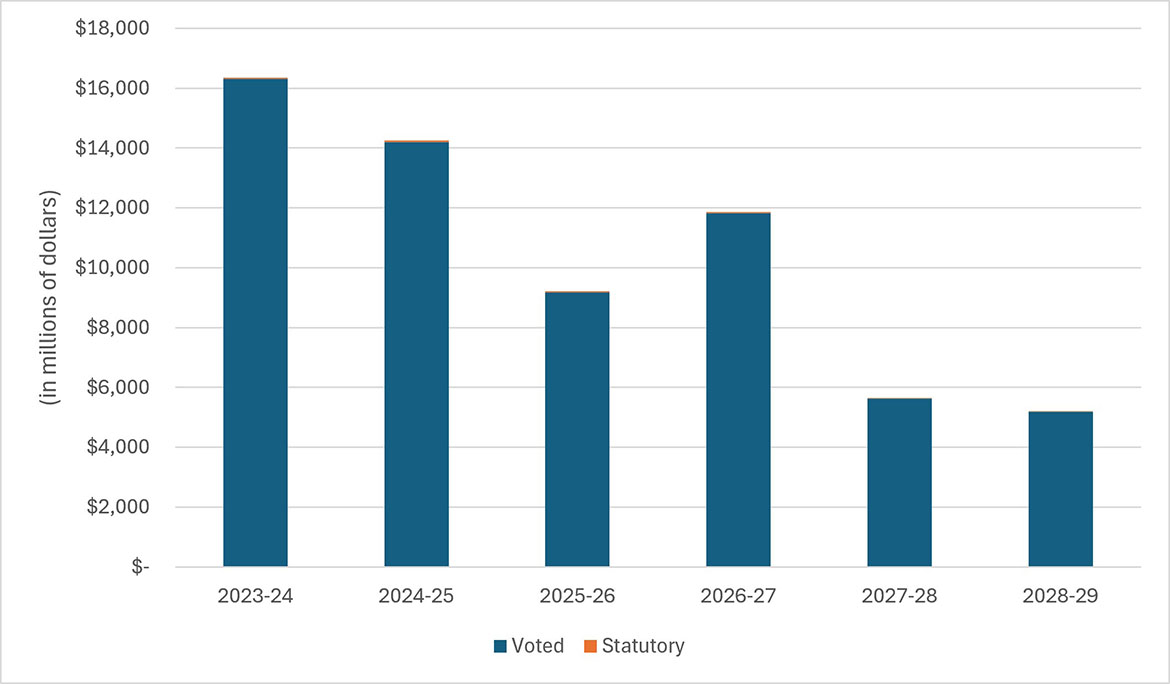
Text alternative for Graph 1: Approved funding (statutory and voted) over a six-year period
| Fiscal year | Statutory | Voted | Total |
|---|---|---|---|
| 2023–24 | $41 | $16,310 | $16,351 |
| 2024–25 | $54 | $14,196 | $14,250 |
| 2025–26 | $36 | $9,174 | $9,210 |
| 2026–27 | $34 | $11,835 | $11,869 |
| 2027–28 | $31 | $5,620 | $5,651 |
| 2028–29 | $30 | $5,181 | $5,211 |
Analysis of statutory and voted funding over a six-year period
In 2025-26, statutory expenditures represented 0.4% of CIRNAC's total actual expenditures, consistent with the average observed over the previous two years. The ratio of statutory to voted planned spending is expected to remain relatively stable over the next three years.
Planned voted expenditures are forecasted to decrease over the next three years, largely as a result of sunsetting funding authorities, particularly those associated with specific claims, settlements and litigation, including Agricultural Benefits Claims, and Childhood Claims.
Consult the Public Accounts of Canada for further information on CIRNAC's departmental voted and statutory expenditures.
Financial statement highlights
This section presents CIRNAC's Financial statements (unaudited) for the year ended March 31, 2026.
Table 15: Condensed Statement of Operations (unaudited) for the year ended March 31, 2026 (dollars)
Table 15 summarizes the expenses and revenues for 2025–26, which net to the cost of operations before government funding and transfers.
| Financial informationTable note * | 2025–26 actual results | 2025–26 planned results | Difference (actual results minus planned) |
|---|---|---|---|
| Total expenses | 9,594,068,002 | 14,536,740,802 | (4,942,672,800) |
| Total revenues | (8,216,037) | (21,404,292) | 13,188,255 |
| Net cost of operations before government funding and transfers | 9,585,851,965 | 14,515,336,510 | (4,929,484,545) |
|
|||
Analysis of expenses and revenues for 2025–26
Planned expenses are based on the 2025-26 Main Estimates, adjusted for anticipated accrued expenses. The ($4,943) million variance between 2025-26 actual and planned expenses can be attributed in part to the reprofiling of funding related to the settlement of specific and litigation claims that progressed slower than anticipated and adjustments to contingent liabilities according to the pace of claims negotiations.
The 2025–26 planned results information is provided in CIRNAC's Future-Oriented Statement of Operations and Notes 2025–26.
Table 16: Condensed Statement of Operations (unaudited) for 2024–25 and 2025–26 (dollars)
Table 16 summarizes actual expenses and revenues and shows the net cost of operations before government funding and transfers.
| Financial informationTable note * | 2025–26 actual results | 2024–25 actual results | Difference (2025–26 minus 2024–25) |
|---|---|---|---|
| Total expenses | 9,594,068,002 | 12,711,046,375 | (3,116,978,373) |
| Total revenues | (8,216,037) | (8,868,206) | 652,169 |
| Net cost of operations before government funding and transfers | 9,585,851,965 | 12,702,178,169 | (3,116,326,204) |
|
|||
Analysis of differences in expenses and revenues between 2024–25 and 2025–26
Expenses: Total expenses were $9,594 million in 2025-26 primarily attributable to $4,547 million in expenses related to specific, special, and comprehensive land claims, $2,504 million in transfer payments to Indigenous groups, $875.5 million in transfer payments to provinces, territories and institutions, and $542 million for specialized services supporting the remediation of contaminated sites.
Revenues: The revenues of 2025-26 were $8 million, which are mostly related to the provision of shared internal services to ISC.
Significant changes: The $3,116 million year-over-year decrease in actual expenses is primarily explained by a $4,836 million decrease in the contingent liability provision for specific, special, and comprehensive land claims, reflecting updates to the extent and pace of negotiations in 2025-26. This decrease was partially offset by a $1,642 million increase in litigation claim expenses, primarily due to a non-recurring transfer of claims in 2024-25 that reduced expenses in that year.
Table 17: Condensed Statement of Financial Position (unaudited) as at March 31, 2026 (dollars)
Table 17 provides a brief snapshot of the amounts the department owes or must spend (liabilities) and its available resources (assets), which helps to indicate its ability to carry out programs and services.
| Financial informationTable note * | Actual fiscal year (2025–26) | Previous fiscal year (2024–25) | Difference (2025–26 minus 2024–25) |
|---|---|---|---|
| Total net liabilities | (61,694,058,590) | (61,562,228,634) | (131,829,956) |
| Total net financial assets | 1,236,907,101 | 1,481,624,207 | (244,717,106) |
| Departmental net debt | (60,457,151,489) | (60,080,604,427) | (376,547,062) |
| Total non-financial assets | 41,505,976 | 45,803,963 | (4,297,987) |
| Departmental net financial position | (60,415,645,513) | (60,034,800,464) | (380,845,049) |
|
|||
Analysis of department's liabilities and assets since last fiscal year
Liabilities: Total net liabilities were $61,694 million at the end of 2025-26. The provision for contingent liabilities associated with claims and litigation represents the largest portion of liabilities at $45,460 million (74%). Other significant liabilities include environmental liabilities of $6,713 million (11%) and accounts payable and accrued liabilities of $9,494 million (15%).
Assets: Total net financial assets at the end of 2025-26 were $1,237 million and included the amount due from the Consolidated Revenue Fund of $1,214 million (98%). Total non-financial assets include tangible capital assets of $8 million and land held for future claims settlements of $34 million.
Significant Changes: The $380 million year-over-year change in the departmental net financial position is primarily attributable to a $266 million increase in environmental liabilities and a $231 million decrease in the amount due from the consolidated revenue fund. These changes were partially offset by a $127 million net decrease in contingent and accrued liabilities.
Human resources
This section presents an overview of the department's actual and planned human resources from 2023–24 to 2028–29.
Table 18: Actual human resources for core responsibilities and internal services for the last three years
Table 18 shows a summary in full-time equivalents of human resources for CIRNAC's core responsibilities and for its internal services for the previous three fiscal years.
| Core responsibilities and internal services | 2023–24 actual full-time equivalents | 2024–25 actual full-time equivalents | 2025–26 actual full-time equivalents |
|---|---|---|---|
| Crown-Indigenous Relations | 959 | 992 | 864 |
| Northern Affairs | 365 | 399 | 377 |
| Subtotal | 1,324 | 1,391 | 1,241 |
| Internal services | 861 | 540 | 503 |
| Total | 2,185 | 1,931 | 1,744 |
Analysis of human resources for the last three years
The decrease of 254 full-time equivalents from 2023–24 to 2024–25, is due to the transfer to Indigenous Services Canada following the dissolution of shared services in Human Resources Management.
The decrease of 187 full-time equivalents from 2024–25 to 2025-26 mainly reflects the sunset of funding for:
- Cowessess First Nation's Child and Family Services Law
- Indigenous infrastructure projects
- Federal framework to address the legacy of residential schools
The decrease is also attributable to the department's ongoing efforts to reduce overall spending through the introduction of operational efficiencies, in alignment with the Responsible Government Spending initiative.
Table 19: Human resources planning summary for core responsibilities and internal services for the next three years
Table 19 shows the planned full-time equivalents for each of CIRNAC's core responsibilities and for its internal services for the next three years. Human resources for the current fiscal year are forecast based on year to date.
| Core responsibilities and internal services | 2026–27 planned full-time equivalents | 2027–28 planned full-time equivalents | 2028–29 planned full-time equivalents |
|---|---|---|---|
| Crown-Indigenous Relations | 769 | 735 | 687 |
| Northern Affairs | 373 | 363 | 341 |
| Subtotal | 1,142 | 1,098 | 1,028 |
| Internal services | 492 | 486 | 482 |
| Total | 1,634 | 1,584 | 1,510 |
Analysis of human resources for the next three years
The decrease of 110 full-time equivalents from 2025–26 to 2026–27 is due to the sunset of funding for:
- Recognition of Indigenous Rights and Self-Determination
- Canada's New Marine Conservation Targets
The decrease of 50 full-time equivalents from 2026–27 to 2027–28 reflects the sunset of funding for:
- Self-Governing and Modern Treaty First Nation, Inuit, and Métis housing
- Supporting the development of a National Action Plan to eliminate violence against Indigenous women, girls, and 2SLGBTQI+ People
- Continued implementation of An Act respecting First Nations, Inuit and Métis children, youth and families
- Transitioning diesel reliant Indigenous communities onto clean energy
The decrease of 74 full-time equivalents from 2027–28 to 2028–29 reflects the sunset of funding for:
- Implementation of the Impact Assessment Act
- Continued implementation of Truth and Reconciliation Commission's Calls to Action 74 to 76
- More inclusive Indigenous participation in northern environmental decision-making
- Supporting Future Arctic Offshore Energy
Note that these sunsetter initiatives may be renewed through future budget decisions.
Supplementary information tables
The following supplementary information tables are available on CIRNAC's website:
Federal tax expenditures
The tax system can be used to achieve public policy objectives through the application of special measures such as low tax rates, exemptions, deductions, deferrals and credits. The Department of Finance Canada publishes cost estimates and projections for these measures each year in the Report on Federal Tax Expenditures. This report also provides detailed background information on tax expenditures, including descriptions, objectives, historical information and references to related federal spending programs as well as evaluations and GBA Plus of tax expenditures.
Corporate information
Departmental profile
Appropriate ministers: The Honourable Rebecca Alty (Minister of Crown-Indigenous Relations) and the Honourable Rebecca Chartrand (Minister of Northern and Arctic Affairs and Minister responsible for the Canadian Northern Economic Development Agency)
Institutional head: Valerie Gideon, Deputy Minister, Crown-Indigenous Relations and Northern Affairs
Ministerial portfolio: Department of Crown-Indigenous Relations and Northern Affairs
Enabling instrument: Department of Crown-Indigenous Relations and Northern Affairs Act, S.C. 2019, c. 29, s. 337
Year of incorporation or commencement: July 15, 2019
Other: None
Departmental contact information
Telephone: Toll-free: 1-800-567-9604
Fax: 1-866-817-3977
Email:
- General and statistical inquiries and publication distribution: infopubs@sac-isc.gc.ca
- Media inquiries (communications): RCAANC.media.CIRNAC@sac-isc.gc.ca
- Departmental library: hqlibraryreference@sac-isc.gc.ca
Website: https://www.canada.ca/en/crown-indigenous-relations-northern-affairs.html
Definitions
- appropriation (crédit)
- Any authority of Parliament to pay money out of the Consolidated Revenue Fund.
- budgetary expenditures (dépenses budgétaires)
- Operating and capital expenditures; transfer payments to other levels of government, departments or individuals; and payments to Crown corporations.
- core responsibility (responsabilité essentielle)
- An enduring function or role of a department. The departmental results listed for a core responsibility reflect the outcomes that the department seeks to influence or achieve.
- Departmental Plan (plan ministériel)
- A report that outlines the anticipated activities and expected performance of an appropriated department over a three-year period. Departmental Plans are usually tabled in Parliament in spring.
- departmental priority (priorité)
- A plan, project or activity that a department focuses and reports on during a specific planning period. Priorities represent the most important things to be done or those to be addressed first to help achieve the desired departmental results.
- departmental result (résultat ministériel)
- A high-level outcome related to the core responsibilities of a department.
- departmental result indicator (indicateur de résultat ministériel)
- A quantitative or qualitative measure that assesses progress toward a departmental result.
- departmental results framework (cadre ministériel des résultats)
- A framework that connects the department's core responsibilities to its departmental results and departmental result indicators.
- Departmental Results Report (rapport sur les résultats ministériels)
- A report outlining a department's accomplishments against the plans, priorities and expected results set out in the corresponding Departmental Plan.
- Full-time equivalent (équivalent temps plein)
- Measures the person years in a departmental budget. An employee's scheduled hours per week divided by the employer's hours for a full-time workweek calculates a full-time equivalent. For example, an employee who works 20 hours in a 40-hour standard workweek represents a 0.5 full-time equivalent.
- Gender-based Analysis Plus (GBA Plus) (analyse comparative entre les sexes plus [ACS Plus])
- An analytical tool that helps to understand the ways diverse individuals experience policies, programs and other initiatives. Applying GBA Plus to policies, programs and other initiatives helps to identify the different needs of the people affected, the ways to be more responsive and inclusive, and the methods to anticipate and mitigate potential barriers to accessing or benefitting from the initiative. GBA Plus goes beyond biological (sex) and socio-cultural (gender) differences to consider other factors, such as age, disability, education, ethnicity, economic status, geography (including rurality), language, race, religion, and sexual orientation.
- government priorities (priorités pangouvernementales)
- For the purpose of the 2025–26 Departmental Results Report, government priorities are the high-level themes outlining the government's agenda as announced in the 2025 Speech from the Throne.
- horizontal initiative (initiative horizontale)
- A program, project or other initiative where two or more federal departments receive funding to work collaboratively on a shared outcome usually linked to a government priority, and where the ministers involved agree to designate it as horizontal. Specific reporting requirements apply, including that the lead department must report on combined expenditures and results.
- Indigenous business (entreprise autochtones)
- Requirements for verifying Indigenous businesses for the purposes of the departmental result report are available through the Indigenous Services Canada Mandatory minimum 5% Indigenous procurement target website.
- non‑budgetary expenditures (dépenses non budgétaires)
- Net outlays and receipts related to loans, investments and advances, which change the composition of the financial assets of the Government of Canada.
- performance (rendement)
- What a department did with its resources to achieve its results, how well those results compare to what the department intended to achieve, and how well lessons learned have been identified.
- performance indicator (indicateur de rendement)
- A qualitative or quantitative measure that assesses progress toward a departmental-level or program-level result, or the expected outputs or outcomes of a program, policy or initiative.
- plan (plan)
- The articulation of strategic choices, which provides information on how a department intends to achieve its priorities and associated results. Generally, a plan will explain the logic behind the strategies chosen and tend to focus on actions that lead to the expected result.
- planned spending (dépenses prévues)
- For Departmental Plans and Departmental Results Reports, planned spending refers to the amounts presented in Main Estimates. Departments must determine their planned spending and be able to defend the financial numbers presented in their Departmental Plans and Departmental Results Reports.
- program (programme)
- An Individual, group, or combination of services and activities managed together within a department and focused on a specific set of outputs, outcomes or service levels.
- program inventory (répertoire des programmes)
- A listing that identifies all the department's programs and the resources that contribute to delivering on the department's core responsibilities and achieving its results.
- result (résultat)
- An outcome or output related to the activities of a department, policy, program or initiative.
- statutory expenditures (dépenses législatives)
- Spending approved through legislation passed in Parliament, other than appropriation acts. The legislation sets out the purpose and the terms and conditions of the expenditures.
- target (cible)
- A quantitative or qualitative, measurable goal that a department, program or initiative plans to achieve within a specified time period.
- voted expenditures (dépenses votées)
- Spending approved annually through an appropriation act passed in Parliament. The vote also outlines the conditions that govern the spending.