Carrying Métis traditions forward: Maxime's story
Maxime Morin is a respected Métis Elder from Île-à-la-Crosse in northern Saskatchewan. As he shares the history of his community, there's an urgency in his voice, a determination to honour the resilience of those who came before him and ensure their legacy endures. Maxime speaks openly about his inner conflict between anger and the desire to forgive in order to heal.
Transcript for Carrying Métis traditions forward
[Text on screen: This video includes subject matter that may be distressing and may trigger memories of past trauma. Support is available at canada.ca/Indigenous-wellness.]
[Instrumental music]
[A drone view shows the sun setting over a landscape, casting golden light across the frozen land where a river flows.]
Maxime: Île-à-la-Crosse was established in 1776.
[Maxime Morin, wearing a blue shirt with a woven Métis collar, speaks to the camera.]
Maxime: We're older than Canada, and we're older than Saskatchewan.
[A Métis flag waves over a small house. Aerial footage reveals the village of Île-à-la-Crosse surrounded by ice-covered water.]
Maxime: One of the main reasons why it was established is because of the fur trade.
[Text on screen: Île-à-la-Crosse School operated from the 1860s until the 1970s. The students attending this school were drawn primarily from Métis communities in northern Saskatchewan. ]
[Historical black-and-white photos appear: people gathered outside a church, Indigenous children standing on steps with religious teachers, and a broad view of the old village.]
[Back to Maxime speaking to the camera.]
[A woven Métis sash flutters in the wind.]
Maxime: I was five years old, 1955 I went in, and I was there for five years.
[Josh Morin, Maxime's son, pushes Maxime in a wheelchair on a sidewalk.]
Maxime: Kids used to kneel down on chalk on the corner and hold books like this.
[Maxime demonstrates by opening his arms, palms up, mimicking how children were forced to hold heavy books, then clapping his hands together.]
Maxime: If you drop the books, bang! The yardstick hits you somewhere in your body. That's how they treated us in those schools.
[Text on screen: Sharing the Journey, Maxime Morin]
[Aerial shot of the frozen river, where a cart speeds through the snow.]
[Maxime stands under a gazebo, looking out over the snowy land.]
Maxime: [Speaks michif]
[Back to Maxime sitting down, talking to the camera.]
Maxime: My name is Maxime Morin. I'm an elder for the Métis Nation of Saskatchewan, and also for Île-à-la-Crosse.
[Aerial shots of snowy forests and lakes alternate with shots of Maxime sitting down and talking to the camera. A Métis flag waves in the wind.]
Maxime: The people were trappers and fishermen, just concerned about where the fish are going to be, where the rabbits are going to be, where the moose is going to be. That's how they used to think before.
[A young girl pushes her bicycle. Art projects made by children are shown.]
Maxime: As kids, we were treated so good by our parents and the community!
[Back to Maxime sitting down, talking to the camera.]
[The scene then shifts to show a wheelchair is being pushed on a sidewalk. The person pushing the chair wears a jacket with the logo for the 2024 Family Camp organized by the Ile-à-la-Crosse Friendship Centre.]
Maxime: If you needed a house, you just let the community know. They'd all come and help you build it.
[Maxime is pushed in his wheelchair, joined by family members walking alongside them.]
[Back to Maxime talking to the camera.]
Maxime: My grandfather didn't have no money to jingle, but he had cattle. He had chickens, a big garden, and over a hundred bags of potatoes and gave them to people in the community.
[The Métis and Every Child Matter flags wave in the wind.]
Maxime: One day in 1974, the residential school closed down. The people said, I think it's time for us to take over our education system. And so they did it.
[Maxime is pushed past a large yellow and white school. A sign in front reads, "Rossignol Community High School."]
Maxime: Now we have our own school division. We have Métis people teaching. They're teaching our Michif language, Cree language.
[The bells of a church are shown. A drone shot shows a cross on top of a church. Maxime sits outside, looking into the distance.]
Maxime: I think about the church and the people that worked there. Sometimes I want to hate them. Sometimes I want to say, let's forgive them. If we forgive them, maybe we'll feel a lot better.
[Older and newer photos of Maxime's family are displayed on a wall.]
Maxime: If we hate them, then we're going to carry it the rest of our life. What's going to heal me? What's going to heal my grandchildren?
[Maxime sits in his living room with a woman, smiling. In another scene, he is pushed in his wheelchair while family members walk beside them.]
Maxime: That's why reconciliation is important. Some people have a hard time understanding what reconciliation does. They think it might be just a word. But me, I see something happening.
Maxime: We'll build our community, and our children will see that, and they'll pick it up too.
[Maxime and his family sit on a bench, reading a commemorative plaque. In the next shot, they smile at each other.]
Maxime: I don't know how long it will take, because if we keep carrying these feelings, the healing is going to take long.
[Maxime smiles at the camera.]
Maxime: We have to be able to move forward, start the healing.
[Text on screen: Join the reconciliation journey at canada.ca/sharing-reconciliation-journey]
[The Canada wordmark appears.]
A community older than Canada
Sakitawak, the Cree name for Île-à-la-Crosse, means "where the rivers meet." Situated between 2 arms of Lac Île-à-la-Crosse, this place has been a gathering point for Indigenous Peoples for thousands of years. "We're older than Canada, and we're older than Saskatchewan," says Maxime proudly.
Long before the arrival of European traders, it was a hub for travel, trade, and cultural exchange among Indigenous communities. Its location made it central to the fur trade in the late 1700s, and it remains a vibrant Métis community where language, traditions, and land-based knowledge continue to be passed down through generations.
A tradition of community care
Maxime grew up surrounded by a way of life built on kinship, land, and sharing; family gardens, community hunts, and neighbours who came together to raise homes and children. That spirit of taking care of one another still guides him today. He remembers elders who "didn't have money to jingle," but had a garden, cattle, chickens, and enough food to share.
Experience in the school system
Maxime remembers that like his siblings, he was forced to attend Catholic school as a young child: "they told my mom and dad: if you don't let them go, then one of you have to go to jail." He goes on to explain that at only 5 years old, he was separated from his family and forbidden to speak the only language he knew. He recalls silently wondering why the people responsible for his care were so unkind. Those experiences left deep marks on students, families, and the community that are still felt across generations, he explains. "Why are you guys mean to us? You don't like us?" Maxime remembers wondering.
Taking back control
As Maxime recounts, the burning of the Ile-à-la-Crosse school in the 1970s marked a turning point. Local leaders and families decided it was time to reclaim control over education. The community created its own school division, hired Métis educators and started teaching Cree and Michif.
Forgiveness, reconciliation, and healing
In sharing his story, Maxime speaks openly about the tension between anger and forgiveness. Some days he wants to hold on to the hurt, other days he knows forgiveness can open a path forward. For him, reconciliation is about healing, so that his grandchildren don't have to carry the same weight. "If we don't forgive and move forward," he reflects, "the healing will take longer."
Hope for future generations
For Maxime, the way forward lies in holding on to the lifestyle and values passed down by Elders, such as mutual support, cultural pride, and community strength. Healing takes time, he says, but it grows with every step we take together. "We'll build our community, and our children will see that, and they'll pick it up too," he adds with hope.
Photo gallery




Maxime Morin is an Elder from Île-à-la-Crosse, known in Cree as Sakitawak, meaning "where the rivers meet". It’s one of the oldest communities in Saskatchewan.
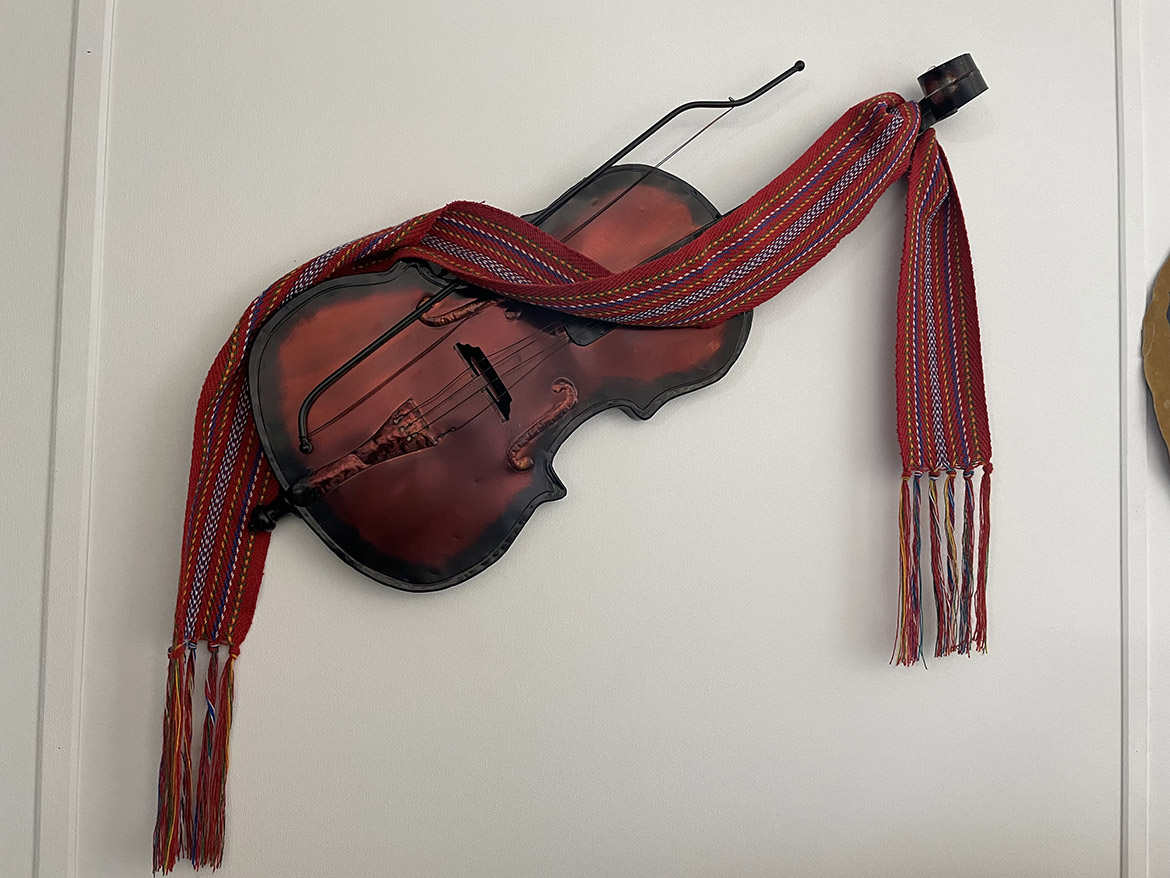
The Métis sash is a symbol of pride, identity, and resilience, traditionally handwoven from brightly coloured wool. Each colour in the sash holds meaning, often representing elements such as the Métis’ mixed heritage, their connection to the land, and the struggles and triumphs of their history.
Métis fiddling is a lively mix of European and Indigenous musical traditions, played on the violin and often paired with fast jigging. It has brought people together at dances and celebrations for generations and remains a proud symbol of Métis culture today.
The Île-à-la-Crosse Integrated Services Centre is home to the Rossignol Community High School, a health clinic, and a range of other community services.
The sister of Métis leader Louis Riel, was a Catholic missionary who died in Île-à-la-Crosse. Her tombstone reads: "Here lies Rev. Sister Marguerite Marie (Riel), who died on December 27, 1883, at the age of 34."