Ministerial Handout Northern Affairs Portfolio December 2024
Table of contents
- Tab 1: Ministerial Handout for Incoming Minister of Northern Affairs (Book 1)
- Introduction
- Quick Overview of Responsibilities of Crown–Indigenous Relations and Northern Affairs Canada and Indigenous Services Canada
- Departmental Structure
- Northern Affairs Organization
- Mandate
- Statutory Authorities of the Minister of Northern Affairs
- Northern Contaminated Sites Program
- Northern Governance
- Nunavut Devolution
- Northern Policy and Programs
- Arctic and Northern Policy Framework
- Northern Land, Resources and Environmental Management
- Northern Science and Technology
- Results Snapshot
- Issues Currently in the Public Eye
- Recommended Nunavut Land Use Plan
- Food Security
- Mary River Iron Mine Project (Steensby Port and Railway)
- Meliadine Gold Mine
- Northern Regulatory Initiative
- Ministerial Working Group on Regulatory Efficiency for Clean Growth Projects
- Proposed Targeted Amendment to the Yukon Environmental and Socio-Economic Assessment Act
- Emergency Management in the North
- Housing and Infrastructure
- Climate Change and Clean Energy
- Yukon Victoria Gold Mine Incident
- Faro Mine Remediation Project: Permanent Water Treatment Plant
- Norman Wells Proven Area Oil Field
- Crown–Indigenous Relations
- Mandate
- Crown–Indigenous Relations Policy and Programs
- Supporting Missing and Murdered Indigenous Women, Girls (MMIWG), and 2SLGBTQIA+ People
- International and Intergovernmental Relations and Obligations
- Inuit Nunangat Policy
- Negotiation of Treaties, Agreements, and Other Constructive Arrangements
- Management and Implementation of Existing Agreements and Treaties
- Rights Recognition and Reconciliation: A Whole-of-Government Approach to Consultation
- Resolution of Specific Claims
- Strategic Management of Childhood Claims
- Indigenous Institutions and Governance Modernization
- United Nations Declaration on the Rights of Indigenous Peoples Act Implementation
- Truth and Reconciliation Commission Calls to Action
- Indigenous Landscape
- Territorial Governments
- Provincial Governments
- Indigenous Partners
- Annex A: Northern Affairs Acts and Legislation
- Tab 2: Minister of Northern Affairs Placemat
- Tab 3: Northern Affairs Organization: Organizational Chart
Ministerial Handout for Incoming Minister of Northern Affairs (Book 1)
Introduction
Crown-Indigenous Relations and Northern Affairs Canada's primary responsibility is to guide and coordinate the federal government's relationships with Indigenous Peoples, including matters pertaining to treaty rights and self-government. The Department is also tasked with leading the federal government's work in the Arctic and Canada's North. Carrying out this work involves working closely with Inuit, First Nations and Métis leadership and communities as well as territorial governments, industry and other federal departments. Of special note, Northern Affairs Organization works in tandem with other Crown–Indigenous Relations and Northern Affairs Canada sectors and with Indigenous Services Canada.
As Minister of Northern Affairs, you are responsible for advancing a broad mandate to help improve access for Canada's Arctic and northern residents to a broad basket of essential services and infrastructure more readily available in Canada's south. While you have leadership roles on several key files, carrying out this mandate requires extensive collaboration and partnering with Cabinet colleagues who often have leadership roles for files of national scope such as housing, health, the environment, energy, or security and defence. As Minister of Northern Affairs, you play a key role in coordinating federal engagement, policy development and implementation activities. Increasingly, this coordination is resulting in more place-based policy development and implementation strategies that take into account the unique realities of Canada's north.
You play the twin roles of helping to advance economic development in Canada's north as well as the sustainable management of its resources. An important part of your mandate is the unique co-management regimes established in each of Canada's three territories. Co-management boards bring together the federal, territorial and Indigenous governments for land-use planning and the management of Canada's northern resources. You play a leadership role in the appointment of Board members as well as in the decision-making governance.
This briefing book is intended to introduce you to the mandate and structure of Crown–Indigenous Relations and Northern Affairs Canada, with a particular focus on the North and provide you with an outline of some of the issues that are shaping how the Department moves forward. There are other matters beyond this overview on which you may wish to receive a briefing at a later time. We and departmental officials will be pleased to brief you and your office in detail on the content presented in this briefing book and we look forward to engaging with you on the wide range of issues that occupy Crown–Indigenous Relations and Northern Affairs Canada.
Valerie Gideon
Deputy Minister
Crown–Indigenous Relations and Northern Affairs Canada
Rob Wright
Associate Deputy Minister
Crown–Indigenous Relations and Northern Affairs Canada
Quick Overview of Responsibilities of Crown–Indigenous Relations and Northern Affairs Canada and Indigenous Services Canada
| Crown-Indigenous Relations and Northern Affairs Canada | Indigenous Services Canada |
|---|---|
Northern Affairs
|
|
Departmental Structure
Deputy Minister of Crown–Indigenous Relations and Northern Affairs Canada: Valerie Gideon
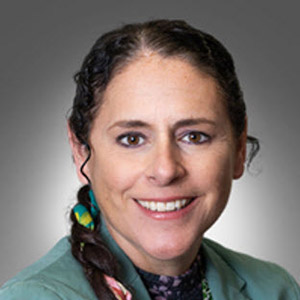
Biographical Information
Dr. Valerie Gideon is a member of the Mi'kmaq Nation of Gesgapegiag, Quebec and a proud mother of two young girls.
She became Deputy Minister of Crown–Indigenous Relations and Northern Affairs Canada on November 25, 2023, and kept her position as President of the Federal Economic Development Agency for Northern Ontario. From September 2020 to October 2022, Valerie was the Associate Deputy Minister of Indigenous Services Canada. From 2018 to 2020, she was Senior Assistant Deputy Minister of the First Nations and Inuit Health Branch, Indigenous Services Canada. From 2012 to 2017, Valerie held the position of Assistant Deputy Minister, Regional Operations, Health Canada. From 2011 to 2012, she was Director General, Strategic Policy, Planning and Analysis at the First Nations and Inuit Health Branch. From 2007 to 2010, she held the position of Regional Director for First Nations and Inuit Health, Ontario Region, Health Canada.
Before working at Health Canada, her experience consisted mainly of working in First Nations health advocacy as Senior Director of Health and Social Development at the Assembly of First Nations and Director of the First Nations Centre at the National Aboriginal Health Organization. She was named Chair of the Aboriginal Peoples' Health Research Peer Review Committee of the Canadian Institutes of Health Research in 2004.
She graduated from McGill University (Montreal) in 2000 with a Doctorate (Dean's List) in Communications (dissertation on telehealth and citizen empowerment). She previously completed a Master of Arts in 1996 at McGill. She's a founding member of the Canadian Society of Telehealth. She's also a former board member of the National Capital Region Young Men's Christian Association and Young Women's Christian Association.
Associate Deputy Minister of Crown–Indigenous Relations and Northern Affairs Canada: Rob Wright

Biographical Information
Rob Wright has an impressive history of public service. He was appointed as Associate Deputy Minister for Crown–Indigenous Relations and Northern Affairs Canada on January 12, 2024. Prior to this new role, he served as Assistant Deputy Minister of the Science and Parliamentary Infrastructure Branch at Public Services and Procurement Canada since the Branch was established in spring 2019. Additionally, Rob served as Assistant Deputy Minister of the Parliamentary Precinct Branch from 2015 to 2019.
Rob holds undergraduate and graduate degrees from St. Thomas University and Western University. His areas of study included engineering, history, leadership, and governance. He went on to oversee various sectors at Public Services and Procurement Canada, such as Planning and Integration, and Major Crown Projects at the Parliamentary Precinct. Furthermore, he served as Regional Director General for the Atlantic Region from 2012 to 2015.
Senior Management

Policy and Strategic Direction
Mary-Luisa Kapelus
Senior Assistant Deputy Minister

Treaties and Aboriginal Government
Danielle White
Senior Assistant Deputy Minister

Resolution and Partnerships
Darlene Bess
Assistant Deputy Minister

Modern Treaties, Consultation and Intergovernmental Relations
Heather McLean
Assistant Deputy Minister
Northern Affairs Organization
Georgina Lloyd
Assistant Deputy Minister

Chief Finances, Results and Delivery Officer
Manon Nadeau-Beaulieu
Chief Finances, Results and Delivery Officer

Corporate Secretariat
Marianne Belair
A/Corporate Secretary

Ombuds Office
Jeremy Ames
Ombuds

Human Resources and Workplace Services
Catherine Villeneuve
Chief Human Resources Officer
Common Services to Crown–Indigenous Relations and Northern Affairs Canada and Indigenous Services Canada
Communications and Public Affairs
Charles Slowey
Assistant Deputy Minister

Audit and Evaluation
Stephanie Barozzi
Chief Executive

Legal Services
Marie Bourry
Senior General Counsel and Head of Legal Services
Financial Overview
Crown–Indigenous Relations and Northern Affairs Canada's 2024–2025 Main Estimates total $10.9 billion.
The table below provides a clear overview of the budgetary allocations across different programs.
| Sector | Programs | Budgetary allocations |
|---|---|---|
| Crown-Indigenous Relations | Consultation and Accommodation (Implementation Sector) | 8.1 |
| First Nation Jurisdiction over Land and Fiscal Management | 62.7 | |
| Indigenous Engagement and Capacity Support | 291.7 | |
| Indian Residential Schools Settlement Agreement | 7.1 | |
| Indigenous-Led Services | 102.1 | |
| Management and Implementation of Agreements and Treaties | 2,009.3 | |
| Negotiation of Treaties, Self-Government Agreements and Other Constructive Arrangements | 143.7 | |
| Other Claims | 976.4 | |
| Residential Schools Legacy | 34.2 | |
| Specific Claims | 6,019.8 | |
| Total | 9,655.1 | |
| Northern Affairs | Northern Contaminated Sites | 713.1 |
| Nutrition North Canada | 133 | |
| Northern and Arctic Governance and Partnerships | 126.5 | |
| Climate Change Adaptation and Clean Energy | 67.0 | |
| Northern and Arctic Environmental Sustainability | 26.6 | |
| Northern Regulatory and Legislative Frameworks | 20.9 | |
| Northern Strategic and Science Policy | 9.0 | |
| Total | 1,096.1 | |
| Internal Services | 162.0 | |
Crown–Indigenous Relations and Northern Affairs Canada's 2024–2025 Main Estimates are comprised of:
- approximately $2 billion or 18.3% in operating expenditures;
- approximately $8.9 billion or 81.7% in transfer payments to Indigenous organizations;
- $75,000 in capital expenditures; and,
- $25.9 million in loan funding for claimants involved in negotiations.
Operating Expenditures
Through operating funding, the department carries out activities related to the assessment, management and remediation of federal contaminated sites, and continues to meet obligations pursuant to significant Indigenous litigation claims. Of the $2.0 billion in operating funds:
- $973.2 million, or 49.3%, is for the settlement of litigation claims;
- $639 million, or 32.4%, is for the remediation of northern abandoned mines;
- $6.4 million, or 0.3%, is for addressing the legacy of residential schools; and,
- $353.8 million, or 18%, is for the operation of the Department.
Included in these funds are transfer payments through which the Department advances its work in the North:
- $33.3 million in Grants for the Political Evolution of the Territories, particularly as it pertains to Devolution.
- $63.7 million in Grants to the Government of the Northwest Territories and the Government of Nunavut for health care of Indians and Inuit;
- $94.2 million in Contributions for promoting the safe use, development, conservation and protection of the North's natural resources, and promoting scientific development for Indigenous Peoples and the North; and,
- $121.7 million in Grants and Contributions to support access to healthy foods in isolated northern communities.
Supplementary Estimates
Annually, the Supplementary Estimates process presents information to Parliament on Government of Canada spending requirements not sufficiently developed in time for inclusion in the Main Estimates. This process provides departments with in-year incremental funding and funding adjustments. The Northern Affairs Organization received an additional $9.5 million through Supplementary Estimates (A) for the following initiatives:
- $9 million to implement the Urban, Rural, and Northern Indigenous Housing Strategy; and
- $0.5 million to support the Inuvialuit participation in the implementation and administration of the Western Arctic – Tariuq (offshore) Accord.
Refocusing Government Spending
Crown–Indigenous Relations and Northern Affairs Canada is contributing towards refocusing Government spending, as announced in Budget 2023 and Main Estimates for 2024–2025. The profile of Crown–Indigenous Relations and Northern Affairs Canada spending reductions is as follows: $15.7 million in 2024–2025, $23.2 million in 2025–2026 and $33.7 million in 2026–2027 and ongoing.
Crown–Indigenous Relations and Northern Affairs Canada has obtained approval from Treasury Board Secretariat to proceed in implementing the following measures starting fiscal year 2024–2025:
- Implementing efficiencies and increasing oversight in internal and external departmental operations;
- Reducing travel by maximizing the use of communications technologies and focusing on work with partners where there is the greatest potential for resolution and advancement of shared priorities;
- Prioritizing the use of professional services by focusing on the negotiation and reconciliation agenda; and,
- Reducing grants and contributions following discussions with partners, by targeting areas that will minimize impacts on communities and/or in areas where the funding has not been fully utilized.
Human Resources Overview
Crown–Indigenous Relations and Northern Affairs Canada has its main base of operations in the National Capital Region. It also has a presence across the country in regional offices. The 2024–2025 Departmental Plan forecasts 1,889 Full-Time Equivalent resources consisting of 1,371 Full-Time Equivalents in the National Capital Region and 518 in the regions.
There are 160 Full-Time Equivalents located in the Vancouver office, who support the negotiation and implementation of comprehensive land claims, self-government agreements, litigation and the work on Missing and Murdered Indigenous Women and Girls, while approximately 142 Full-Time Equivalents work out of the various Indigenous Services Canada regional offices.
The Northern Regional Landscape
A total of 442 Full-Time Equivalents located in the National Capital Region and the North are part of the Northern Affairs Organization. Crown–Indigenous Relations and Northern Affairs Canada's northern regional offices located in Whitehorse, Yellowknife and Iqaluit support northern Canadians in their efforts to improve social and economic well-being, to develop healthier, more sustainable communities and to participate more fully in Canada's political, social and economic development. The regional office in Whitehorse, Yukon has 55 Full-Time Equivalents, while the Northwest Territories office in Yellowknife has 83 Full-Time Equivalents and the Nunavut Office in Iqaluit has 78 Full-Time Equivalents.
Shared Service Model Between Crown–Indigenous Relations and Northern Affairs Canada and Indigenous Services Canada
Subsequent to the announcement of the dissolution of Indigenous and Northern Affairs Canada and the establishment of Crown–Indigenous Relations and Northern Affairs Canada and Indigenous Services Canada, units supporting the specific mandates of the new departments were transferred between them. As part of the establishment of both departments, a shared service model was established where some corporate level activities are shared between them, including information technology, accommodations, security, cabinet, parliamentary and communications functions.
Northern Affairs Organization
Mandate
The Northern Affairs Organization, within Crown–Indigenous Relations and Northern Affairs Canada, is responsible for leading the Government of Canada's work in the North through the development, implementation and coordination of federal policy across departments in the North. It also leads the negotiation and implementation of the transfer of federal responsibilities to territorial governments (referred to as "devolution"), manages a number of federal regulatory and other functions not devolved through the Territorial acts, supports the negotiation and implementation of Indigenous land claims and self-government agreements, and delivers federal programs and initiatives in the region.
The Department of Crown–Indigenous Relations and Northern Affairs Act outlines the Department's responsibilities over the administration of lands in Yukon, the Northwest Territories and Nunavut. As well, it outlines the work to complete the devolution of authorities to territorial governments. The resource management regimes in the North are co-managed and implemented in large part by boards made up of representatives from Indigenous governments and organizations, the territorial governments, and the Government of Canada, as defined by land claim agreements. Until the devolution process is fully implemented, the Department maintains provincial-like responsibility for management of lands and water in Nunavut, which includes the approval of most water licences and land use permits issued in the territory. The Department is also responsible for the legislation governing environmental assessments and holds some decision-making powers involving environmental assessments and land use planning, as well as retaining responsibility for the management of offshore resources including oil and gas in all three territories.
Statutory Authorities of the Minister of Northern Affairs
The Minister of Northern Affairs has authority specifically defined by sections 11 to 18 of the Department of Crown–Indigenous Relations and Northern Affairs Act, as well as over, in full or in part, statutes relating to Canada's territories (e.g. Nunavut Act, Yukon Act), management of Northern land, resources and environment (e.g. Territorial Lands Act, Mackenzie Valley Resource Management Act), the management of northern regulatory regimes (e.g. Northwest Territories Waters Act); and northern and polar science (e.g. Canadian High Arctic Research Station Act). A complete list of statutes relating to Northern Affairs can be found in Annex A.
Northern Contaminated Sites Program
Through the Northern Contaminated Sites Program, the Department manages more than 160 contaminated sites across the North, representing an estimated $6.3 billion in environmental liability (Public Accounts of Canada March 2023). The eight largest abandoned mine projects located in the Yukon and the Northwest Territories are administered through the Northern Abandoned Mine Reclamation Program; this includes the Giant Mine and Faro Mine remediation projects, two of the largest contaminated sites in Canada. Crown–Indigenous Relations and Northern Affairs Canada's remaining sites in the North are funded through Environment and Climate Change Canada's Federal Contaminated Sites Action Plan.The objectives of the Northern Contaminated Sites Program is to manage contaminated sites in a cost-effective and consistent manner, reduce risks to human health and the environment and associated federal environmental liabilities, while advancing partnerships and socio-economic opportunities for Northerners and Indigenous Peoples. Priority is given to those sites posing the highest risks.
Northern Governance
A focus of the Department has been the improvement of governance structures and mechanisms in the Canadian North. A key activity in this area has been the transfer of federal responsibilities for lands and natural resources to territorial governments (called "devolution") to ensure greater local control, as well as to fostering effective relations with territorial and Indigenous governments. Devolution was completed in Yukon (2003), Northwest Territories (2014) and, following the signing of the Nunavut Lands and Resources Devolution Agreement in January 2024, the full transfer is targeted for 2027 following a three-year implementation phase.
Nunavut Devolution
On January 18, 2024, the Prime Minister, the Minister of Northern Affairs, the Premier of Nunavut, and the President of Nunavut Tunngavik Incorporated signed the Nunavut Lands and Resources Devolution Agreement in Iqaluit. The signing of the Nunavut Lands and Resources Devolution Agreement launched a three-year implementation phase towards bringing the Devolution Agreement into effect on April 1, 2027.
Next steps for implementation include: drafting and passing of legislation to give effect to the final agreement; provision of implementation funding to the Government of Nunavut and Nunavut Tunngavik Incorporated; the legal description and/or survey of lands; and furthering deliverables related to the transfer of lands, human resources, properties and assets. Section 35 consultations with Indigenous groups with rights within Nunavut will continue over the course of the implementation of the Devolution Agreement.
Northern Policy and Programs
Crown–Indigenous Relations and Northern Affairs Canada works with Indigenous organizations and other territorial partners to help meet the needs and interests of Northerners in areas such as food security, post-secondary education, health and medical care in Nunavut and the Northwest Territories, economic development, climate change (adaptation) and reduced reliance on diesel. The Department also advances Canadian and northern interests through forums such as the Arctic and Northern Policy Framework and the International Arctic Council.
Arctic and Northern Policy Framework
The Arctic and Northern Policy Framework was launched in 2019 and was co-developed with with Inuit, First Nations, and northern Métis, the territorial governments of the Northwest Territories, Nunavut and Yukon, and the provincial governments of Manitoba, Quebec, and Newfoundland and Labrador. The Framework provides "a shared vision of the future where Arctic and northern people are thriving, strong and safe" and is intended to guide the Government of Canada's national and international policy objectives with the priorities of Northerners.
Crown–Indigenous Relations and Northern Affairs Canada continues to work with Framework partners to ensure that Northerners' needs are met. Housing and infrastructure needs were key priorities raised by Framework partners in advance of the 2024 Leadership Committee meeting, held on October 11 in Iqaluit, along with Arctic and northern security and defense, international Arctic policy, and mental health and wellness.
Other priorities noted by partners include the need for a formalized mechanism for sharing information with territorial and First Nation governments; economic development (including clean energy/green economic measures); climate change; and measures to address the high cost of living.
Northern Land, Resources and Environmental Management
While striving to increase the transfer of federal responsibilities to territorial governments as part of devolution, the federal government, through Crown–Indigenous Relations and Northern Affairs Canada's administration of Northern Affairs, retains responsibility over some lands and resources in the North, including oversight for resource co-management legislation that reflects, respects and gives effect to the Northern resource co-management regimes set out in modern treaties.
As a result, several programs and policies focus on the co-management, sustainable development and regulatory oversight of the land, water, natural resources, and environment of the North. This includes managing oil and gas resource development; implementation of the offshore oil and gas accord; managing royalties in areas of federal responsibility, participating in impact assessment and regulatory processes for projects (and has a decision role in some instances) and ensuring completion of territorial land use planning; supporting Critical Mineral Strategy's Northern Regulatory Initiative; and contributing to marine conservation and other ocean-related initiatives. Key is ensuring northern perspectives are captured in federal policies and programs. Northern Affairs also provides a supporting role on modern treaty negotiations on topics involving resource management, and leads consequential amendments to resource co-management legislation resulting from the finalization or modernization of treaties.
Northern Science and Technology
The Northern Affairs portfolio has long played a central role in supporting scientific research and technology in the North and Arctic through programs, partnerships and infrastructure to ensure domestic and international policy on key northern issues is better informed by a scientific knowledge base which includes Indigenous Knowledge. To do so, its focus is to: research and monitor contaminants and their impacts on the ecosystem and human health through the Northern Contaminants Program; assess, manage and communicate scientific data and results, and contribute expertise to help inform public policy-making and international controls on certain contaminants; lead Canada's participation in the Arctic Monitoring and Assessment Programme, the working group of the Arctic Council focused on issues of pollution and climate change and their effects on ecosystems and human health; and support the advancement of northern research infrastructure. This work is accomplished by working closely with partners, [redacted].
Results Snapshot
| Action | Outcome | Context |
|---|---|---|
| Protection of human health and safety and the environment | 90% of high-priority northern contaminated sites are being actively managed. While under Crown–Indigenous Relations and Northern Affairs Canada's purview, there has not been a serious environmental or human health disaster at any of the sites. |
Crown–Indigenous Relations and Northern Affairs Canada is responsible for 163 sites in the North. |
| Socio-economic benefits | Since 2006, over 14,000 Northerners have been employed at contaminated sites. Of 9,700 contracts awarded to Northern companies; an estimated 33% were for Indigenous procurement. There are four governance agreements in place with Indigenous partners to create socio-economic benefits. |
| Action | Outcome | Context |
|---|---|---|
| Nunavut Devolution | The Nunavut Devolution signing ceremony took place on January 18, 2024. Work has entered a three-year implementation phase with transfer expected by April 1, 2027. |
The Nunavut Lands and Resources Devolution Agreement is the conclusion of a longstanding commitment toward the vision of self-determination of Nunavummiut. |
| Housing and Infrastructure | 89 public housing units in Nunavut 55 public housing units in the Northwest Territories |
Since 2021, $200 million have been invested to support affordable housing in the North. An additional $52 million was provided directly to First Nations in the Northwest Territories not captured by distinctions-based investments. |
| Emergency Management | In 2023–2024, $15 million was provided to 27 Indigenous governing bodies directly affected by the 2023 wildfires in the Northwest Territories. | |
| Northern Contaminants Program | The number of contaminants that have been added to the United Nations Stockholm Convention on Persistent Organic Pollutants has tripled since the Convention came into force in 2004, supported by data produced through the Northern Contaminants Program. | |
| Historic Legacy Reconciliation | $2.2 million were provided over two years (2022–2023 to 2023–2024) to support the Yellowknives Dene First Nation to undertake historical research and community engagement on the impacts of Giant Mine. |
Yellowknives Dene First Nation are seeking an apology and compensation for alleged harm. |
| Arctic and Northern Policy Framework | While not specifically referenced as such, targeted federal investments in Budgets 2019, 2021, 2022 and 2023, some of which have been led by Crown–Indigenous Relations and Northern Affairs Canada, have funded a range of measures which support Framework implementation and complement existing efforts to strengthen Arctic and northern communities. Crown–Indigenous Relations and Northern Affairs Canada regularly provides support to the departments of National Defence and Global Affairs Canada in the implementation of the security and defence and international chapters to the Framework. |
Since the release of the Framework, the federal government has made significant investments to support northern economies and move forward on social and political self-determination, in areas such as housing, education, economic development, Arctic and northern security and defence, and Indigenous reconciliation. |
| Northern Post-Secondary Education | $47.97 million have been invested to support four projects (Yukon University, the Dechinta Centre for Research and Learning, Aurora College and the Northern Task Force) to advance the goals and objectives of the Framework. Budget 2024 invested $5.2 million for Dechinta Centre for Research and Learning. |
There is a rapidly evolving and growing network of post-secondary institutions across the North, gaining recognition for providing high quality education that responds to the needs and priorities of the diverse populations and perspectives of the North. |
| Action | Outcome | Context |
|---|---|---|
| Canada's Strengthened Climate Plan | Budget 2021 invested $300 million to transition Indigenous and remote communities from diesel to clean, renewable and reliable energy. | $60 million of the $300 million commitment was provided as a top-up to the Northern Responsible Energy Approach for Community Heath and Electricity (REACHE) program. |
| Northern Responsible Energy Approach for Community Heat and Electricity (REACHE) program | 216 projects funded since 2016 and 11 hydro projects funded since 2021. Target of 7 million litres of diesel avoided annually with clean energy for 2030. This number has steadily improved from 366,000 litres avoided in 2020–2021 to 1,000,000 litres avoided in 2023–2024. |
The program supports clean energy initiatives in northern, Indigenous and remote communities with the aim of reducing reliance on diesel. |
| Indigenous Climate Leadership | Budget 2021 invested $29 million to co-develop an Indigenous Climate Leadership Agenda. | Crown–Indigenous Relations and Northern Affairs Canada provided funding to Indigenous Peoples to support the Indigenous Climate Leadership co-development process. |
| Climate Change Preparedness in the North | 368 projects funded since 2016. Percentage of plans for which adaptation measures have been implemented:
|
Funding supports climate change adaptation projects in Yukon, Northwest Territories, Nunavut, Nunavik and Nunatsiavut. |
| Indigenous Community-Based Climate Monitoring | 227 projects funded since 2017. 143 communities have baselines and multi-year community data. |
Funding supports Indigenous communities to monitor climate and the effects of climate change on their communities. |
| Engaging Indigenous Peoples in Climate Policy | 60 projects funded since 2017. |
| Action | Outcome | Context |
|---|---|---|
| Retail Subsidy | Between 2011 and March 2023, the average volume of eligible items shipped to northern isolated communities increased by approximately 98%. Approximately 374.2 million kilograms of eligible items were subsidized, with an average increase of about 1.6 million kilograms annually. The total amount of annual Nutrition North Canada funding increased by more than 3 times since 2011 if you include funding provided for the Harvester`s Support Grant and Community Food Program Fund. Subsidy rates have increased by over 50% since the inception of the Program. The number of eligible communities has increased from 80 to 124. This represents an increase of 55%. |
Since its inception in 2011, Nutrition North Canada's retail subsidy has helped to lower the prices of eligible food and essential items in isolated northern communities while increasing the amount of perishable nutritious food available. Budget 2024 provided an additional $23.2 million in subsidies. |
| Harvesters Support Grant | In the first two years, the Harvesters Support Grant supported 15,000 harvesters, 410 hunts and harvests, and over 717 food-sharing initiatives in over 112 isolated communities. | The Harvesters Support Grant increases access to country foods by providing funding to support traditional hunting, harvesting and food sharing activities and initiatives across 112 eligible communities under 24 recipient Indigenous Organizations. |
| Research Grant | $1.5 million supported five Indigenous-led research projects in 2023–2024 to identify options to further improve the program's operations, transparency, and accountability. | Through Budget 2021 investments, the Food Security Research Grant was launched in 2022–2023. |
| Oversight | Since 2011, 79 recipient audits were carried out via independent auditors with an additional seven recipient audits to be completed in 2024–2025. An internal evaluation is anticipated to be complete by summer 2025. |
Registered businesses and charitable organizations submit monthly claims outlining how many kilograms of eligible items they shipped to eligible communities. These claims are reviewed independently by an accredited third party to ensure that the subsidy was applied correctly. Once a claim is reviewed, Nutrition North Canada reimburses the registered business or charitable organization for the amount recommended by the third party. |
Issues Currently in the Public Eye
The following issues may be raised by the public or partners in the early days of the mandate.
We will be pleased to brief you on these and other more forward-looking issues over the coming weeks.
Recommended Nunavut Land Use Plan
The Nunavut Planning Commission was established in 1995, pursuant to the Nunavut Agreement. It is responsible for preparing land use plans in the Nunavut Settlement Area that provide for the conservation, development and use of land and marine regions; and that reflect the priorities and values of Nunavummiut.
A Nunavut-wide land-use plan, which would be one of the largest regional land use plans in the world, has been in preparation since 2007.
The fourth draft of the Plan, the 2021 draft Nunavut Land-Use Plan, was publicly reviewed and subject to five regional public hearings in 2022. Based on input received during this review process, the Nunavut Planning Commission made revisions and submitted the 2023 Recommended Nunavut Land Use Plan for decisions by the three parties on June 20, 2023.
Decisions on whether to accept or reject a land use plan are made jointly by Nunavut Tunngavik Incorporated, the Minister of Northern Affairs and the Nunavut Minister of Environment. If accepted by all three parties, the two ministers would seek approval of the Governor in Council and the Executive Council of Nunavut. If rejected by any party, it would be referred back to the Nunavut Planning Commission with written reasons for revisions. Under the Nunavut Planning and Project Assessment Act, there are no legislated timelines; decisions are to be made as soon as practicable.
To date, initial reactions from external stakeholders to the Recommended Plan have been mixed, with the mining industry indicating serious concerns and urging its rejection, and environmental non-governmental organizations expressing the view the Recommended Plan represents a solid foundation for land management in Nunavut and urging its approval.
Crown–Indigenous Relations and Northern Affairs Canada is coordinating the Government of Canada analysis of the Recommended Plan through a federal working group in preparation for substantive discussions with the Government of Nunavut and Nunavut Tunngavik Incorporated.
It is expected these discussions will continue through fall and early winter 2025, with the aim of reaching a joint decision whether to accept or reject the Recommend Plan. Crown–Indigenous Relations and Northern Affairs Canada is also conducting joint Crown consultation with the Government of Nunavut.
Once Crown consultation is complete and the Parties' discussions on concerns with the Plan and a path forward have concluded, a decision package will be routed to the Minister of Northern Affairs to accept or reject the Recommended Plan.
Food Security
Traditionally, the Nutrition North Program's primary focus was not food security, but health and nutrition as a function of northern development. The Program adjusted its mandate through Budget 2021 to include food security as a policy driver in both northern and southern Canada's remote communities.
Food insecure households are those that are uncertain of having or are unable to acquire enough food to meet the needs of all their members. Food insecurity in northern and isolated communities poses significant challenges that directly affect the health and well-being of Northerners.
Food security is a complex challenge with many variables. Northern Affairs has a number of programs and initiatives such as Nutrition North Canada subsidy, the Harvester's Support Grant, the Community Food Programs Fund, Nutrition Education Initiatives and the Nutrition North Food Security Research Grant, that are aimed at strengthening nutritional choices, supporting traditional harvesting practices, increasing food security, and community health.
Nutrition North Canada's food security programming was co-developed with Indigenous and community partners, and included involvement from all four Inuit modern treaty holders organizations and is the first formal federal recognition of the Inuit Nunangat Food Security Strategy.
Budget 2024 provided $124 million into Nutrition North Canada expanded programming:
- Harvesters Support Grant: $36 million over three years.
- Community Food Programs Fund: $60.8 million over three years.
- Subsidy: $23.2 million in 2024–2025.
- Food Security Research Grant: $2.1 million over three years.
Through Budget 2024, Nutrition North Canada is sustaining the expanded subsidy program to food banks and registered charities, as well as maintaining subsidy rates to address rising inflation.
The Harvesters Support Grant and the Community Food Programs Fund promote local decision-making and increase access to country foods by providing funding to support traditional hunting, harvesting and food sharing in 112 eligible communities. In the first two years, the Harvesters Support Grant supported 15,000 harvesters, 410 hunts and harvests, and over 717 food sharing initiatives in over 110 isolated communities.
Nutrition North Canada continues to evolve in response to recommendations from Indigenous and Northern partners. The program has increasingly taken a food systems approach and co-delivery with Indigenous partners to promote food security and food sovereignty in isolated and northern communities. Through its Food Security Research Grant, Nutrition North Canada continues to work with academics and Indigenous organizations to examine the retail subsidy and review the audit process in order to develop meaningful policy options to make the program work better for those it serves.
In order to comprehensively assess the effectiveness of the Nutrition North Canada program, a Crown–Indigenous Relations and Northern Affairs Canada internal evaluation has been launched to be completed by the end of summer 2025. This evaluation is under the authority of the Audit and Evaluation Sector. Its terms of reference and design are founded on the direct involvement of Indigenous partners, local communities, Elders and Knowledge Keepers, and others affected by Nutrition North Canada. In October 2024, it was also announced that a Ministerial Special Representative would be appointed in early 2025 to lead an independent external review of the Nutrition North Canada program. A research symposium is being organized to receive and promote dialogue about the research results.
Mary River Iron Mine Project (Steensby Port and Railway)
Baffinland Iron Mines Corporation's Mary River Mine is located on North Baffin Island, in the Qikiqtani Region of Nunavut. Operations, which commenced in 2015, consist of mining high-purity iron ore (added to Canada's critical minerals list is 2024) for shipping to market without the need for concentrating or processing.
The Mary River Mine, which has been subject to numerous impact reviews given changes made since the project was approved in 2012, continues to garner public interest, including internationally. Key concerns raised in relation to Mary River operations include potential impacts of ore transportation on marine mammals and caribou, and the impacts of the deposition of iron ore dust on ice, drinking water and wildlife.
The Mary River Mine is a major source of Inuit employment and has a significant impact on the economy of Nunavut, and the economy of the North Baffin region, in particular. However both support and opposition to the project have been expressed by various parties.
Ongoing project development is occurring related to the originally approved phase of the project for the nominal production of 18 metric tonnes per annum of iron ore, to be transported south by a new railway to a new port at Steensby Inlet.
Meliadine Gold Mine
Agnico Eagle Mines Limited's Meliadine Mine is located in the Kivalliq Region of Nunavut, approximately 25 kilometers north of Rankin Inlet. It consists of open pit and underground mining of gold. Commercial production began in 2019.
The Meliadine Mine is a major source of Inuit employment and has a significant impact on the economy of Nunavut, and the economy of the Kivalliq region in particular.
Agnico Eagle Mines is working with Environment and Climate Change Canada as the regulator for Metal and Diamond Mining Effluent Regulations related to marine testing requirements. Agnico Eagle is also undergoing a Nunavut Water Board Type A Water License process to amend the existing license to include mining of four additional deposits and add associated project infrastructure for the Project and to increase the annual freshwater consumption limit set in the water license.
The final hearing concluded on September 12, 2024, and the Board has 45 days to issue a recommendation (i.e. by October 25, 2024). A Ministerial decision will be required within 45 days following receipt of the report (i.e., by December 9, 2024).
Northern Regulatory Initiative
Budget 2022 provided $3.8 billion to Natural Resources Canada for the implementation of a Canadian Critical Minerals Strategy. As part of the Strategy, $40 million are allocated over seven years to the Northern Regulatory Initiative which seeks to advance regulatory priorities in the North including: supporting participation in impact assessment and land use planning processes, clarifying and coordinating Crown consultation processes, supporting cumulative effects and regional studies, and establishing multi-party regulatory dialogues to collaboratively identify regulatory priorities and advance actions.
The design of a Regional Study in the Slave Geological Province in the Northwest Territories, as requested by the Tłı̨chǫ Government, is currently underway. Partners have drafted Terms of Reference for the Minister's consideration. The Minister is also responsible for appointing Committee members to lead the study. Once the Terms of Reference are approved (targeting fall 2024) and Committee members appointed (targeting winter 2025), the study would begin.
Budget 2024 laid the groundwork for a whole-of-government approach in advancing clean growth initiatives including possible transformative change to northern regulatory processes project review frameworks to ensure the North is prepared to assess and build clean growth projects. The Northern Regulatory Initiative under the Critical Minerals Strategy is an example of how the Government of Canada is advancing regulatory efficiency work to support clean growth objectives.
Ministerial Working Group on Regulatory Efficiency for Clean Growth Projects
The Ministerial Working Group on Regulatory Efficiency for Clean Growth Projects (the Ministerial Working Group) was established in 2023 to coordinate Government of Canada efforts to grow the clean economy, help meet Canada's net-zero commitments, and increase investor confidence. As a part of this work, the Ministerial Working Group released an action plan, "Building Canada's Clean Future: A plan to modernize federal regulatory and permitting processes to get clean growth projects built faster" (the Action Plan). This includes a number of actions led by Crown–Indigenous Relations and Northern Affairs Canada and the Canadian Northern Economic Development Agency to build on the strength of unique northern regulatory processes. The Minister of Crown–Indigenous Relations is a member of the Ministerial Working Group, and the Minister of Northern Affairs is invited to participate as a special guest when items pertaining to the North arise.
The Ministerial Working Group, which is chaired by the Honourable Gudie Hutchings, is responsible for ensuring the Action Plan is being implemented and will present an update to Cabinet in spring 2025. Ministerial Working Group meetings to plan for the Cabinet meeting will take place in late November and early in the New Year. The Minister of Northern Affairs will be responsible for presenting on the Action Plan items under their purview. This includes providing updates on progress towards transformational changes to ensure the North is prepared to assess and build clean growth projects.
Proposed Targeted Amendment to the Yukon Environmental and Socio-Economic Assessment Act
A proposal to amend the Yukon Environmental and Socio-economic Assessment Act (the Act) has been co-developed by the Council of Yukon First Nations, Government of Yukon, and Government of Canada (the Parties) to exempt certain projects from re-assessment with consent from affected Yukon First Nations. The Government of Yukon continues to promote this targeted amendment as key to efficient and responsive regulatory processes in the territory and has identified this item as a high priority. Member Chiefs of the Council of Yukon First Nations signed a formal Resolution in preliminary support of the proposal in January 2024 provided the final amendment maintains the requirement for First Nations consent.
Consultations on the draft legislative proposal began in December 2024 to support its introduction in Parliament as early as winter 2025. The 2024 Fall Economic Statement announced the Government's intention to pursue this amendment in advance of a comprehensive review of the Act, which is targeted for 2026. The proposed amendment does not pose a high risk; however, the risk level will increase if consultation is not conducted in a meaningful manner. Tight timelines will be a factor to consider moving forward.
Emergency Management in the North
Climate change is impacting the North at a rate that is three times the global average. As demonstrated during the 2023 wildfire season, emergency management across Canada's three territories is faced with unique challenges due to large geographies, small populations, remote communities, and accelerated impacts of climate change. The 2023 fires in the Northwest Territories illuminated gaps in federal emergency management programming, mostly in terms of Indigenous eligibility and programmatic barriers to access in Public Safety's Disaster Financial Assistance Agreements, as well as Indigenous Services Canada's Emergency Management Assistance Program. In response, Crown–Indigenous Relations and Northern Affairs Canada provided one-time funding in the amount of $15 million to Northwest Territories Indigenous partners to address emergency management policy gaps.
Successful preparation for and response to emergencies in the North requires coordinated communication and cooperation between all levels of government, including (and most importantly) Indigenous governments and leadership. Following the 2023 fire season, Crown–Indigenous Relations and Northern Affairs Canada initiated work with other federal departments to develop a long-term strategy to address culturally appropriate emergency management services in the North. Analysis of existing federal programming identified an important gap in Emergency Management, particularly as it relates to planning and preparation for Indigenous communities who are not eligible under other federal programming including the Disaster Financial Assistance Arrangements operated by Public Safety Canada or Indigenous Services Canada's program (Métis, Inuit, and First Nations people living off reserve). Crown–Indigenous Relations and Northern Affairs Canada is engaging with Indigenous partners across the North, as well as with the territories, in order to further understand policy gaps and community needs. So far, these sessions have shown a need for increased community capacity in order to better prepare communities.
Housing and Infrastructure
Canada's northern, remote and isolated communities face unique housing and infrastructure needs given the challenges presented by geography, climate change, limited infrastructure, location, and historic underfunding. Investing in housing and community infrastructure creates resilient northern communities, generates lasting employment, and results in "healthier, safer, and more prosperous northern communities in the long-term."
Through investments and ongoing partnerships with Canada's territorial governments, the Government of Canada is supporting access to sustainable and safe housing for all Northerners. This approach supports the health and welfare of Northerners using "made-in-the-North" solutions.
The funding provided by the Minister of Northern Affairs is for all Northerners and complements other investments to Self-Governing and Modern Treaty First Nations, Inuit Treaty Organizations and Métis organisations for partner-led programming premised on self-determination and advancing reconciliation made by Crown–Indigenous Relations and Northern Affairs Canada. Funding is used to support partners priorities, which for the Territories are often characterized as critical social housing needs, given that social housing is the predominant form of housing in the North. Crown–Indigenous Relations and Northern Affairs Canada also has an integral role in the implementation of the co-developed Inuit Nunangat Housing with the goal of narrowing the core housing gap for Inuit.
Funding committed to address Inuit housing needs since 2016 totals over $1.5 billion. This funding is being delivered directly to Inuit Treaty Organizations and includes the most recent investment of $197.5 million over seven years through the Urban, Rural, and Northern Indigenous Housing Strategy.
Budget 2023 announced $4 billion to support an Urban, Rural and Northern Indigenous Housing Strategic which is intended to support the housing needs of Indigenous Peoples in urban, rural and northern areas. This initiative is led by Housing Infrastructure and Communities Canada with delivery support from Crown–Indigenous Relations and Northern Affairs Canada and Indigenous Services Canada. Of this funding, $1.8 billion will be allocated to distinctions-based partners, including $651 million for distinctions Crown–Indigenous Relations and Northern Affairs Canada is responsible for, divided as follows:
- First Nations located within the territories (not including Modern Treaty and Self-Governing First Nations): $118 million.
- Modern Treaty and Self-Governing First Nations: $118 million.
- Inuit Treaty Organizations: $197 million.
- Métis governments and partners (including Métis National Council Governing Members, Manitoba Métis Federation, Northwest Territories Métis, Metis Settlement General Council): $217 million.
Similar to housing, distinctions-based infrastructure funding is delivered to partners by Crown–Indigenous Relations and Northern Affairs Canada for Indigenous-led delivery based on self-determination. Through the Indigenous Community Infrastructure Fund (Budget 2021), $517.8 million over four yeas has been delivered to Inuit Treaty Organizations for community driven infrastructure targeting culture, recreation, childcare, transportation and energy priorities. Budget 2024 announced an additional $370 million over four years to help further address infrastructure and housing needs in Inuit communities.
Climate Change and Clean Energy
Indigenous and northern communities in Canada are most exposed and most sensitive to the impacts of climate change due to a combination of cultural and geographic factors. Furthermore, the impacts of climate change exacerbate other socio-economic challenges.
Through its five climate change programs, Crown–Indigenous Relations and Northern Affairs Canada is working with northern and Indigenous communities and partners to engage in climate policy, advance an Indigenous Climate Leadership Agenda, monitor climate change trends, assess impacts and implement adaption solutions, and integrate cleaner sources of energy. Projects are community-led, build and enhance local capacity and skills, and yield economic opportunities for communities. Since 2016, these programs have supported more than 1125 projects across Indigenous and northern communities with investments totaling more than $327 million.
The Northern Responsible Energy Approach for Community Heat and Electricity (REACHE) program supports and prioritizes Indigenous-led and partnered clean energy projects in the North, as well as supporting an enabling environment to help address energy security needs. Although small, the program has been instrumental in supporting early stages of larger projects from conceptualization, feasibility and planning work to de-risk projects and prepare for next stages and larger investments.
Budget 2022 committed $29.6 million for Crown–Indigenous Relations and Northern Affairs Canada and Environment and Climate Change Canada to co-develop an Indigenous Climate Leadership Agenda with First Nations, Inuit and Métis partners. Crown–Indigenous Relations and Northern Affairs Canada has supported over 50 Indigenous regional governments and organizations to undertake Indigenous-led regional engagement and develop recommendations to establish a transformational, long-term partnership with First Nations, Inuit, and Métis partners on climate change, and ensure that Indigenous Peoples have the resources and authorities necessary to take self-determined climate action on adaptation and mitigation.
Yukon Victoria Gold Mine Incident
On June 24, 2024, a heap leach facility failure occurred at Victoria Gold Corp.'s Eagle Gold Mine, near Mayo, Yukon, located within the traditional territory of the First Nation of Na-cho Nyak Dun. Several million tons of ore saturated with sodium cyanide solution was released into the Dublin Gulch Watershed. The Government of Yukon is accountable to regulate this mine.
The First Nation of Na-cho Nyak Dun has called on the Government of Yukon to conduct a public inquiry to investigate how heap leach failure occurred and place an immediate moratorium on all mineral development in their traditional territory during this period. On August 6, 2024, Premier Pillai announced a partial moratorium on mineral development in First Nation of Na-cho Nyak Dun traditional territory. The moratorium included a 60 day pause on consultations for projects before the Yukon Environmental Socio-Economic Board. The moratorium impacted 39 proposed projects and expired on October 1, 2024.
On August 14, 2024, Victoria Gold entered receivership. Price Waterhouse Cooper was appointed as the receiver and is responsible for site operations. Price Waterhouse Cooper is supported by Parson as the lead environmental consultant. Upon the appointment of a receiver, the Victoria Gold Board of Directors resigned. On August 30, 2024, the Government of Yukon appointed an Independent Review Board to identify the root causes of the heap leach failure.
The department engages in regular discussions with other government departments, the First Nation of Na-Cho Nyak Dun and the Government of Yukon to ensure open communication channels, and allows space for concerns to be raised and addressed.
Faro Mine Remediation Project: Permanent Water Treatment Plant
The current Interim Water Treatment System at the Faro Mine site is no longer suitable for managing the volume and quality of contaminated water. It must be replaced to address increasing environmental risks, support ongoing care and maintenance and support long-term operation. A Permanent Water Treatment Plant is a significant and costly component of the Faro Mine Remediation Project and the advancement of the Plant as an urgent work is strongly supported by all First Nation partners. Parsons Inc, the Main Construction Manager, led a two-part procurement process for the Permanent Water Treatment Plant, which closed on December 1, 2023.
Norman Wells Proven Area Oil Field
The Norman Wells oil field is located within the municipal boundary of the Town of Norman Wells and within an area called the Proven Area. Imperial Oil Resources N.W.T Ltd. is the sole operator of the Norman Wells Operations since its development in the 1920s. Canada has a one-third ownership interest in the Proven Area and retains significant Crown lands not transferred to the Government of the Northwest Territories during devolution.
Two Norman Wells environmental assessments are underway as a result of referrals from Sahtu Secretariat Incorporated: Line 490 and Operations. The Mackenzie Valley Environmental Impact Review Board is intending to complete each within nine months. There will be pressure on responsible ministers to make timely decisions, especially in the case of the Operations decision, given Imperial holds a Type A Water Licence issued by the Sahtú Land and Water Board that expires on March 4, 2025 (the renewal process is halted while the environmental assessment is completed).
The Sahtú Land and Water Board cannot issue a renewed licence while the environmental assessment is proceeding, and the Mackenzie Valley Resource Management Act does not grant the Board authority to issue interim licences. Following Imperial's Request for Ruling from the Mackenzie Valley Environmental Impact Review Board, the Board determined that it will not reverse its decision to proceed with an environmental assessment.
Imperial has indicated it will be preparing to move equipment and materials required for shutdown on the winter road in early 2025 given the Mackenzie Valley Environmental Impact Review Board's decision on the request for ruling and the uncertainty around the options available for the Sahtú Land and Water Board water licence. Consequences of a shut-in of the Norman Wells oil field will have a major impact on the Town of Norman Wells: 15 percent reduction in local workforce, $6 million annual property tax loss, and no locally produced natural gas to generate electricity (likely requiring diesel fuel as an electricity generating alternative).
The Mackenzie Valley Resource Management Act does not grant the Land and Water Boards the authority to extend licences; however, the Land and Water Boards have the authority to act in the public's interest and this includes decisions taken to avoid an emergency situation. In order to allow time for the environmental assessment process to be carried out, the Board is considering initiating a process to renew the licence for a period of three years on an emergency basis, with no changes to the licence. The Minister of Northern Affairs would be required to approve the renewal prior to March 4, 2025, when the current licence expires.
Crown–Indigenous Relations
The Minister of Northern Affairs works closely with the Minister of Crown–Indigenous Relations. As your mandate and statutory authorities intersect with the mandate of the Minister of Crown–Indigenous Relations, it can be found here for your information.
Mandate
In 2017, the Department of Indian Affairs and Northern Development was dissolved and the departments of Crown–Indigenous Relations and Northern Affairs Canada and Indigenous Services Canada were established so as to separate the process of designing and rebuilding new relationships with Indigenous Peoples from the administration of the Indian Act. The Department is responsible for carrying out activities that support the Government of Canada's commitment to advancing reconciliation with First Nations, Inuit and the Métis, by leading whole-of-government approaches relating to overall Crown–Indigenous relationships. Its primary focus is to renew relationships based on affirmation and implementation of rights, respect, cooperation, and partnership. Crown–Indigenous Relations and Northern Affairs Canada also works to promote respect for the rights of Indigenous Peoples as recognized and affirmed by section 35 of the Constitution Act, 1982, and support the implementation of the United Nations Declaration on the Rights of Indigenous Peoples. Key activities include: facilitating collaboration and cooperation with Indigenous Peoples and with the Provinces and Territories in relation to entering into and implementing agreements; the recognition and implementation of treaties concluded between the Crown and Indigenous Peoples; promoting self-determination, prosperity and well-being for the residents and communities of the Canadian North, taking into account their respective needs and challenges; recognizing and encouraging Indigenous ways of knowing, being and doing; addressing historical wrongs; and promoting public awareness and understanding of the importance of working toward and contributing to reconciliation with Indigenous Peoples.
The Department supports Indigenous self-determination through the negotiation and implementation of self-government and comprehensive land claims agreements, the recognition and implementation of Indigenous and treaty rights, as well as through the settlement of claims relating to lands and historical grievances. It also consults and works with Indigenous Peoples, provinces and territories, and other stakeholders on policies, initiatives and legislation that could affect Indigenous communities.
To achieve a coherent whole of government federal approach to Crown–Indigenous relationships, the work of Crown–Indigenous Relations and Northern Affairs Canada is always conducted in partnership with other government departments such as Fisheries and Oceans Canada, Justice Canada and Employment and Social Development Canada. Of all federal departments, the effective delivery of Crown–Indigenous Relations and Northern Affairs Canada's work is highly dependent upon the close cooperation and collaboration with Indigenous Services Canada. Crown–Indigenous Relations and Northern Affairs Canada and Indigenous Services Canada are mandated to work together on a wide range of activities, such as capacity building to bring control of and jurisdiction for service delivery back to Indigenous communities. Where Crown–Indigenous Relations and Northern Affairs Canada is responsible for continuing to modernize institutional structures and governance so that Indigenous Peoples can build capacity that supports the implementation of their vision of self-determination, Indigenous Services Canada's primary responsibilities are focused on capacity building to improve access to high-quality services, and to support Indigenous Peoples in assuming control of the delivery of services at the pace and in the ways they choose.
The Department guides the Government of Canada's work to create new relationships with First Nations, Inuit, and Métis, using different approaches to respect the unique situations of each of these three groups. The Department, with the support of Justice Canada, plays a leadership role in ensuring that the Government of Canada is respecting its obligations as set out in agreements and the application of section 35 of the Constitution Act, 1982, which provides a constitutional recognition and affirmation of the Indigenous and treaty rights of Indigenous Peoples in Canada.
Crown–Indigenous Relations Policy and Programs
Historic relationships between the Government of Canada and Indigenous Peoples have been challenging and complex. The Department has sought to establish new approaches to this relationship and find a constructive path forward to advance Indigenous economic and social participation and self-determination. A key element of this approach has been to engage organizations representing First Nations, Inuit, Métis, and Indigenous women, Two-Spirit and LGBTQIA+ people in high-level meetings to discuss priorities and interests to implement agreements and ensure voices of all Indigenous Peoples are reflected and gaps are addressed. This includes through the distinctions-based permanent bilateral mechanisms with the national Indigenous organizations, which were announced by the Prime Minister in 2016 and serve as a collaborative means to identify joint priorities, co-develop policy and monitor progress.
The Department is often the focal point within the Government of Canada for leading whole-of-government efforts on initiatives that advance reconciliation with Indigenous Peoples. Commissions and inquiries, such as the National Inquiry into Missing and Murdered Indigenous Women and Girls and the Truth and Reconciliation Commission, have provided recommendations which directly affect Crown–Indigenous relationships by setting out a way forward. Implementing the federal responses to these Commissions' findings requires a coordinated approach among federal departments and with a range of other players, including provincial and territorial governments. The Department is also working with Inuit partners to implement the Inuit Nunangat Policy across the federal government, a policy intended to support socio-economic and cultural equity and foster the accessibility and effectiveness of policies, programs, services and initiatives for Inuit.
Supporting Missing and Murdered Indigenous Women, Girls (MMIWG), and 2SLGBTQIA+ People
Ending the disproportionally high levels of violence that Indigenous women, girls, and 2SLGBTQIA+ people experience continues to be a priority for Indigenous Peoples and the Government of Canada. The National Inquiry into Missing and Murdered Indigenous Women and Girls highlighted the underlying factors of this violence, and provided 231 Calls for Justice to address them, directed at all governments, industry, service providers, the media, and all Canadians.
The 2021 Missing and Murdered Indigenous Women, Girls and 2SLGBTQIA+ People National Action Plan, a whole-of-government, and whole-of-Canada action plan, requires strong coordination and collaboration. The Department leads and coordinates the collaboration with families and survivors of missing and murdered Indigenous women, and girls and 2SLGBTQI+ people, Indigenous (women and 2SLGBTQIA+) groups and organizations, other federal departments, provinces, and territories. The Department also leads and coordinates the Government of Canada's work on the Federal Pathway to Address Missing and Murdered Indigenous Women, Girls and 2SLGBTQQIA+ People, which is the Government of Canada's contribution to the National Action Plan and includes the work of over 20 departments and agencies.
Budget 2023 committed $2.5 million over five years to facilitate and coordinate work on advancing the National Action Plan by establishing a standing national Indigenous-Federal-Provincial-Territorial Roundtable on Missing and Murdered Indigenous Women, Girls and 2SLGBTQI+ People. Two National Roundtables of Indigenous leaders and representatives, federal, provincial, and territorial governments were held in January 2023 and February 2024. Ministers from Nunavut and Yukon, along with senior and working-level officials, attended the 2024 Roundtable. The Government of Yukon is particularly active in its implementation of the Calls for Justice, and provided a presentation on their collaboration with Indigenous partners, namely the Yukon Advisory Committee, which was established in 2015 and continues to play a strong role in the development and implementation of Yukon's strategy to addressing the Calls for Justice. Representatives from northern regional and grassroots organizations were in attendance, including modern treaty and self-governing partners (e.g. Nunavut Tunngavik Incorporated and Little Salmon Carmacks First Nation).
Budget 2024 included an investment of $1.3 million over three years to co-develop a regional Red Dress Alert system with Indigenous partners on a priority first phase. In May 2024, the Government of Canada and the Government of Manitoba announced their partnership to develop, alongside Indigenous partners, a Red Dress Alert pilot which will provide notification when an Indigenous woman, girl, Two-Spirit, or gender-diverse person goes missing so they can be brought home safely.
International and Intergovernmental Relations and Obligations
The Government of Canada exercises leadership on engagement with Indigenous leaders on substantive federal-provincial-territorial issues, with a view to increasing the level of federal-provincial-territorial–Indigenous engagement, and international engagement.
On the international stage, the Department has an active profile multilaterally, bilaterally, and in trade relations, collaborating with Indigenous and government partners to ensure that international work contributes to positive domestic outcomes for Indigenous Peoples.
The Department works to articulate national interests and promote/enhance Indigenous participation in international forums, and plays an important role in delivering on Canada's human rights obligations. Crown–Indigenous Relations and Northern Affairs Canada works closely with other federal departments, such as Global Affairs Canada, to ensure that Canada's views are represented at international forums, such as the United Nations, the Arctic Council, and the Organization of American States. The Department also works closely with other government departments in the delivery of policies, including the Arctic Foreign Policy.
Inuit Nunangat Policy
In April 2022, the Inuit Nunangat Policy was endorsed by Prime Minister Justin Trudeau and Inuit Tapiriit Kanatami President Natan Obed following approval by federal and Inuit leaders. The purpose of this policy is to promote prosperity, support community and individual wellbeing throughout Inuit Nunangat, and recognizes Inuit Nunangat – the Inuit homeland – as a distinct geographic, cultural, and political region, encompassing the Inuvialuit Settlement Region, Nunavut, Nunavik, and Nunatsiavut (and is inclusive of urban areas where Inuit reside). It is intended to guide the design, development, and delivery of all new or renewed federal policies, programs, services, and initiatives that apply in Inuit Nunangat or benefit Inuit.
Since its endorsement, Inuit partners have raised concerns over the Inuit Nunangat Policy's implementation and the effects the delay is having on Inuit communities. Inuit partners have since advocated for the co-development of a Cabinet Directive to support the implementation of the Inuit Nunangat Policy, which the Prime Minister committed to in March 2024.
Negotiation of Treaties, Agreements, and Other Constructive Arrangements
Many treaties were concluded between the Crown and Indigenous Peoples prior to Confederation, but a significant number of communities have outstanding claims, rights and interests, including those related to lands and resources, that have not been addressed. The Government of Canada believes that respectful dialogue and co-development are important methods of resolving outstanding issues and reaching agreements that result in lasting solutions and benefit everyone.
In addition, the Government of Canada is working with Indigenous groups across the country to explore new ways of working together to reach agreements that will recognize the rights of Indigenous groups and advance their visions of self-determination for the benefit of their communities and all Canadians. These discussions are open to all Indigenous groups with rights under section 35 of the Constitution Act, 1982. Discussions are community-driven and respond to the unique rights, needs and interests of First Nations, Inuit and Métis groups. Through the negotiation of modern treaties, self-government agreements, and other constructive arrangements, the Government of Canada and Indigenous groups are creating the foundations for enduring relationships based on the recognition of rights, respect, cooperation and partnership.
Depending upon the priorities and interests of Indigenous groups, various federal departments may be implicated. The Department coordinates the federal government's interests in these negotiations.
Management and Implementation of Existing Agreements and Treaties
Modern treaties and self-government arrangements are fundamental to advancing reconciliation. They create enduring intergovernmental relationships, sustained through ongoing implementation efforts that uphold the honour of the Crown.
Crown–Indigenous Relations and Northern Affairs Canada provides oversight on the efficient implementation of modern treaties, self-government agreements and other section 35 agreements, creating and maintaining ongoing partnerships to support this goal. It also provides policy guidance and advice to other departments and agencies on the implementation of obligations and on how best to meaningfully engage and consult treaty and self-governing partners.
The Cabinet Directive on the Federal Approach to Modern Treaty Implementation and,subsequently, Canada's Collaborative Modern Treaty Implementation Policy were designed to address challenges regarding horizontal management for the Government of Canada.The Policyincludes a commitment to revise the Cabinet Directive and related policy tools – for example, the Assessment of Modern Treaty Implications that public servants complete when undertaking new policy initiatives.
The Policy established an annual Intergovernmental Leaders' Forum (a permanent forum which brings together the Prime Minister, key federal ministers, and the leaders of Indigenous Modern Treaty and Self-Government partners) to provide an opportunity for direct conversations between leadership on a variety of cross-cutting issues.
Introduced earlier this month by the Minister of Crown–Indigenous Relations, Bill C-77, An Act respecting the Commissioner for Modern Treaty Implementation would establish a Commissioner for Modern Treaty Implementation as an independent Agent of Parliament, marking a significant milestone in modern treaty implementation oversight and accountability. Responding to over 20 years of calls for modern treaty implementation oversight and accountability, the legislation was co-developed with Indigenous Modern Treaty Partners and would provide for the appointment of a Commissioner to conduct reviews and performance audits of federal implementation of modern treaties to help ensure that Canada lives up to its obligations, objectives, and relationships set out in Modern Treaties.
Rights Recognition and Reconciliation: A Whole-of-Government Approach to Consultation
The Crown has a duty to consult and, where appropriate, accommodate when it contemplates conduct that might adversely impact potential or established Aboriginal or treaty rights. Government of Canada departments and agencies are responsible for understanding when their conduct might have adverse impacts on Aboriginal or Treaty rights and Crown–Indigenous Relations and Northern Affairs Canada supports other government departments in fulfilling their legal duties to consult. To support the whole-of-government approach to the Duty to Consult, Crown–Indigenous Relations and Northern Affairs Canada is currently engaging Indigenous groups to renew the Guidelines for Federal Officials to Fulfill the Duty to Consult (2011).
The Federal Initiative on Consultation supports the co-development and implementation of consultation protocols and resource centres. Consultation protocols foster stronger relationships while clarifying engagement processes, laying out important parameters and standards necessary to the planning process. Resource centres support Indigenous partners to meaningfully engage in consultation by ensuring that they have the tools and capacity to manage and coordinate requests for consultation.
Crown–Indigenous Relations and Northern Affairs Canada maintains the Aboriginal and Treaty Rights Information system, an online geography-based information system relied upon by federal officials to assist in baseline understanding of potential and established Aboriginal and treaty rights.
Resolution of Specific Claims
Specific claims are grievances that First Nations have against the Government of Canada for its failure to discharge its lawful obligations with respect to pre-1975 treaties and the management of First Nation lands, monies, and other assets. The 1973 Specific Claims Policy provides a voluntary alternative dispute resolution framework that allows the federal government to discharge its outstanding legal obligations through negotiated settlements, rather than through litigation. In 2008, the Specific Claims Policy was updated to reflect the adoption by Parliament of a legislative framework for specific claims resolution via the Specific Claims Tribunal Act. This legislation sets out specific timelines for the Government to assess and negotiate claims. It also created an independent Specific Claims Tribunal with the power to make legally binding decisions on the validity of specific claims and to make compensation awards up to a maximum of $150 million per claim.
Specific claims resolution is key to addressing historical grievances from First Nations and creating pathways to support nation-building, self-determination and economic development. Settlements are often used by First Nations to support their longer-term community plans and economic development objectives. The Specific Claims Program is a high-volume operation that engages Crown–Indigenous Relations and Northern Affairs Canada directly with First Nations across the country. In the last eight years, 310 specific claims have been resolved, for $12 billion in compensation going to First Nations. Last fiscal year, 42 claims were settled for $2.5 billion in compensation. Since the program's inception, 11 claims from Yukon and Northwest Territories First Nations were settled for close to $200 million in compensation. The most recent settlement was in 2023.
Strategic Management of Childhood Claims
Indigenous Childhood Claims Litigation includes class actions, individual and multi-plaintiff litigation related to the Sixties Scoop, Indian Residential Schools day scholars, Indian Days Schools, Indian Hospitals, Indian Boarding Homes, provincial residential schools, joint schools, and other education and care programming. The approach has been to resolve Childhood Claims outside of the courts, whenever possible. By negotiating resolution of Childhood Claims outside of the courts, settlements can balance individual compensation with forward-looking programming for healing, wellness, education, language, culture, and commemoration.
While significant progress has been made in resolving claims with clear federal liability, the second phase of Childhood Claims, including off-reserve child welfare and Métis and Non-Status Sixties Scoop, has required Canada to advance the litigation before the courts due to clear provincial and territorial involvement.
Indigenous Institutions and Governance Modernization
Economic self-sustainability is an important element of Indigenous self-determination. To support this goal, the Department has established programs and policies to bring greater economic flexibility to First Nation communities.
Through the First Nations Fiscal Management Act and the support of its fiscal institutions, First Nations build their capacity and are able to transition away from the Indian Act allowing for greater control over financial and fiscal management as well as providing access to long-term, low-interest financing for infrastructure and socio-economic development projects.
Crown–Indigenous Relations and Northern Affairs Canada is responsible for two pieces of legislation relating to lands that support self-determination and reconciliation. The Department provides policy direction for the lands legislation, while Indigenous Services Canada performs related operational activities.
The First Nations-led Framework Agreement on First Nation Land Management provides mechanisms for communities to gain greater control of their lands and resources by withdrawing from the 44 land management provisions of the Indian Act. Over 212 First Nations have signed the Framework Agreement, and 118 First Nations now manage their lands. The Framework Agreement on First Nation Land Management Act, which received Royal assent in December 2022, now gives the force of the law to the Framework Agreement on First Nation Land Management.
The Minister of Crown–Indigenous Relations is also responsible for the Addition of Lands to Reserves and Reserve Creation Act. This legislation facilitates the setting apart of reserve land for the use and benefit of First Nations. Lands are at the heart of First Nation traditions, identity and economic opportunities, and advance self-determination. Through the Additions to Reserve and Reserve Creation Initiative, First Nations are strategically increasing their reserve land and resource base, including urban reserves, which are critical for First Nations' own-source revenue and aspirations for self-determination or self-sufficiency.
United Nations Declaration on the Rights of Indigenous Peoples Act Implementation
The United Nations Declaration on the Rights of Indigenous Peoples Act (the Act) affirms the United Nations Declaration on the Rights of Indigenous Peoples (the United Nations Declaration) as an international human rights instrument that can help interpret and apply Canadian law. It also provides a framework to advance the implementation of the Declaration at the federal level. As per 2021 Mandate Letters, every Minister is directed, "to implement the United Nations Declaration on the Rights of Indigenous Peoples and to work in partnership with Indigenous Peoples to advance their rights." Under the Act, the Government of Canada must work in consultation and cooperation with Indigenous Peoples to meet three obligations: take all measures necessary to ensure the laws of Canada are consistent with the United Nations Declaration (section 5); prepare and implement an action plan to achieve the objectives of the United Nations Declaration (section 6); and develop annual progress reports and submit them to Parliament (section 7).
Justice Canada is the lead on the whole-of-government approach called for in the action plan, which was tabled in June 2023. The objectives of the United Nations Declaration and the Act relate closely to Crown–Indigenous Relations and Northern Affairs Canada's mandate. Indigenous partners have formally called on the Government of Canada to influence the provincial and territorial implementation of the Declaration.
Truth and Reconciliation Commission Calls to Action
In 2015, the Truth and Reconciliation Commission of Canada called on the Government of Canada, provincial and territorial governments, churches, corporations and schools to implement 94 Calls to Action. Out of the 94 Calls to Action, 44 are under the sole responsibility of the federal government alone, 32 are under the joint responsibility of the federal government and other key parties, and 18 are under non-federal responsibility.
In 2021, the Minister of Crown–Indigenous Relations was tasked with leading federal work to accelerate the implementation of all Calls to Action. To date, over 85 percent of the Calls to Action under the responsibility of the federal government alone or shared responsibility between the federal government, provincial and territorial governments, and other key partners, are complete or well underway. Completing all 94 Calls to Action requires fundamental policy and legislative changes to address systematic barriers. Details about progress on the implementation of the 76 Calls to Action can be found at Delivering on Truth and Reconciliation Commission Calls to Action.
Indigenous Landscape
Indigenous Peoples in Canada consist of three main groups: First Nations (also referred to as Indians in laws such as the Indian Act), Inuit, and Métis. There are many cultural and legal differences between and within each of these three groups. Modern treaties, as constitutionally protected agreements, are part of the constitutional framework of Canada and represent a distinct expression of reconciliation. Modern treaties are unique agreements that cut across other existing distinctions-based categories.
First Nations
First Nations are not a single group but include several different groups speaking different languages with a wide range of traditions and cultural practices. Despite this diversity, First Nations share similar experiences as a result of their interactions with the Government of Canada, life on reserves and the impact of specific laws, such as the Indian Act. This Act, which is a piece of federal legislation, legally defines which individuals are entitled to be registered as "Indians" based on their ancestry. These individuals are typically referred to as "status" or "registered" Indians. Section 6 of the act provides the basis for how status is or can be passed down from parents to children. Status and place of residence are key in determining an individual's eligibility for federal programs and services.
Within First Nation communities, there is also a difference between Status Indians who are recognized as members of a First Nation community (also known as a "band") versus non-band members. Through provisions of the Indian Act, some individual communities determine how band membership is established. Band membership may confer a variety of benefits, including acceptance as a member of the community and its culture and access to band-administered programs and services.
Another distinction lies between Treaty Indians – individuals who are members of First Nations having signed an agreement relating to historic land surrender (prior to 1975) or modern agreements (since 1975) with the Crown – and non-treaty Indians. Specific rights and benefits, such as treaty rights to hunt and fish or annual treaty annuity payments under the terms of the treaties, are available to Treaty Indians whether or not they live on reserve.
The Assembly of First Nations is a national advocacy organization that has been serving over 600 First Nations communities across Canada for decades. There are also other organizations at the national, regional and community level that advocate for First Nations women and 2SLGBTQIA+ peoples. These organizations include the Native Women's Association of Canada (since 1974), the Ontario Native Women's Association (since 1971) and Les Femmes autochtones du Quebec ("Quebec Native Women," since 1974) who are active advocates and policy and legislation influencers.
Inuit
Inuit are the Indigenous Peoples originating in northern Canada. Most Inuit reside in Nunavut, the Mackenzie Delta area of the Northwest Territories (Inuvialuit), as well as northern parts of Quebec (Nunavik) and Labrador (Nunatsiavut). Since the conclusion of land claims agreements with Inuit have been settled, they are most readily identified as beneficiaries of one of four land claim agreements:
- the Inuvialuit Final Agreement (1984);
- the Nunavut Land Claims Agreement (1993);
- the Labrador Inuit Agreement (2005); and,
- the Nunavik Inuit Land Claims Agreement (2006)/the Inuit-specific part of the Northern Quebec James Bay Agreement (1975)
Over time, through migration and the need to access services, many Inuit have settled outside of Inuit Nunangat. There are significant Inuit populations in the south, including Edmonton, Winnipeg, Ottawa, Montreal, and Halifax.
Inuit Tapiriit Kanatami is the national voice of approximately 70,000 Inuit, living primarily in 51 communities in four Inuit land claim regions: Inuvialuit Settlement Region (Northwest Territories); Nunavut; Nunavik (Northern Quebec); and Nunatsiavut (Northern Labrador). Pauktuutit Inuit Women of Canada is a national advocacy organization that has been working to advance the needs and interests of Inuit women, children and families for over 40 years. It works closely with Inuit Tapiriit Kanatami.
Métis
While there is no single or definitive legal definition of Métis, it is generally accepted that Métis are the descendants of First Nation women and European men who formed their own unique culture, traditions, language and way of life in distinct communities separate from other Indigenous and European communities.
Several court decisions have helped define Métis rights, such as the 2003 Powley decision where the Supreme Court of Canada held that for the purpose of establishing Indigenous rights, the term "Métis" in section 35 of the Constitution Act refers to distinctive peoples who, in addition to their mixed ancestry, developed their own customs, way of life, and recognizable group identity separate from their Indian and European forebears. In the 2013 Manitoba Métis Federation case, the courts signalled that the federal Crown needs to engage with the descendants of the Métis people of the Red River Valley in a meaningful way.
The Métis landscape is continuing to evolve. The Métis National Council represents two governing members: Métis Nation of Alberta, and Métis Nation Ontario. The Manitoba Métis Federation, Métis Nation – Saskatchewan and Métis Nation British Columbia withdrew from the Métis National Council in 2021 and 2024, respectively. The Métis Settlement General Council represents the eight Métis settlements of Alberta and is the only land-based Métis organization.
Les Femmes Michif Otipemisiwak is a national organization advocating for Métis women and brings forward their perspectives to inform policy and program development.
Beyond those with defined Métis rights, a broader community of Métis of mixed Indigenous–European ancestry is located throughout Canada, including outside the Métis homeland east of Ontario and in the North. Some members of this community are represented by the Congress of Aboriginal Peoples.
There are between 3,000 and 5,000 Northwest Territories Indigenous residents who identify as Métis. They are represented by Métis locals in a number of communities including Fort Simpson, Fort Providence, Norman Wells, Fort Smith, Fort Resolution and Hay River. The Métis residing in the Northwest Territories are not represented by the Métis National Council and are typically unable to access funding programs offered by Crown–Indigenous Relations and Northern Affairs Canada and Indigenous Services Canada. This has left a policy funding gap – one that various Northwest Territories Métis groups have expressed concern over since the creation of distinctions-based policies.
Indigenous Modern Treaty and Self-Governing Partners
Modern treaty and self-government arrangements outline a unique relationship with the Government of Canada and guide how partners are engaged. A modern treaty or self-government arrangement implies a unique relationship. Accordingly, National Indigenous Organizations do not represent Indigenous Modern Treaty Partners except where these partners indicate that they wish to be represented by such an organization (for example, in most circumstances, Inuit Modern Treaty Partners choose to be represented by Inuit Tapiriit Kanatami). Rather, Indigenous Modern Treaty Partners are represented by Indigenous governments and/or collective modern treaty organizations, depending on the context and partner preference.
Non-Status Indians
Non-Status Indians are persons who identify themselves as First Nation but who are not eligible to be registered under the Indian Act, as they do not meet the criteria established in section 6 of the Act, or choose not to register, and are thus not eligible for federal benefits flowing from registration. In 2016, the Supreme Court of Canada ruled in Daniels v. Canada that Non-Status Indians are "Indians" for the purposes of section 91(24) of the Constitution Act, 1867. Canada continues to work toward a response to the Daniels v. Canada decision that will address the unique circumstances of Non-Status First Nations and Métis.
The Congress of Aboriginal Peoples is a national advocacy organization (since 1971) that represents Non-Status First Nations as well as the interests of off-reserve Status First Nations, Métis outside the Métis Nation, and Southern Inuit of Labrador. Work is underway to better define the scope of the organization's membership, which resides across Canada, and where the vast majority live in urban areas.
Separate from non-status Indians, across the Yukon and Northwest Territories, there are First Nations without modern treaties where reserves weren't created and instead land was "set aside." As a result, these populations tend not to be eligible for the majority of the Indigenous Services Canada service based funding.
Demographics
The Indigenous population is younger than the overall Canadian population and is growing more rapidly than any other segment of the Canadian population.
In the 2021 Census, 1.8 million people in Canada identified themselves as Indigenous, representing five percent of the Canadian population.
| Type | % of Population | Population |
|---|---|---|
| Registered Indian | 41.6% | (753,110) |
| Métis | 34.5% | (624,220) |
| Non-Status Indian | 16.3% | (295,290) |
| Inuit | 3.9% | (70,545) |
| Other IndigenousTable note 2 | 1.5% | (28,860) |
| Responses not included elsewhereTable note 2 | 1.9% | (35,225) |
| Total | 100% | (1,807,250) |
|
||
In 2021, 41 percent of the Registered Indian population lived on reserve. Among the other groups, the majority of Non-Status Indians and Métis (respectively 75 percent and 71 percent) lived in urban areas. While Inuit lived predominantly in northern and rural areas, the number of Inuit living in large urban centres has increased since 2016 up from 13.00 percent to 15.03 percent.
Historical Context of Crown–Indigenous Relationships
Indigenous Peoples' relationships with the Government of Canada have evolved over time, and continue to do so. Early interactions between European explorers and "Indians" (First Nations), Inuit, and, later, Métis, were based on mutually beneficial objectives and strategic alliances through treaties that largely focused on trade and protection, and eventually on land purchases. After the issuance of the Royal Proclamation of 1763 which established British authority in New France and addressed some First Nations' interests, the nature of Crown–Indigenous relationships changed from one built on concepts of nation-to-nation relations to one where the Crown exercised growing power and authority over Indigenous Peoples.
By the 19th century, new ideas and approaches towards these relationships began to take hold. Starting in the 1820s, different initiatives were undertaken to assimilate First Nations into British settler society. After 1867, Canada assumed responsibility for the management of "Indians and Indian lands" and adopted the Indian Act of 1876. This Act gave greater authority to the Department of Indian Affairs by permitting it to intervene in the lives of First Nations and oversee local governance of communities. Amendments to the Indian Act led to increased restrictions and even greater controls upon the lives of First Nations. The Department of Indian Affairs was mandated to manage reserve lands and to push policies and programs aimed at bringing about the cultural and social change of Indigenous Peoples. Of specific note, the Department of Indian Affairs used the Indian Act and other policies relating to educational programs to force a transformation of Indigenous societies. Residential schools were established in the 1880s to educate Indigenous children in a religious environment. These schools saw the removal of 150,000 Indigenous children, often forcibly, from their families and communities to attend faraway schools, resulting in a loss of Indigenous languages and culture.
Since Confederation in 1867, Inuit were outside the responsibility of the Department of Indian Affairs, as it was argued that the wording of the British North America Act only included "Indians" as a federal responsibility, and not Inuit. After a Supreme Court of Canada ruling in 1939 indicating that Inuit should be considered as "Indians" and be the responsibility of the federal government, programs and services were slowly developed for Inuit and other northern Indigenous Peoples. Although managed separately from the Department of Indian Affairs until 1966, programs and policies were largely ineffective and often inappropriate for northern regions. Since the 1970s, Inuit communities have negotiated land claims and governance agreements over their traditional lands, culminating in the creation of the territory of Nunavut as a public government.
By the mid-1940s, it was apparent that the policies to assimilate First Nations needed to be abandoned as First Nation communities rejected cultural assimilation into non-Indigenous society. This started a slow process of amendments to the Indian Act and other policies to gradually limit some of the authority of the federal government over First Nation communities. During the last half century, local control has been transferred through various programs, as well as through agreements on self-government, as a response to increasing calls for greater First Nation autonomy and growing recognition of an Indigenous right to self-government and self-determination.
While treaties to determine Indigenous land rights were in place up to the early 20th century, later policies ended the practice of treaty making and rejected Indigenous rights. By the 1970s, new policies, such as the Comprehensive Land Claims Policy and the Specific Claims Policy, were developed to address outstanding Indigenous claims and rights. After a series of landmark court decisions brought about an important shift in the recognition of Indigenous rights in Canada, a new policy was announced to settle Indigenous claims to lands and resources through a negotiated process. Since 1975, there have been 27 such agreements, commonly known as "modern treaties," signed with Indigenous Peoples across northern Quebec, the Northwest Territories, Yukon, and British Columbia. In conjunction, a companion policy was created in 1973 to address claims of a more specific nature relating to historic grievances, such as for unfulfilled treaty obligations or improper land management, known as "Specific Claims." Since 2008, this process is supplemented by the Specific Claims Tribunal Act, which created an independent body known as the Specific Claims Tribunal with the authority to make binding decisions in respect to the validity of claims and compensation.
When the Canadian constitution was repatriated in 1982, First Nations, Inuit, and Métis political organizations pushed and succeeded in securing their places at the discussion table. These discussions culminated in the inclusion of section 35 to the Constitution Act, 1982, which recognized "existing Aboriginal and treaty rights" as well as a definition of Indigenous Peoples which included all three groups. Section 35 has become an important mechanism for Indigenous Peoples to define and clarify the extent of Indigenous and treaty rights.
Much like Inuit in Canada's North, Métis were long ignored by the federal government. Not recognized as an Indigenous group until 1982, Métis struggled to gain recognition of their rights or any federal responsibilities towards them. Since their recognition in section 35, provincial Métis organizations as well as the Congress of Aboriginal Peoples have used the courts to advocate for their place in Canada.
Since the adoption of section 35, new focus has been placed on addressing the errors of past policies and actions. After nearly a decade of discussions and negotiations, a settlement was announced in 2007 to compensate residential school survivors. As part of this settlement, the Truth and Reconciliation Commission was established to act as an independent body to provide a safe and culturally appropriate place for former students and others affected by the residential school system to share their experiences. On June 11, 2008, Prime Minister Stephen Harper offered a formal apology to former students of residential schools, their families and communities, and sought forgiveness for the students' suffering as well as for the impact of the schools on Indigenous cultures, heritage and languages. In 2015, the Truth and Reconciliation Commission issued its final report and Calls to Action calling for a sweeping overhaul of the relationship between Indigenous Peoples and Canadians. As Government of Canada and Indigenous partners continue to implement the Calls to Action, the announcement of unknown remains of children at the sites of residential schools continues to cause Canadians to confront the racist and discriminatory history of Canada's treatment of Indigenous Peoples.
Since the shift away from the policies of assimilation in the 1970s and the introduction of policies aiming to resolve outstanding claims and grievances, new processes have supported the advancement of relationships and reconciliation. Over the course of 40 years, 27 modern treaties have been signed with over a hundred Indigenous communities, while over 500 Specific Claims have been settled, bringing over $6 billion in compensation into First Nations communities. To date, 22 of the 27 Modern Treaties include self-government components. In addition, there are three stand-alone and ten sectoral self-government arrangements. These arrangements have helped enable Indigenous communities to take back control of their own affairs, creating new opportunities for growth and change. Building on the recognition of Aboriginal and treaty rights in the Constitution Act, 1982, new ways of discussing how to better recognize and implement those rights have been established, which will help to restore Crown–Indigenous relationships and finding constructive paths to advance Indigenous economic and social participation and self-determination.
Territorial Governments
Government of Nunavut

Premier P.J. Akeeagok
P.J. Akeeagok was elected as Premier of Nunavut by the sixth assembly in November 2021. He is a first time Member of the Legislative Assembly, elected to represent the constituency of Iqaluit–Niaqunnguu with 84 percent of the vote. Previously, he served for seven years as the President of the Qikiqtani Inuit Association. He was first elected as Qikiqtani Inuit Association President in December 2014 and re-elected in December 2018.
As Qikiqtani Inuit Association President, Akeeagok initiated numerous new projects and programs in Qikiqtani. He negotiated a successful Inuit Impact Benefit Agreement for Tallurutiup Imanga National Marine Conservation Area, and other companion agreements for interim protection of Tuvaijuittuq Marine Protected Area, these areas encompassing Canada's largest bodies of protected waters. Akeeagok also secured an acknowledgement and apology from the Government of Canada for the colonial policies and practices imposed on Qikiqtani Inuit from 1950 to 1975. The apology was accompanied with an initial investment and a Memorandum of Understanding for additional funds in the future to address healing, cultural awareness, and preservation initiatives.
Originally from Canada's most northern community, Grise Fiord, Akeeagok has devoted his career to representing Nunavummiut. Prior to becoming Qikiqtani Inuit Association's president, Akeeagok served in numerous roles with Inuit organizations, including as assistant executive director at Qikiqtani Inuit Association, assistant director of communications for Nunavut Tunngavik Inc. and project coordinator at Inuit Tapiriit Kanatami.
Premier Akeeagok is married with three children. He is an avid harvester who enjoys time on the land.
Government of Yukon
Premier Ranj Pillai
Ranj Pillai was first elected to the Yukon Legislative Assembly in 2016 and was appointed as Deputy Premier, Minister of Energy, Mines and Resources; Minister of Economic Development; and Minister responsible for the Yukon Development Corporation and Yukon Energy Corporation.
He was elected for a second term in April 2021 and served as the Minister of Economic Development; Minister of Tourism and Culture; and the Minister responsible for the Yukon Housing Corporation, Yukon Liquor Corporation and Yukon Lottery Commission. In addition to his duties as Premier, he currently serves as Minister of the Executive Council Office; Minister of Economic Development; and Minister responsible for Yukon Housing Corporation.
At the onset of the COVID-19 pandemic, Pillai established the Business Advisory Council to provide guidance to the Government of Yukon. Under Pillai's leadership, the Government of Yukon was the first jurisdiction in Canada to implement a number of crucial measures, including the Yukon Business Relief and Paid Sick Leave programs, to ensure businesses and their employees were well-positioned to weather the impacts of the pandemic.
Premier Pillai is a trusted decision-maker and tireless community advocate who has contributed to numerous Yukon businesses, governments, schools and not-for-profits. He also co-chaired the 2020 Energy and Mines Ministers' Conference alongside the Government of Canada's Minister of Natural Resources Seamus O'Regan and the Committee on Internal Trade alongside the Government of Canada's Minister of Intergovernmental Affairs, Infrastructure and Communities Dominic LeBlanc.
Premier Pillai sat as a Whitehorse City Councillor from 2009 to 2012. During his tenure, he spearheaded the first anti-racism and discrimination bylaw North of 60.
He was previously, as the Executive Director of the Champagne and Aishihik First Nations Government, has held senior roles with private sector businesses and Yukon University and is a former member of the Governor General's Leadership Conference and Banff Forum. He has also held previous roles with numerous First Nations development corporations and junior mining companies, as well as a number of non-governmental organizations focused on helping youth and vulnerable citizens.
Government of Northwest Territories

Premier R.J. Simpson
Minister of Executive and Indigenous Affairs
Minister of Justice Government
R.J. Simpson was elected to the 20th Northwest Territories Legislative Assembly, representing the constituency of Hay River North. On December 7, 2023, Mr. Simpson was elected Premier of the Northwest Territories.
Born and raised in Hay River, Premier R.J. Simpson graduate from Diamond Jenness Secondary School. Following graduation, he earned a Bachelor of Arts from MacEwan University and a law degree from the University of Alberta's Faculty of Law.
His legal education is complemented by his involvement as the Aboriginal Law Students' Association President and his volunteer work with the Soaring Eagle Friendship Centre and the Canada–Ghana Education Project. His professional journey includes roles in the public and private sectors.
Premier Simpson's political career began with his election to the 18th Legislative Assembly in 2015, representing Hay River North. During his first term as a Member of the Legislative Assembly, he held key positions such as Deputy Speaker, Deputy Chair of the Standing Committee on Government Operations, Chair of the Special Committee on Transition Matters, and membership in several other committees.
In 2019, he was acclaimed for a second term as the Member of the Legislative Assembly for Hay River North and was chosen by his colleagues in the Assembly to serve on Cabinet. During the 19th Legislative Assembly, Premier Simpson served as the Minister of Education, Culture and Employment, the Minister of Justice and the Government House Leader.
During this, his third term as an Member of the Legislative Assembly, Premier Simpson was selected by his colleagues to serve as Premier. His vision for the Northwest Territories is ambitious and inclusive, focusing on thriving ecosystems, cultures, languages, economies, and self-governments. He emphasizes the importance of cooperative governance and the potential strength of the region's diversity. His approach includes continuing the work of the Northwest Territories Council of Leaders, advancing land claim and self-government negotiations, and addressing immediate challenges like housing, healthcare, and economic development.
Provincial Governments
Government of Québec

Patrick Beauchesne
Chairman and Chief Executive Officer of the Société du Plan Nord
With a bachelor's degree in forest resource management and a master's degree in forestry, Mr. Beauchesne has held various positions within the Ministère de l'Environnement et de la Lutte contre les changements climatiques since 1992. As Director General of Ecology and Conservation, he contributed to the preparation of land protection objectives in the context of the development of the Plan Nord in 2010 and 2015. He became assistant deputy minister for sustainable development and environmental quality in 2014, then deputy minister in 2017. He then held the position of associate secretary general at the Ministère du Conseil exécutif and secretary of the Comité ministériel de l'économie et de l'environnement. He was appointed President and Chief Executive Officer of the Société du Plan Nord in November 2019.
Mr. Beauchesne sits on the boards of directors of the Société ferroviaire et portuaire de Pointe-Noire S.E.C., the Société ferroviaire Qc Rail S.E.C., as well as the steering committee of the Institut nordique du Québec.
Government of Newfoundland and Labrador

Hon. Scott Reid
Minister responsible for Indigenous Affairs and Reconciliation
Scott Reid completed a degree in Political Science and Economics at Memorial University and a Masters in Educational Leadership, returning to university in 1999 to complete a PhD at the University of Ottawa.
Mr. Reid has many years of experience in government starting in 1989 when he took a staff position in the government of Clyde Wells. Outside of government, Mr. Reid taught at the Department of Political Science and the Faculty of Business at Memorial University. He also owned and was editor of a small community newspaper.
Mr. Reid was first elected in a by-election in August 2014 and was re-elected in the general elections in 2015, 2019, and 2021 continuing to represent the people of St. George's - Humber in the House of Assembly. Mr. Reid served as Speaker of the House of Assembly from 2019–2021.
He and Shaunna Reid (Lawrence) of Isle aux Morts have a 19 year-old daughter, Katherine.
Government of Manitoba

Honourable Ian Bushie
Minister of Municipal and Northern Relations
Minister of Indigenous Economic Development
Ian Bushie was first elected as the Member of the Legislative Assembly for Keewatinook in 2019. He is a member and former Chief of Hollow Water First Nation. Bushie served as the official opposition critic for transportation and infrastructure as well as the deputy house leader. In 2021 and 2022, he introduced legislation to mark Orange Shirt Day as a statutory holiday in Manitoba. Bushie has owned a small business in his home community for over 25 years. He is the proud father of six children and looks to them as inspiration for his work in improving the lives of northern Manitobans.
Indigenous Partners
Yukon Indigenous Partners
Council of Yukon First Nations
Grand Chief Peter Johnston
Peter Johnston was elected Grand Chief of the Council of Yukon First Nations in June 2016. He is a member of the Teslin Tlingit Council and a member of the Yanyedi clan (Wolf Moiety). His 12 years of service in Teslin Tlingit Council Government have provided him opportunities to sit in many capacities ranging from education, investments to economic development. He has several years of proven leadership abilities at the highest levels of First Nations Governance.
Grand Chief Johnston is passionate about passing on his cultural teachings to his four children. He enjoys playing hockey, hunting, fishing and living a traditional lifestyle.
Yukon Assembly of First Nations

Regional Chief Kluane Adamek (Aagé)
Kluane Adamek, who first became regional chief in 2018, acclaimed for second term as Assembly of First Nations Yukon regional chief in November 2021
She is a proud Northerner and citizen of Kluane First Nation, and she acknowledges the Matriarchs who have welcomed her into the Dakl'aweidi (Killerwhale) Clan. Kluane is an Indigenous woman with mixed ancestry in Canada. Having lived in both northern and southern parts of the country, her lived experiences give her the ability to analyze the world around her from several different perspectives.
As the youngest serving Yukon Regional Chief, and the youngest ever female Regional Chief, she continues to press for change in the ways that women, young people and the next generation are included in decision-making forums, and she is committed to advancing solutions while approaching leadership from a place of values.
As the Assembly of First Nations's lead on climate change and the environment, she has succeeded in establishing the environment as a top priority for the organization by being a key representative at international conferences and a powerful voice within global conversations on climate. Most recently, she served on the Net-Zero Advisory Body to the Minister of Environment and Climate. She has also served as the Co-Chair of the COVID-19 Northern and Remote Communities Working Group. She holds the Modern Treaties portfolio where she is actively working to resolve and enforce the treaties signed after 1975. Kluane is deeply committed to the 14 Yukon First Nations and works closely with the leadership and members to advance their priorities and interests, both regionally and nationally.
Since 2009, she has worked with Yukon First Nations and local communities in the areas of education, economic development and governance serving on several boards and committees including the Yukon College Board of Governors, Kluane Dana Trust, Actua, the Aboriginal Healing Foundation, and the Aboriginal Sport Circle.
Regional Chief Adamek is enriched and inspired daily by the Matriarchs, Elders, and youth who guide her work and the future of Yukon First Nations.
Champagne and Aishihik First Nations

Chief Barb Joe
With 298 votes, Barb Joe was elected Dän nätthe ada (Chief) of the Champagne and Aishihik First Nations in October 2022.
Chief Joe's career path was inspired by examples in her community and her family role models. Barb's maternal and paternal great grandfathers and her paternal grandfather were all chiefs. Commitment to government was something she also heard about and witnessed as a girl growing up in Klukshu. She would "listen to Harry Allen, Dave Joe and Paul Birckel talk about life on the road as they balanced leadership with hunting, fishing or harvesting." Her aunt, Margaret Commodore (Joe), who was active in the Yukon Indian Women's Association and Yukon Association of Non-status Indians, also mentored her.
Chief Joe also worked for the Yukon Association of Non-Status Indians and the Council for Yukon Indians when she was very young. She witnessed many great events taking place in the Yukon. The events, people and history being made inspired her to seek post-secondary education with a bachelor's degree from the University of Alaska and a law degree from the University of Victoria. The degrees allow her to move between interpreting agreements to discussing rules for arbitration to applying the principles of administrative justice.
Carcross/Tagish First Nation

Ḵaa Shaadé Hení (Chief) Maria Benoit
Chief Maria Benoit was elected as Haa Shaa du Hen (chief) in a by-election in June 2022.
She is member of the Deisheetaan Clan, and the Carcross/Tagish First Nation, her Tlingit name is La.óos Tláa and Tagish name is Yaa Gin Du Hen. She is mother of two women, grandmother of five and great grandmother of two girls.
Chief Benoit previously sat on Executive Council representing the Deisheetaan Clan for nine years, appointed in October 2011.
Kluane First Nation

Chief Bob Dickson
Chief Robert (Bob) Dickson of Kluane First Nation was re-elected for his seventh term in November 2021. Before being elected in 2016 (and re-elected in 2019 and 2021), Bob previously served four productive terms as Chief from 1996 to 2007. The Kluane First Nation's final and self-government agreements were signed by Chief Dickson on October 18, 2003.
Chief Dickson was born in Whitehorse, Yukon, to Agnes Johnson and Russell Dickson, and grandparents Sam and Jessie Johnson and James "Buck" and Lillian Dickson. He is part of the Crow clan and has resided for most of his life in Burwash Landing.
He has sat on numerous boards throughout the Yukon over the years, including as the chair for two terms on the Fish and Wildlife management board. Currently, he sits on the Chiefs Committee on Education and is a volunteer fire fighter, a Canadian Ranger, a Firearms and Hunters course instructor, and an avid hunter. He is also a Red Seal journeyman carpenter and a father of two. He plays an active role on health and social issues including child welfare, education, and justice. His ongoing dedication and commitment to his nation and community have been greatly appreciated as he continues to share his wealth of knowledge, insight, and vision to build a healthy, prosperous, and united community as Kluane First Nation continues to strengthen their future and honor their past for generations to come.
Kwanlin Dün First Nation

Chief Sean Smith
Chief Sean Smith was elected Chief of Kwanlin Dün First Nation in March 2023.
Previously, he was a councillor of Kwanlin Dün First Nation and also ran for chief in 2020. He lost that election by 70 votes.
Little Salmon/Carmacks First Nation

Chief Russell Blackjack
Chief Russell Blackjack was elected as Chief of Little Salmon/Carmacks First Nation in November 2024. He was previously elected as Chief in 2016. On his platform, he expressed the need for honesty and transparency. He wants to keep his people informed. In his previous election, he wanted to focus on developments on the land and mining. He highlighted housing as a focus.
First Nation of Nacho Nyäk Dun

Chief Dawna Hope
Chief Dawna Hope was elected chief of the First Nation of Nacho Nyak Dun in April 2023. Her campaign biography states that she's is a fair and honest person with a strong voice and cares about the First Nation's rights, culture and lands.
Chief Hope has a bachelor of science in northern environmental and conservation sciences, a bachelor of arts in Indigenous governance and a renewable resource management diploma with honours.
Previously, she served as the Director of Lands Resources and Heritage at the First Nation of Nacho Nyak Dun.
Selkirk First Nation

Chief Sharon Nelson
Chief Sharon Nelson is a member of the Wolf Clan. She was raised in Pelly Crossing and moved to Whitehorse to complete High school and College.
She was elected chief of Selkirk First Nation in April 2023.
Previously, Chief Nelson worked as the Executive Assistant, Executive Director, and Senior Policy Advisor to the Finance and Constitution Committees with Selkirk First Nation. She also worked as an Executive Director for two years with the Regional Chief of the Assembly of First Nations Yukon office. Furthermore, she worked as an Implementation Representative for Selkirk First Nation for many years and was also appointed as the Selkirk First Nation Representative at negotiation and technician tables.
Ta'an Kwach'an Council

Chief Ruth Massie
Ta'an Kwäch'än Council Citizens elected Ruth Massie as their new Chief on October 21, 2024.
Chief Massie previously served as chief for Ta'an Kwäch'än Council from 2004 to 2009. She was also the Council of Yukon First Nations Grand Chief from 2010 to 2016. Some of her priorities include planning to build a new administration building, embarking on a significant housing initiative, building townhouses for its citizens in Whistle Bend and implementing Ta'an Kwäch'än Council's Final Agreement. She outlined that that there is an obligation to engage in those agreements as tripartite agreements. Lastly, Chief Massie plans to prioritize communication with citizens about decisions made on their behalf and wants more of Ta'an Kwäch'än Council's citizens to get involved, through opportunities like group planning and committees.
Teslin Tlingit Council

Naa Shaáde Háni (Chief) Eric Morris
Teslin Tlingit Council citizens elected Chief Eric Morris as the new Naa Sháade Háni (Chief) in September 2020. The priorities he identified for his four-year term of office include strengthening governance internally, ensuring citizens' needs are met, having the Teslin Tlingit Council government departments work together more, reinforcing adequate training for local people to take people in local projects, and focus on the mental health and wellness of citizens
Chief Morris has been in First Nation leadership roles since the 1980's. In his early 20's, he started his working career for Teslin Tlingit Council as an Education Support worker. In his First Nation Leadership roles, he has served a 4-year term as Deputy Chief and two- 4 year terms as Chief of Teslin Tlingit Council from 2000–2008. In addition to previous terms as Naa Sháade Háni of the Teslin Tlingit Council, he has served in leadership roles at the Council of Yukon First Nations and the Assembly of First Nations Yukon Region
Tr'ondëk Hwëch'in First Nation

Hähkè/Chief Darren Taylor
Hähké Darren Taylor was elected as chief (Hähké) of the Tr'ondëk Hwëch'in First Nation in April 2023.
Hähké Darren Taylor is a proud and dedicated leader who was born and raised in the Tr'ondëk Hwëch'in Traditional Territory. As the son of Tommy and Nancy Taylor, he carries a strong connection to his roots and a deep sense of responsibility to his community.
Hähké Taylor's commitment to the Tr'ondëk Hwëch'in people has spanned decades, with his involvement in various roles within the community. He began his journey with the Tr'ondëk Hwëch'in in the Lands Department, actively participating in crucial endeavors such as Lands Claims Negotiations and site investigations.
Between 1999 and 2008, Hähké Taylor was elected to lead the Tr'ondëk Hwëch'in First Nation for three terms, leading to numerous accomplishments. These include the successful completion of the C-4 sub-division, strategic investments with RAB Energy and Kilrich Industries, and active involvement in various boards and committees.
Hähké Taylor 's dedication to implementing the Tr'ondëk Hwëch'in Final Agreement and passing key legislation resulted in the establishment of government operations and successful completion of projects.
Vuntut Gwitchin First Nation

Chief Pauline Frost
Chief Pauline Frost was elected as the new chief of the Vuntut Gwitchin First Nation government in November 2022.
A former Yukon government cabinet minister, Chief Frost held the Environment, Health and Social Services and the Housing Corporation portfolios for the Yukon Liberals after winning the Vuntut Gwitchin riding in the 2016 territorial election. Chief Frost was defeated in the 2021 territorial election, when she found herself tied in votes with the New Democratic Party candidate, Annie Blake. The riding went to the New Democratic Party when Blake's name was drawn from a box – a rare step taken under Yukon election law when a recount confirms a tie. Prior to entering territorial politics, Frost worked for the Vuntut Gwitchin Government as their negotiator, Intergovernmental Coordinator, and senior official for six years. She was the President of the Vuntut Gwitchin Limited Partnership, Chair of the Yukon Salmon Sub-Committee, and sat on the Air North Board and the Yukon First Nations Culture and Tourism Association. Previously, she worked as the Director of the Yukon First Nations Self Government Secretariat.
Liard First Nation

Chief Stephen Charlie
Chief Stephen Charlie was born in Watson Lake on the Liard First Nation Traditional Territory (also Kaska Traditional Territory; Liard First Nation is one of four Kaska Communities) and is from the Wolf Clan.
Chief Charlie attended the Lower Post residential school for over five years as a child, giving him a keen understanding of the harmful effects that still linger in his community today. After graduating from F. H. Collins High School in 1982, he studied Renewable Resources at Aurora College in Fort Smith, Northwest Territories and, in 1991, received a degree in Environmental Studies at the University of Waterloo.
Chief Charlie worked for the Department of Environment with the federal government, as Director of Lands (which included Land Claim Negotiations) for Liard First Nation, with Environment Canada in the Northwest Territories and the Department of Fisheries and Oceans. Chief Charlie also worked as the Director of Lands and Resources for the Gwich'in Tribal Council until 2019.
In 2020, Chief Charlie became the Chief of Liard First Nation (three-year term) in his hometown, where he now resides with his wife Melma Greenland and three beautiful daughters: Amie, Hillary and Joelle. When not working, Chief Charlie enjoys being out on the land living a traditional lifestyle with his family and friends.
He was re-elected to a second term as chief of the Liard First Nation in June 2023.
Ross River Dena Council
Chief Dylan Loblaw
Chief Dylan Loblaw, who was born and raised in Ross River, was elected chief of the Ross River Dena Council in March 2022. His campaign focused on housing, culture and language revitalization, and mental health concerns in the community. Prior to the election, he was serving as a councillor during the last council.
White River First Nation

Chief Bessie Chasse
Chief Bessie Chasse's native name is K'ehnaa, meaning "move after." She was elected Chief of the White River First Nation in March 2021. Prior to becoming Chief, she was the Employment and Training Officer for the First Nation.
Northwest Territories Indigenous Partners
Łutselk'e Dene First Nation
Chief James Marlowe and Band Council
The son of Madeline and Johnny Marlowe, Chief James Marlowe was born and raised in Łutsël K'é, though he has lived away from the community at points, including to attend Sir John Franklin High School in Yellowknife and Trent University in Peterborough, Ontario. His early experiences living and learning on the land have kept him grounded in Dënesųłıné language and traditions throughout his life.
Chief Marlowe was a member of the Thaidene Nëné Advisory Committee from its inception until the signing of the establishment agreements in 2019. In that capacity, he provided direction and advice to the negotiating team as they worked to protect the Land of the Ancestors. James continues to be an advocate for Thaidene Nëné as a member of Xá Dá Yáłtı. Thaidene Nëné Xá Dá Yáłtı, which means those who speak for Thaidene Nëné in Dënesųłıné, is the management board for the Indigenous protected area.
While all of Thaidene Nëné is special for Chief Marlowe, he is particularly fond of Ɂedacho Kúe (Artillery Lake) because it is rich with wildlife. He also loves the sacred areas of Betsı̨ı̨ghıé (Utsingi Point) and Ts'ąkuı Theda (Lady of the Falls). Protecting Thaidene Nëné, the heart of the Łutsël K'é Dene's ancestral territory, also means protecting sacred sites like Ts'ąkuı Theda and ensuring the old lady will help the people of Łutsël K'é forever.
His resume includes, among other things, wildlife monitor, broadcaster, land claim negotiatior, mine safety, council member, translator/interpreter, businessman, and tour operator.
Denı́nu Kų́ę́ First Nation

Chief Louis Balsillie and Band Council
Chief Louis Balsillie was re-elected to serve another four-year term as Chief of Deninu Kųę́ First Nation in June 2023.
Yellowknives Dene First Nation (Dettah)
Chief Ernest Betsina
Chief Ernest Betsina is the second oldest of seven children and has two sisters and four brothers.
After graduating from high school, he completed a four-year carpentry journeyman certification program. He gained experience in the private sector in both construction and diamond mining.
Spending time with his family and his two sons is important for Ernest. His three grandchildren bring him much joy and being an active part of their lives is a priority. Watching and playing hockey is a passion in his life, as is walking and running for exercise. Playing hand-games, drum dancing and camping are favorite activities.
As Chief, Ernest is very committed to be a healthy and strong leader for the members of his community. He supports many community activities and is recognized as an initiator and motivator.
Chief Betsina was elected as the Dettah Chief for the Yellowknives Dene First Nation in August 2023.
Yellowknives Dene First Nation (Ndılǫ)

Chief Fred Sangris
Chief Fred Sangris was born in the Yellowknife Bay area to parents Morris (Tia Chee) and Theresa Sangris Nee' Black and grandfather, David (olter'caulther) Kamelli Sangris – grandson of the famous 1860 chief of the Coppermine River, Nayatii. Chief Sangris is a part of the long-standing leadership from the Kemili/Sangris family lineage and is a direct descendant of Chief Nayatii of the Copper Mine River and edge of the wood Yellowknives Dene.
While growing up, Chief Sangris had to endure the residential school system for many years. Although this was a very bad period in his life, Fred acknowledges the skills he learned such as reading and writing in the English language. In the early 1970s, having left residential school, he returned to the land with his family for many years. During his time on the land, he was taught the travel routes, place names, burial sites and family names for many, many areas. The Yellowknives Dene First Nation Elders taught Fred the history and leadership he relies on today.
Chief Sangris is a well-known and experienced hunter and trapper. He used to spend up to five months of the year in the barren lands trapping white fox just south of Lac de Gras where the diamond mines are today.
In the late 1990s, Chief Sangris was elected Chief of the Community of Ndilo and again in 2006 until 2010. In 2015, Fred became the Community Negotiator, negotiating the Akaitcho Land Claim on behalf of the Community. He was recently re-elected as Chief in 2021 with a focus on settling long and outstanding land settlements for governance, lands, and resources. Chief Sangris has extensive experience in leadership, politics and his community's priorities, and frequently demonstrates this knowledge as Chief.
While Chief Sangris is very busy with his duties as Chief, he still enjoys giving lessons on history, treaties, and land use as well as the Dene way of life. He is an advocate for passing on the knowledge, especially to the next generation. Chief Sangris also continues to spend time on the land, settings nets, trapping and hunting.
Salt River First Nation

Chief Toni Heron
Chief Toni Heron was elected as Chief of Salt River First Nation in September 2022.
Previously, she served in elected offices for Salt River First Nation, including serving as sub-chief, over a decade ago.
Chief Heron said she would work to advance programs that support seniors, trades, education, and on-the-land activities for youth.
Northwest Territory Métis Nation

President Garry Bailey
President Garry Bailey was acclaimed to a fifth term leading Northwest Territories Métis Nation in November 2022 at the Northwest Territory Métis Annual General Assembly for a term of 2022–2026.
President Bailey has dedicated his career to advancing the cause of Indigenous people in the Northwest Territories, Canada, including in the fields of heritage, culture, the environment, and lands and resources – as well as a being a small business entrepreneur.
Towards this end, President Bailey has held the following political offices: President of the Northwest Territory Métis Nation (represents Fort Resolution Métis Council, Fort Smith Métis Council and Hay River Métis Government Council); Mayor of the Hamlet of Fort Resolution; and President of the Métis Council of Fort Resolution.
Since 2012 President Bailey has been responsible for providing leadership and direction in a wide range of areas: Indigenous Land Claim and Self-Government, Land Claim Negotiations, and Establishment of Indigenous Self-Government.
In addition, he has worked towards the implementation of an agreement to devolve powers and authority from the Canadian Government to the Government of the Northwest Territories; overseen the Management of Contaminated Sites including participation on the Waste Sites Management Committee; and participated in the Management of Resource Development and provided feedback to Government on Development.
President Bailey is a proud Métis and worked with the Métis Cultural Institute to protect and preserve Métis history, heritage resources, historical and sacred sites and burial grounds, as well as archive Métis cultural and historic knowledge.
Kátł'odeeche First Nation

Chief Elaine Auger
Chief Elaine Auger was elected on December 13, 2024. In her term as chief, Auger plans to prioritize improving transparency with community members, implementing more drug and alcohol programs, and offering more services for youth and Elders.
Dehcho First Nation

Grand Chief Herb Norwegian
Grant Chief Herb Norwegian was elected grand chief of the Dehcho First Nation in June 2022. As Grand Chief he will serve a four-year term and represent First Nation and Métis communities within the Dehcho First Nations of the Northwest Territories. He has returned to the role having previously become the grand chief in 2003, 2006, 2012 and 2015.
Grand Chief Norwegian's key priorities include taking care of the land, caring for young people, and the provision of education in both the ways of the land and the Western world. Norwegian has also committed to wrapping up land claim negotiations for the Dehcho Process, which has been ongoing for almost two decades, by engaging with Dehcho communities and including them in the Process. Grand Chief Norwegian serves as co-chair for the Dehcho Land-use Planning Committee and Edéhzhíe Management Board. Norwegian has been involved in advocacy for Dene people since the 1970s, when the organization now known as the Dene Nation was called the Indian Brotherhood.
Since then, Grand Chief Norwegian has served as vice president of the Dene Nation, chief of the Łı́ı́dlı̨ı̨ Kų́ę́ First Nation, and negotiator for the Dehcho Process. In 2018, he won the Glen Davis Conservation Leadership Prize.
Acho Dene Koe First Nation

Chief Eugene Hope
Chief Eugene Hope was elected as chief of the Acho Dene Koe Nation in 2024. Chief Hope was first elected in 2017, and subsequently re-elected multiple times.
Tłı̨chǫ Government

Grand Chief Jackson Lafferty
Grand Chief Lafferty was elected September 4, 2021, after stepping down from his elected role as Member of the Legislative Assembly for Mǫnfwì in June 2021.
Grand Chief Lafferty was first elected to the Northwest Territories Legislature in 2005 and held several positions over the course of his 16-year tenure, including the roles of Deputy Premier; Minister of Education, Culture and Employment; Minister of Justice; Minister Responsible for Official Languages; Minister Responsible for the Workers' Safety and Compensation Commission; and Speaker of the House.
Prior to being elected to the 15th Assembly, Mr. Lafferty worked with local Indigenous governments, the territorial government, and with the corporate sector. He also served on various boards and agencies at the local, regional, and territorial levels.
Grand Chief Lafferty graduated from Sir John Franklin High School in Yellowknife, attended Red Deer College and the University of Lethbridge to study business and community development. He has completed the Executive Leadership program through the Banff School of Management.
Born in Behchokǫ, Grand Chief Lafferty lived in his home community until moving to Yellowknife in 2003 where he currently resides. Mr. Lafferty and his wife Dianne have five children: two boys and three girls.
Grand Chief Lafferty has been a firm defender of the Tłı̨chǫ language and has participated in several community language workshops. In addition, he has spoken in Tłı̨chǫ on a regular basis during his tenure at the Northwest Territories Legislative Assembly.
Sahtu Secretariat Inc.

Chair Charles McNeely
Originally from Fort Good Hope, Chair McNeely worked as a heavy equipment operator on seismic programs for the oil industry in the region. He grew up as a hunter and a trapper.
Chair McNeely was originally acclaimed as chair in September 2018 after filling the position on an interim basis since June of that year, when former Member of Parliament Ethel Blondin-Andrew stepped down from the role.
Delegates at the fall 2021 Sahtu Assembly in Délı̨nę voted unanimously to give McNeely another term.
Délı̨nę Got'ı̨nę Government

Ɂekw'ahtı̨dǝ́ Danny Gaudet
The Ɂek'wahtı̨dǝ́ (which means "highest honest leader" in the Délı̨nę Got'ı̨nę dialect) is the elected leader of the Délı̨nę Got'ı̨nę Governement, and also sits on the Délı̨nę Got'ı̨nę K'aowǝdó Ke. The Ɂek'wahtı̨dǝ́ must be a Délı̨nę First Nation Citizen and a resident of Délı̨nę. The current Ɂek'wahtı̨dǝ́ is Danny Gaudet, who was elected in July 2022.
Ɂekw'ahtı̨dǝ́ Gaudet was Délįnę's chief negotiator for nearly two decades in reaching a self-government agreement with the federal and territorial governments. The Délįne Final Self-Government Agreement Act was the first of its kind in Canada, and the model has provided the remote Indigenous community with independence, while empowering it to tackle alcoholism, violence and economic development.
He was awarded a Meritorious Service Medal on August 2, 2017, from the Governor General of Canada in recognition of his efforts in leading the establishment of the government's constitution, electoral processes and financial administration.
Ɂekw'ahtı̨dǝ́ Gaudet's term took effect September 1, 2022. His three stated focuses for the immediate future are healthcare, housing, and education.
Gwich'in Tribal Council

Interim Grand Chief Michael Greenland
On September 16, 2024, Gwich'in Tribal Council has appointed Michael Greenland as its interim grand chief while a dispute over the results of the last election goes to the Northwest Territories Supreme Court.
Frederick Blake Jr. was elected as Grand Chief on August 19. However, Ken Kyikavichik, the incumbent who lost his bid for re-election, filed an appeal over "false accusations" on August 21. An investigation into the complaint was initiated; the election results remain preliminary until the board decided on the appeal.
On September 3, the Gwich'in Tribal Council announced its decision and called for a new election for grand chief. However, on September 4, a Northwest Territories Supreme Court judge granted an injunction against the Council's decision, thereby putting the new election on hold. As a result of the Supreme Court decision, Chief Kyikavichik cannot act as grand chief.
Interim Grand Chief Greenland will hold the position until the Northwest Territories Supreme Court rules on the case and any further election processes resulting from that decision have concluded.
Gwich'in Council International
Canadian Co-Chair Sharla Greenland
Gwich'in Council International announced the appointment of Sharla Greenland as the Canadian Co-Chair on January 2022. She had joined the Gwich'in Council International Board in April 2019.
Sharla Greenland is the youngest daughter of Freddie and Bella Greenland. She is Ehditaat Gwich'in on her father's side and Vuntut Gwich'in on her mother's. Sharla was raised in Aklavik, Northwest Territories, and enjoyed most of her childhood summers in Old Crow, Yukon. She spent many of her early years on her family trap-line in the Mackenzie Delta, as well as on family hunting trips up the Porcupine River, learning the Gwich'in lifestyle from her parents, grandparents and the Elders in her communities. Sharla is passionate about youth wellness and is an advocate for reconnecting and strengthening cultural practices as the foundation of community health and identity. She completed a Masters of Education from Acadia University and served in the education field for 12 years. Currently, she is the Chief Operating Officer of Gwich'in Tribal Council and lives in Inuvik, Northwest Territories, with her husband Pat and their dog Jake.
North Slave Métis Alliance

President Marc Whitford
Marc Whitford was elected the new North Slave Métis Alliance president in June 2023. Formerly the group's vice-president, he was the alliance's acting president for the past two years, while Enge (the former president) received medical care.
Dene Nation

National Chief George Mackenzie
After three rounds of voting, National Chief George Mackenzie of Behchokǫ̀ was elected Dene National Chief in July 2024 in Dettah.
Inuit Partners
Inuit Tapiriit Kanatami

President Natan Obed
Founded in 1971, Inuit Tapiriit Kanatami is the national voice of approximately 55,000 Inuit living primarily in 53 communities in four Inuit land claim regions: Inuvialuit Settlement Region (Northwest Territories); Nunavut; Nunavik (Northern Quebec); and Nunatsiavut (Northern Labrador). Inuit Tapiriit Kanatami represents and promotes the interests of Inuit on a wide variety of environmental, social, cultural, and political issues. Inuit Tapiriit Kanatami's Board is made up of the Presidents of Inuit Tapiriit Kanatami and four Inuit land claim organizations (Nunavut Tunngavik Incorporated, Makivik Corporation, the Nunatsiavut Government, and the Inuvialuit Regional Corporation), as well as the President of Inuit Circumpolar Council (Canada). The presidents of the National Inuit Youth Council and Pauktuutit Inuit Woman of Canada are ex-officio members.
On August 19, 2021, it was announced that Natan Obed had been elected by acclamation as President of Inuit Tapiriit Kanatami to a four-year term. This will be President Obed's third term as President of the organization.
In the 1990s, Natan Obed left his home in Nain, Nunatsiavut, to get a bachelor's degree in English and American studies at Tufts University in Boston, Massachusetts. After that, he went to work for the Labrador Inuit Association, helping negotiate an Inuit impact and benefits agreement with respect to the Voisey's Bay nickel mine. From there, he served nearly two years as Inuit Tapiriit Kanatami's director of socio-economic development before moving to Iqaluit to become the director of social and cultural development for Nunavut Tunngavik Incorporated. He has devoted his career to working with Inuit representational organizations to improve the well-being of Inuit in Canada.
Nunavut Tunngavik Incorporated

President Jeremy Tunraluk
Born in Arctic Bay, Nunavut, Jeremy Tunraluk was elected President of Nunavut Tunngavik Incorporated in December 2024 for a four-year term with 34.4 per cent of the vote. Tunraluk takes over from former president Aluki Kotierk, who announced in 2024 that she wouldn't be seeking re-election. Prior to the election, Tunraluk served as secretary-treasurer and member at large for Qikiqtani Inuit Association, community director in Arctic Bay, and board chair for Kakivak Association. Prior to joining QIA, he was a Constituency Assistant for the MLA for Quttiktuq and, prior to that, a Senior Administrative Officer for the Judge's Chambers in Iqaluit.
Tunraluk is passionate about the advancement of Inuit rights. He ran for office with a desire to involve the smaller communities within the Qikiqtani Region.
Tunraluk is a musician and sings with his wife Debbie and children. He says singing as a family is uplifting and spiritually rewarding and that other people have told them how much their music has made a difference. He also enjoys carving and hunting when he has the time.
Makivvik Corporation

President Pita Aatami
President Pita Aatami was re-elected President of Makivvik in February 2024. He previously held this position from 1998 to 2012, returning in January 2021. From 2013 to 2020, he served as the President and Chief Executive Officer of Air Inuit, a wholly-owned subsidiary of Makivvik.
His history with Makivvik goes back to 1987 when he was elected Board Member for the community of Kuujjuaq, where he grew up. In 1993, he was elected Treasurer of Makivvik, a position he held until becoming President in 1998.
President Aatami was previously Chairman of First Air, President of Kuujjuamiut, Halutik Enterprises, and Director of Air Inuit, and Seaku Fisheries. He is past President of the Nayumivik Landholding Corporation in Kuujjuaq, and was the Deputy Mayor of Kuujjuaq for ten years, as well as the past president of the Kuujjuaq Recreation Committee. He started the Kuujjuaq Youth Camp in his community.
President Pita Aatami was born in Kuujjuaq in 1960. His education includes attending the Federal Day School in Kuujjuaq, and Red River College in Winnipeg, Manitoba, in 1978–1979. He has three children. He is interested in collectibles, notably baseball-style caps, and cowboy hats. He plays hockey (centre) in a recreational league in Kuujjuaq. He enjoys hunting and fishing as well.
Nunatsiavut Government
President Johannes Lampe
President Johannes Lampe was re-elected President of Nunatsiavut Government in 2020. He hopes to preserve the Inuit culture, identity and language. Before becoming president of Nunatsiavut Government in 2016, he served as a member of the Nunatsiavut Assembly for Nain and he served as Minister of Culture, Recreation and Tourism. Lampe also attempted to return the remains of Labrador Inuit to Labrador from European museums including the remains of Abraham Ulrikab.
Inuvialuit Regional Corporation

Chair and Chief Executive Officer Duane Ningaqsiq Smith
Duane Smith was elected chair and Chief Executive Officer of the Inuvialuit Regional Corporation in 2022 after the only other candidate in the race withdrew.
This is Smith's third term at the helm of the Inuvialuit Regional Corporation. Smith was born and raised in Inuvik, and has been the Inuvialuit Regional Corporation's chair and Chief Executive Officer since 2016.
Inuit Circumpolar Council (Canada)

President Lisa Qiluqqi Koperqualuk
Lisa Qiluqqi Koperqualuk was born in Puvirnituq, Northern Quebec (Nunavik), Canada. Raised by her grandparents Lydia and Aisa Koperqualuk, her elementary schooling was done in Nunavik. With a bachelor's degree in Political Science from Concordia University, Montreal, she holds a Master's degree in Anthropology from Laval University, Quebec City.
Fluent in Inuktitut, English and French, Lisa acted as Communications Officer for Makivvik Corporation for seven years and participated in various regional, national and international fora such as Inuit Circumpolar Council General Assemblies in Kuujjuaq in 2002, in Barrow in 2006 (as a delegate). She was elected in July 2018 in Utqiaġvik as Vice-President International for the Inuit Circumpolar Council (Canada).
Lisa is a member of the Kativik Environmental Quality Commission, an independent decision-making body responsible for evaluating and reviewing development projects in Nunavik, since 2010. Created by virtue of the James Bay and Northern Quebec Agreement, Kativik Environmental Quality Commission is governed by the James Bay and Northern Quebec Agreement and the Environmental Quality Act of Quebec. As the co-founder and former president of Saturviit Inuit Women's Association of Nunavik, the issues of social justice concerning Inuit women and children led her to spearhead a study looking into the situation of Inuit women in Nunavik based on their perspective. The Bring Hope and Restore Peace report raised issues expressed by Inuit women of Nunavik on housing needs, education and employment, violence and abuse and the justice system in Nunavik. Her mandate as researcher with the National Inquiry into Missing and Murdered Indigenous Women and Girls ended with the submission of the Final Report, Reclaiming Power and Place in June 2019.
Lisa served as the Inuit Circumpolar Council (Canada)'s Vice President of International Affairs from 2018–2022 before being acclaimed as President of the Inuit Circumpolar Council (Canada) at the 14th General Assembly in Kuujjuaq, Nunavik on July 18, 2022. As Vice-President of International Affairs Lisa focused much of her work in the areas of international shipping regulations successfully leading the Inuit Circumpolar Council to receive provisional status at the International Marine Organization where Inuit are the first Indigenous People.
In Lisa's current role as President of the Inuit Circumpolar Council (Canada), she also serves as Vice-Chair of the Inuit Circumpolar Council International. In this international role, she promotes collaboration with the other three Inuit Circumpolar Council offices in Greenland, Alaska, and Chukotka. Greenland currently holds the position of the Inuit Circumpolar Council International Chair.
She works for Inuit interests in self-determination, advocating Inuit political and economic autonomy, social justice (particularly through Inuit law), and protection of the environment, culture and language.
Pauktuutit Inuit Women of Canada
President Nancy Etok
Pauktuutit Inuit Women of Canada, incorporated in 1984, is the national representative organization of Inuit women in Canada. It is governed by a 14-member Board of Directors from across Canada. The organization fosters greater awareness of the needs of Inuit women, advocates for equality and social improvements, and encourages Inuit women's full participation in the community, regional and national life of Canada.
In June 2017, the Canada–Pauktuutit Memorandum of Understanding to Establish Key Priorities for Joint Collaboration and Implementation with Pauktuutit Inuit Women of Canada was signed. This was a commitment to establish a deeper, whole-of-government relationship to address the issues of common concern that directly affect the well-being and safety of Inuit women and children across Canada, to help ensure significant progress in priority areas, and to contribute to the broader goal of reconciliation and healing with all Indigenous Peoples. In October 2020, Canada and Pauktuutit amended the memorandum of understanding to remove the five-year end term.
Representing Nunavik, Ungava, Nancy Etok, previously the Vice-President of Pauktuutit, became interim President in February 2024 and was acclaimed with full board support as President in October 2024.
Nancy has been the vice-principal at Ulluriaq School (primary and secondary) in Kangiqsualujjuaq, QuebecFootnote 1 since August 2009. Nancy is fluent in three languages including French and English. Empowering youth is one of her main goals. She loves being connected to the land and enjoying the incredible place where she lives. Nancy particularly enjoys ice fishing.
Nancy helped start the Qarmaapik Family House, a non-profit company for the community of Kangiqsualujjuaq. The Family House serves families that need assistance with various crisis interventions. Nancy has served on the Board since December 2013.
On September 20, 2024, Nancy was presented a King Charles roman numeral 3 Coronation Medal by Her Excellency the Honourable Mary Simon, Governor General, for her commitment to advancing reconcilation, for educating and empowering Inuit youth, and for transforming the lives of Inuit women by encouraging resilience and strength.
First Nations Partners
Assembly of First Nations

National Chief Cindy Woodhouse Nepinak
The Assembly of First Nations is a national advocacy organization that represents more than 600 First Nations communities across Canada. Of note, Alberta First Nations withdrew from the Assembly of First Nations in 2021, and have yet to return (Treaties 6, 7, and 8).
The Assembly of First Nations takes direction from the First Nations-in-Assembly through resolutions, and is guided by its Executive Committee made up of the National Chief and 11 Regional Chiefs. It is also supported by a Women's Council, Youth Council, Veterans Council, Knowledge Keepers Council, and 2SLGBTQ+ Council to ensure the concerns and perspectives of First Nations inform all work.
Since June 2017, the Government of Canada and the Assembly of First Nations have worked collaboratively through the distinctions-based Permanent Bilateral Mechanism to identify joint priorities; engage a whole-of-government approach to advance work on joint priorities; and, monitor progress to ensure effective implementation. Significant progress has been achieved, but there is still much work to be done.
National Chief Cindy Woodhouse Nepinak was born and raised in Pinaymootang First Nation, Manitoba. Her ancestor, Chief Richard Woodhouse, was an original signatory of Treaty 2. She began her term as National Chief of the Assembly of First Nations on December 7, 2023, becoming the youngest woman to hold the position.
National Chief Woodhouse Nepinak holds a Bachelor of Arts degree from the University of Winnipeg and has completed Harvard Business School's Tribal Leaders program. In 2021, she was elected as the Regional Chief for the Assembly of First Nations Manitoba Region. During her tenure, she was the lead negotiator for the First Nations Child and Family Services and Jordan's Principle class action lawsuit.
Throughout her career, National Chief Woodhouse Nepinak has accumulated a wealth of experience lobbying the Senate, House of Commons, Cabinet Ministers, and the Prime Minister's Office to fulfill mandates from Chiefs. She continues to advocate for First Nations priorities, as directed by the First Nations-in-Assembly collaboratively with First Nations leadership, to protect collective rights, Treaty rights, inherent rights, title and jurisdiction, the right to self-determination, and all human rights.
A mother to three children, she is passionate about leaving a better future for all First Nations children and the next seven generations, envisioning a future where all First Nations Peoples live in balance as her ancestors envisioned since time immemorial.
Native Women's Association of Canada
President Josie Nepinak
The Native Women's Association of Canada is an inclusive national Indigenous organization representing political voices of Indigenous Women, Girls, Two-Spirit, Transgender, and Gender-Diverse + People in Canada.
Incorporated in 1974 as a non-profit organization, an aggregate of provincial and territorial member associations located across Canada, the organization was founded on the collective goal to enhance, promote, and foster social, economic, cultural, and political well-being of Indigenous Women, Girls, Two-Spirit, Transgender, and Gender-Diverse + People in their respective communities and Canadian societies.
The Canada–Native Women's Association of Canada Accord was signed on February 1, 2019, by the Minister of Crown–Indigenous Relations on behalf of Canada. The Accord sets out a whole-of-government approach to shared priorities and interests such as environment, housing, poverty reduction, education, corrections and Gender Based Analysis+.
Josie Nepinak, former President of the Institute for Advancement of Aboriginal Women in Alberta (appointed 2023) and the Secretary on the Board of the Native Women's Association of Canada (elected July 2022) was elected President in September 2024, further to the resignation of former President Carol McBride due to health issues.
Anishinabe from Treaty 4 with deep family roots in Manitoba, Josie resides in Alberta and is the Executive Director of the Awo Taan Healing Lodge Society in Calgary. Her background includes 30 years steeped in complex social issues working with Indigenous organizations and advocacy for Indigenous women and families affected by family violence. As President, she believes in taking a balanced approach, with teachings of Indigenous wisdom and healing in combination with contemporary western methodologies in promoting the health and well-being of First Nations, Inuit and Métis individuals, families and communities.
Priorities for the organization are the implementation of the Calls for Justice, solutions to ending violence and abuse, increasing the active participation of Indigenous women in all facets of socioeconomic life and the inclusion of Indigenous women in decision-making.
Métis Partners
Métis National Council
President, Victoria Pruden
Formed in 1983, the Métis National Council is mandated with representing the Métis Nation nationally and internationally, with a central goal "to secure a healthy space for the Métis Nation's ongoing existence within the Canadian federation." Currently, the Métis National Council represents two governing members: Métis Nation of Alberta, and Métis Nation Ontario.
Former governing members include:
- Manitoba Métis Federation (withdrew in September 2021);
- Métis Nation – Saskatchewan (withdrew in September 2024); and
- Métis Nation British Columbia (withdrew in November 2024).
On December 4, 2024, Victoria Pruden was elected as the new President of the Métis National Council. Victoria Pruden is a proud Métis woman and mother with deep ancestral roots in the Métis Nation. Born in Edmonton, President Pruden is the seventh generation of a large Métis family whose legacy includes her forefather, an Hudson's Bay Company Chief Factor who named Edmonton.
President Pruden has dedicated much of her life and career to advocating for Métis citizens and uplifting her community, she brings a wealth of experience to her role as President. President Pruden held leadership roles with the Métis Nation of British Columbia in Women, Elders, Employment, Child and Family Services, and Veterans ministries, and has served her Métis community in Victoria, British Columbia as President, Vice-President, and Director for over ten years. As a strong matriarch, President Pruden served as Women's Representative of the Métis Provincial Council of Métis Nation of British Columbia . Most recently, Victoria joined the Métis National Council as Senior Director of Strategic Policy in April 2024 until she was confidently appointed Chief Executive Officer (Interim) in October 2024 until her recent election.
Governing Members:
Métis Nation of Ontario, President Margaret Froh
Métis Nation of Alberta, President Andrea Sandmaier
Manitoba Métis Federation

President David Chartrand
The Manitoba Métis Federation is a federally recognized Métis organization provincially incorporated in December 1967.
The Manitoba Métis Federation signed the Manitoba Métis Self-Government Recognition and Implementation Agreement with Canada at Upper Fort Garry on July 6, 2021. The agreement provided immediate recognition of the Manitoba Métis Federation as the democratically elected Métis Government for the Red River Métis. This was followed by the 2024 signing of the "Red River Métis Self-Government Recognition and Implementation Treaty."
David Chartrand has served as the democratically elected President of the Manitoba Métis Federation since 1997. He is the longest-serving president of the Manitoba Métis Federation's history, currently serving an eighth term following the 2022 acclamation of all elected officials. He has also served as a member of the Board of Governors of the Métis National Council from 1997 to 2021 and held a variety of portfolios prior to the withdrawal of the Manitoba Métis Federation from the Métis National Council in 2021.
Métis Nation – Saskatchewan

President Glen McCallum
The Métis Nation – Saskatchewan is a federally recognized Métis organization provincially incorporated in 2000. The Métis Nation – Saskatchewan represents the political, socioeconomic, cultural and educational interests of Métis citizens in the province through an elected representative system at local, regional and provincial levels.
In April 2024, Métis Nation – Saskatchewan decided to withdraw its support from Bill C-53 Recognition of Certain Métis Governments in Alberta, Ontario and Saskatchewan and Métis Self-Government Act. Instead, it is embarking on a new path tailored to the needs of their citizens to pursue their own Treaty with Canada. To this end, the Métis Nation – Saskatchewan is pursuing its own agreement, the Kischi Mashinaayikun Ooshchi Michif – the Sacred Document (proposed self-determination Michif treaty process).
In September 2024, the Métis Nation – Saskatchewan withdrew from the Métis National Council after determining that its participation in the organization is no longer necessary or beneficial to the work of their nation. They remain committed, however, to working alongside other legitimate Métis governments representing those with section 35 rights across the Homeland outside of the Métis National Council structure.
Glen McCallum has served as the democratically elected President of the Métis Nation – Saskatchewan since 2017. Previously, he had served as the area director for Northern Region roman numeral 3 from 2012 to 2017.
Métis Nation British Columbia

President Walter Mineault
The Métis Nation British Columbia is a non-profit organization representing Métis people residing in British Columbia. Originally established in 1996, it was one of the members of the Métis National Council until November 2024, when it withdrew from the Council.
Walter Mineault has been a lifelong Métis Nation community member in British Columbia, with roots in Kelly Lake, Pouce Coupe and Dawson Creek. He has served as a Métis Community President in Pouce Coupe, British Columbia, served two previous terms as the Regional Director in the Métis Nation British Columbia Northeast region, and is the former Métis Nation British Columbia Vice-President. On September 7, 2024, Walter Mineault was elected the new Métis Nation British Columbia President. As President, he has several key priorities: affirming Métis Rights, Recognition and Self-Government; advancing Economic Development Initiatives; supporting the advancement of Métis Child and Family Initiatives as led by the Métis Nation; focus on Métis Culture and Language opportunities and programs; and focus on addressing issues of Missing and Murdered Indigenous Women and Girls. He is also committed to shared leadership, transparency, and a positive approach to nation-building at all levels – local, regional, provincial and national for the betterment of all Métis citizens.
Les Femmes Michif Otipemisiwak (Women of the Métis Nation)
President Melanie Omeniho
Les Femmes Michif Otipemisiwak is the National Indigenous Women's Organization democratically mandated to represent the Women of the Métis Nation across the Métis Motherland. Originally established as a secretariat of the Métis National Council in 1999, Les Femmes Michif Otipemisiwak was officially incorporated as an independent, not for profit organization in 2010 at the organization's inaugural meeting.
The organization describes itself as the national and international voice for Métis women. They aim to consult, promote and advance the personal, spiritual, social, cultural, political and economic interests and aspirations of Métis women in Canada. Since 2010, the organization has worked closely with the Métis National Council and the Governing Members as reflected by its Board which is comprised of a representative from each of the Governing Members. As the composition of the Métis National Council evolves with the departure of the Manitoba Métis Federation (2021) and the Métis Nation – Saskatchewan (2024), the organization is examining its governance and bylaws. It is anticipated that there will be a change to its governance structure which will be presented at the November 2024 Annual General Meeting for consideration. The recent relationship breakdown between the organization and the Métis National Council has also contributed to this period of transition.
In August 2021, Melanie Omeniho, President of Les Femmes Michif Otipemisiwak, and the Minister of Crown–Indigenous Relations signed the Canada–Les Femmes Michif Otipemisiwak Declaration. This historic declaration between the Government of Canada and the national organization representing women of the Métis Nation commits the parties to work together to advance the priorities of Métis Nation women and girls.
First elected as National President of Les Femmes Michif Otipemisiwak – Women of the Métis Nation in October 2010, Melanie Omeniho was re-elected to a fourth term in October 2018. As the President of Women's Métis Nation, she attempts to make sure that the Métis traditions and culture are a part of the initiatives advanced.
Melanie Omeniho has comprehensive knowledge and understanding of the issues facing Métis women and has been actively involved in the Métis community her entire life. She is a recipient of a Queen's Jubilee Medal in recognition for her work in education, Métis youth and advocating for families involved with Children Services. In September 2024, she received the King Charles roman numeral 3 Coronation Medal for courageously defending Métis women, youth and education in Canada, and for advocating Métis self-government and self-determination.
Indigenous Institutions
First Nations Tax Commission
Chief Commissioner C.T. (Manny) Jules
The First Nations Tax Commission is a shared governance First Nations public institution that operates at arm's length from the federal government. It supports the implementation of First Nations' property taxation regimes under the First Nations Fiscal Management Act and under section 83 of the Indian Act. In addition to advocating for the advancement of First Nations' fiscal jurisdiction and new areas of revenues, the First Nations Tax Commission is supporting the First Nations Infrastructure Institute Development Board in its efforts to develop a national institution providing First Nations with infrastructure planning, procuring, financing, and management capacity. The First Nations Fiscal Management Act sets out the First Nations Tax Commission's purposes, functions, and powers.
Chief Commissioner C.T. (Manny) Jules was the driving force behind the First Nations Fiscal Management Act (2005), which created the First Nations Tax Commission. He also led the amendment to the Indian Act (1988) which enabled First Nations to levy property taxes on designated lands. The Indian Taxation Advisory Board and the current First Nations property tax system were created as a result. Manny Jules served as Chair of the Indian Taxation Advisory Board from 1989–2003, and 2005–2007. He served as Chief of the Kamloops Indian Band from 1984–2000.
Manny Jules has devoted more than 30 years of his life to public service in support of Aboriginal issues and received an Honorary Doctorate of Laws from the University of British Columbia in 1997, and another from Thompson Rivers University in 2006.
First Nations Financial Management Board

Executive Chair Harold Calla
The Financial Management Board is a shared-governance public institution that operates at arm's length from the federal government. The Financial Management Board assists First Nations in strengthening local financial management regimes, provides independent certification of First Nations' financial performance and systems, and manages intervention mechanisms for the First Nations Fiscal Management Act regime. The Financial Management Board is also working collaboratively with Indigenous Services Canada on the implementation of the ten-year grants initiative and has been piloting a new approach to strengthen the governance capacity of First Nations that are in default with the conditions in their funding agreements. The First Nations Fiscal Management Act sets out the Financial Management Board's purposes, functions, and powers.
Harold Calla is a member of the Squamish Nation located in North Vancouver, British Columbia. After many years of experience in international business, he worked with the Squamish Nation as a negotiator in the areas of economic development, land management, and finance, and served eight years on the Squamish Council. He has also acted as an advisor and an arbitrator for First Nations in Western Canada.
He has completed terms on the Boards of the Canada Mortgage and Housing Corporation, Partnerships British Columbia Inc., and the Nicola Valley Institute of Technology, and has either chaired or served on audit committees of these boards. Harold Calla is a recipient of numerous awards in recognition of excellence in leadership. In particular, the Certified General Accountants Association of Canada, when celebrating its 100th year in 2008, recognized him as one of 100 certified general accountants who, in its view, have influenced changes. In August 2012, Harold Calla was also awarded a fellowship by the Certified General Accountants Association of Canada. Harold Calla is a member of the Aboriginal Financial Officers Association and has been awarded the designation of Certified Aboriginal Financing Manager.
First Nations Finance Authority

President and Chief Executive Officer Ernie Daniels
The First Nations Finance Authority is a statutory not-for-profit organization without share capital, operating under the authority of the First Nations Fiscal Management Act. The First Nations Finance Authority's purpose is to provide First Nations governments with investment options, capital planning advice, and perhaps most importantly, access to long-term loans at preferable interest rates. The First Nations Finance Authority is governed solely by the First Nations communities that join as borrowing members. The First Nations Finance Authority is also exploring innovative infrastructure financing approaches for First Nations to leverage government transfers for long-term loans. The First Nations Fiscal Management Act sets out the First Nations Finance Authority's purposes, functions, and powers.
Ernie Daniels is a certified general accountant and a certified Aboriginal financial manager. Mr. Daniels moved from Ottawa, Ontario, to Kelowna, British Columbia, in fall 2011, to work with the First Nations Finance Authority as Director of Finance and was appointed as President and Chief Executive Officer in June 2012. Prior to joining the First Nations Finance Authority, Ernie Daniels was President and Chief Operating Officer of the Aboriginal Financial Officers Association of Canada for seven years and the Director of Assessment and Finance Operations at the Aboriginal Healing Foundation for five years. He has worked at a number of Aboriginal non-for-profit organizations in leadership and management positions. He was a member of the Canadian Institute of Chartered Accountants' Research Study Group that looked at financial reporting by First Nations, and has served as Chair of the Northwest Territories Legislative Assembly Society, Chair of the Northwest Territories Development Corporation, and a former board member of the First Nations Financial Management Board.
First Nations Infrastructure Institute
Chair of the First Nations Infrastructure Institute Development Board, Allan Claxton
The First Nations Infrastructure Institute (the Institute) was formally established as the fourth institution under the First Nations Fiscal Management Act on June 20, 2023, with the Royal Assent of Bill C-45.
The new Institute is an Indigenous-led national institution mandated to provide interested First Nations (including those with self-governing and modern treaty agreements), and Indigenous organizations (such as the Atlantic First Nations Water Authority) with the skills, tools, technical support and processes necessary to efficiently and effectively plan, develop, procure, implement, own, manage, operate, and maintain infrastructure assets on their land. The Institute's approach is focused on improving its clients' infrastructure outcomes through the use of standards and industry best practices at all stages of the infrastructure life-cycle.
The concept of a First Nations Infrastructure Institute was first proposed by the First Nations Tax Commission in 2016–2017. An interim Development Board and Technical Working Group led the developmental work for the new institution.
Allan Claxton served his community of Tsawout as Chief for 20 years and as a councillor for ten years and is currently serving on Council. Allan has worked to develop infrastructure projects such as a multipurpose health and recreation facility and dealt with many challenges for roads and access to lands. Allan also served as Chair of the Chiefs Committee on Health nationally and co-chair of the Chiefs Health Committee regionally. He was also a member of the First Nations Fish Council for numerous years as well chair of many local boards and committees including the Wsanec School Board.
Annex A: Northern Affairs Acts and Legislation
Enabling Legislation
Department of Crown–Indigenous Relations and Northern Affairs Act S.C. 2019, c. 29
Northern Affairs Legislation
Arctic Waters Pollution Prevention Act R.S.C., 1985, c. A-12
Canada Lands Surveys Act R.S.C., 1985, c. L-6
Canada Oil and Gas Operations Act R.S.C., 1985, c. O-7
Canada Petroleum Resources Act R.S.C., 1985, c. 36
Canadian High Arctic Research Station Act S.C., 2014, c. 39, s. 145
Dominion Water Power Act R.S.C., 1985 c. W-4
Mackenzie Valley Resource Management Act S.C., 1998, c. 25
Northern Canada Power Commission (Share Issuance and
Sale Authorization) Act S.C., 1988, c.12
Northern Canada Power Commission Yukon Assets
Disposal Authorization Act S.C., 1987, c. 9
Northwest Territories Act S.C., 2014, c. 2, s. 2
Northwest Territories Devolution Act S.C., 2014, c. 2
Nunavut Act S.C., 1993, c. 28
Nunavut Waters and Nunavut Surface Rights Tribunal Act S.C., 2002, c. 10
Nunavut Planning and Project Assessment Act S.C., 2013, c. 14, s. 2
Territorial Lands Act R.S.C., 1985, T-7
Yukon Act S.C., 2002, c. 7
Yukon Environmental and Socio-economic Assessment Act S.C., 2003, c. 7
Yukon Surface Rights Board Act S.C., 1994, c. 43
Tab 2: Minister of Northern Affairs Placemat
Northern Affairs
- The Minister of Northern Affairs is responsible for overall federal coordination, as well as having distinct policy and program responsibilities in Canada's North.
The Minister's role is to lead federal responsibility for building healthy and sustainable communities and advancing broader scientific and social development objectives in the North. - The Minister of Northern Affairs' authorities are defined by the Department of Crown–Indigenous Relations and Northern Affairs Act.
The Act outlines the Department's responsibilities over the administration of lands in the Canadian Territories and the work to complete the devolution of authorities to territorial governments. - The Minister's authority is further defined by statutes relating to Canada's territories (Nunavut Act, Yukon Act), the management of Northern land, resources and environment (e.g. Territorial Lands Act, Mackenzie Valley Resource Management Act), the management of northern regulatory regimes (e.g. Northwest Territories Waters Act); and northern and polar science (e.g. Canadian High Arctic Research Station Act).
2024-2025 Departmental Plan:
Includes three key priorities focused on making continued progress in building a strong, vibrant, and prosperous North and Arctic:
Northerners and Indigenous Peoples advance their political, economic and social governance development.
- Nunavut Devolution - Nunavut Lands and Resources Devolution Agreement was signed on January 18, 2024. Canada, Nunavut, and Nunavut Tunngavik Inc. now have a three-year implementation period to transfer responsibility for Nunavut's public lands, resources and rights to waters to the Government of Nunavut.
- Arctic and Northern Policy Framework - Since its release in 2019, the federal government has made significant investments to support northern economies and move forward on social and political self-determination.
- Nutrition North Canada – Core program focused on Food Security in remote and isolated communities. Between 2011 and March 2023, the average volume of eligible items shipped to northern isolated communities increased by approximately 106%. The Harvesters Support Grant supported 15,000 harvesters, 410 hunts and harvests, and over 717 food sharing initiatives in over 110 isolated communities.
- Northern Post-Secondary Education – Four strategic projects to advance the goals and objectives of the Framework and Task Force Calls to Action ($53 millions supporting Dechinta Centre for Research and Learning, Yukon University, Task-Force on Post-Secondary Education and Aurora College).
Northern and Indigenous communities are resilient to changing environmental conditions.
- Housing and Infrastructure - Strategic investments to support affordable housing in the North in partnership with Territorial governments ($200 millions) and funding directly to First Nations in the Northwest Territories not captured by distinctions-based funding ($52 million) since 2021. Department also funds (on a distinctions basis) $121 millions to Northern Indigenous partners in the Northwest Territories and Yukon in support of the Urban, Rural and Northern Indigenous Housing Strategy.
- Indigenous Climate Leadership – Lead efforts to co-develop an Indigenous Climate Leadership Agenda ($29 million) on a distinctions-basis with over 50 regional governments and organizations. Recommendations are forthcoming from the co-development process.
Northern lands, waters, and natural resources are sustainably managed.
- Northern regulatory regimes – Alongside Modern Treaty partners, continue to meaningfully participate in the co-management of lands, resources, waters, and wildlife, and implement legislative responsibilities that are rooted in modern Treaty commitments (e.g. ensure the efficient appointments of board members to lead regulatory processes).
- Northern Contaminated Sites Program – Funding to remediate a portfolio of more than 160 sites, while providing socio-economic benefits to Northerners, including $9.1 billion over 15 years (2020-2035) for the Northern Abandoned Mine Reclamation Program (eight largest and most complex contaminated sites) and $413 million over 10 years (2020-2030) from the Federal Contaminated Sites Action Plan.
- Climate Change and Clean Energy - Since 2016, over 1,100 Indigenous and northern-led projects to transition communities from diesel to clean energy and assess and plan for impacts of climate change.
Financial Overview
| 2024-25 Main Estimates | Millions ($) |
|---|---|
| Northern Affairs | 1,096.1 |
| Climate Change Adaptation and Clean Energy | 67.0 |
| Northern and Arctic Environmental Sustainability | 26.6 |
| Northern and Arctic Governance and Partnerships | 126.5 |
| Northern Contaminated Sites | 713.1 |
| Northern Regulatory and Legislative Frameworks | 20.9 |
| Northern Strategic and Science Policy | 9.0 |
| Nutrition North | 133.0 |
| Year | Reductions |
|---|---|
| 2024-25 | $15,745,357 |
| 2025-26 | $29,319,471 |
| 2026-27 | $44,896,145 |
| 2027-28 | $44,492,143 |
| 2028-29 | $45,388,831 |
Transfer Payments:
$121.7 million in contributions to support access to healthy foods in isolated northern communities;
- $94.2 million in contributions for promoting the safe use, development, conservation and protection of the North's natural resources, and promoting scientific development for Indigenous Peoples and the North;
- $63.7 million in Grants to the Government of the Northwest Territories and the Government of Nunavut for health care of Indians and Inuit; and
- $33.3 million in Grants for the Political Evolution of the Territories, particularly as it pertains to Devolution.
Supplementary Estimates Part A Funding:
- $9 million to implement the Urban, Rural, and Northern Indigenous Housing Strategy;
- $0.5 million to support the Inuvialuit participation in the implementation and administration of the Western Arctic – Tariuq (offshore) Accord
Human Resources Overview
CIRNAC has its main base of operations in the National Capital Region. It also has a presence across the country in regional offices. There are a total of 1,889 FTE (full-time equivalents) in the Department, of which 1,371 work in the National Capital Region. The remaining 518 employees are based in regions, including 160 employees in Vancouver and 142 employees who work out of the various Indigenous Services Canada (ISC) regional offices.
Northern Affairs Organization
A total of 442 FTE are located in the National Capital Region and the North as part of the Northern Affairs Organization. CIRNAC's northern regional offices located in Whitehorse, Yellowknife and Iqaluit support northern Canadians in their efforts to improve social and economic well-being, to develop healthier, more sustainable communities and to participate more fully in Canada's political, social and economic development. Regional territorial offices have 55 FTE in Whitehorse, 83 FTE in Yellowknife, and 78 FTE in Iqaluit.
Key Priorities – Fall 2024 / Winter 2025
Emergency Management: Design of an approach that addresses gaps in culturally appropriate emergency management supports for Indigenous communities in the North.
Nutrition North Canada: Appointment of a Ministerial Special Representative to undertake an external review. Treasury Board Submission seeking enhanced authorities to address deficit resulting from increased cost of demand-driven subsidy. Policy and funding proposal for Nutrition North Subsidy enhancements.
Northern Regulatory: Decision on recommended Nunavut Land Use Plan and advance Yukon Environmental and Socio-economic Assessment Act amendments. Agnico Eagle Mines is working with Environment and Climate Change Canada (ECCC) as the regulator related to compliance with new marine testing effluent requirements.
Northern Contaminated Sites Program: Address highest risks to the environment and human health and safety and renewal of the Federal Contaminated Sites Action Plan (led by ECCC) through a Fall 2024 Treasury Board submission. Work underway to advance next steps regarding historical legacies for Giant Mine and procuring the permanent water treatment plant at Faro mine.
Arctic and Northern Policy Framework (ANPF): The Minister plays an important role in supporting other ministers to advance the ANPF, its International chapter and its Safety, Security and Defence chapter, given the whole-of-government nature of the Framework's co-developed goals and objectives, and in ensuring that ANPF implementation takes into consideration related initiatives and policies such as the Arctic Foreign Policy, the Inuit Nunangat Policy, the Collaborative Modern Treaty Implementation Policy and the Arctic and northern elements of Canada's new defence policy, Our North Strong and Free.
Northern Affairs Organization Organizational Chart
December 2024
Mandate and Responsibilities of the Northern Affairs Organization
The Northern Affairs Organization ("Northern Affairs") is responsible for matters relating to: Yukon, the Northwest Territories and Nunavut, their resources, affairs; and policies, directives and programs with respect to the Canadian North.
This includes:
- the coordination of the activities of agencies, boards, and departments of the Government of Canada in the territories;
- the development and implementation of policies and programs to promote the social and economic development of the territories; and
- fostering, through scientific research and technology, knowledge of the Canadian North and the taking of various measures to support its development.
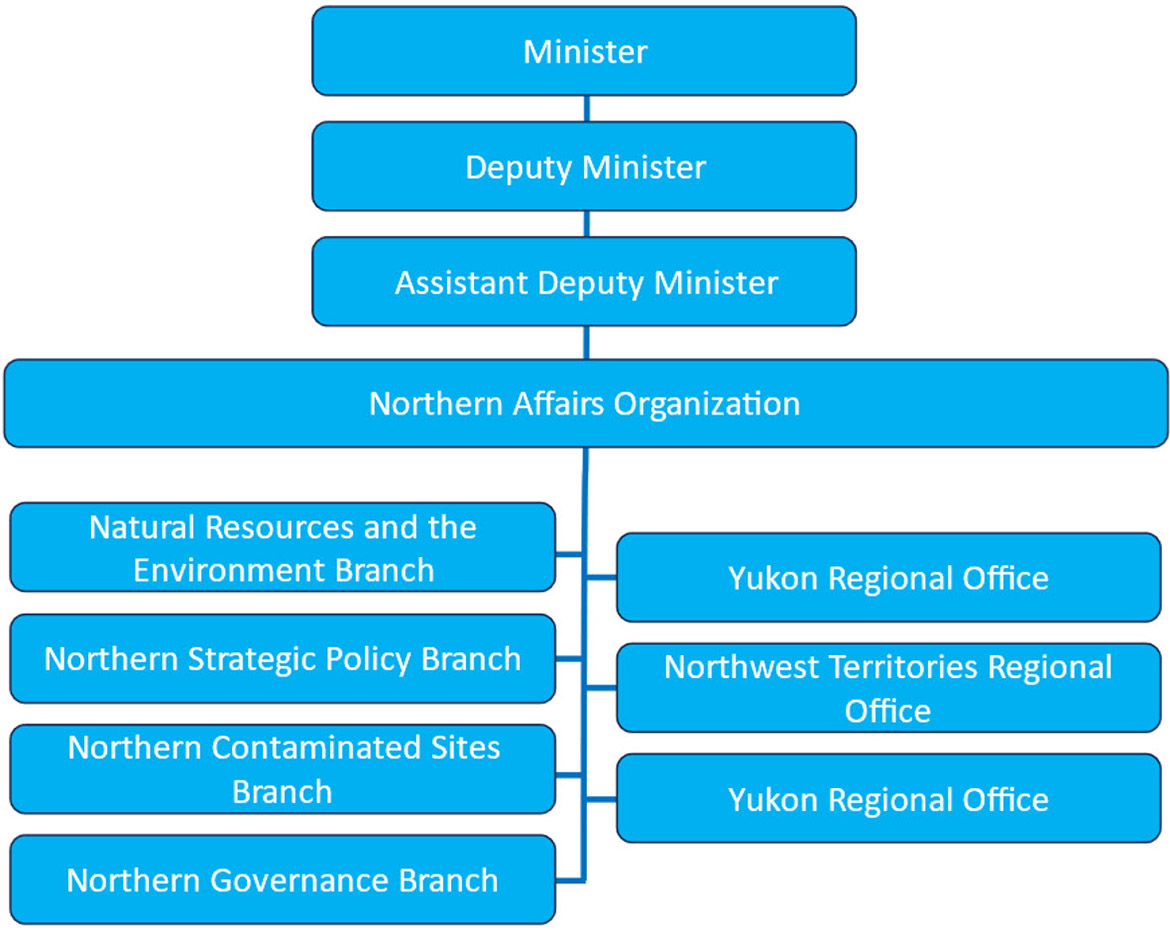
Note: In 2024, an Emergency Management Team was established within Northern Affairs to address a departmental priority. As this team is currently staffed using surge capacity, they are not formally captured in the organizational chart.
Text alternative for Organizational Structure: Northern Affairs Organization
The organizational structure starts with the Minister, followed by the Deputy Minister and Assistant Deputy Minister (Northern Affairs Organization). Northern Affairs Organization oversees four branches - Natural Resources and the Environment, Northern Strategic Policy, Northern Contaminated Sites, and Northern Governance - as well as regional offices in the Yukon, Nunavut and Northwest Territories.
Assistant Deputy Minister: Georgina Lloyd
Northern Affairs Organization is responsible for the delivery of programs, services and initiatives supporting the Department and Minister's mandate and responsibilities.
This includes:
- The management of three regional offices, in Yukon, Northwest Territories and Nunavut.
- Management and remediation of contaminated sites.
- Completion and ongoing implementation of Devolution in Yukon, Northwest Territories and Nunavut.
- Participation in implementation of modern treaties (Land Claims and Self-Government agreements).
- Development and coordination of federal policies in the North and Arctic.
- Delivery of regulatory, environmental and resource management activities and initiatives.
- Responding to emerging needs and priorities in the region such as proposals to address gaps in emergency management identified during the 2023 wildfire season.
Director Generals – Programs Managed from the National Capital Region
Northern Affairs' Branches support the Department and the Minister's priorities and responsibilities including devolution, implementation of modern treaties, policy development, legislative and regulatory initiatives and program management.
Director General: Joanna Ankersmit

The Natural Resources and Environment Branch (NREB) plays a key role in regulatory, environmental and resource management activities on behalf of the federal government, including implementation of co-management regimes.
This includes:
- Responsible for the Critical Minerals Northern Regulatory Initiative;
- Leads the Northern Affairs role in regulatory decisions related to impact assessments and water licencing across the northern territories;
- Leads federal decision role in Land Use Planning and participates in federal Conservation planning and programming activities in the North;
- Leads northern Climate Change and Clean Energy policy and programs;
- Manages Northern/Arctic offshore mineral & petroleum resources policy, regulation/legislation and royalties; and
- Leads northern legislative initiatives (e.g. amendments, Order in Councils, etc.) and provides input and advice on resource management chapters of modern treaty negotiations.
Director General: Wayne Walsh

The Northern Strategic Policy Branch (NSPB) is responsible for providing strategic advice, leading policy development and delivering strategic programs and initiatives for Northern Affairs. NSPB's activities include:
- Management of the Nutrition North Canada Program to make food and some essential items more accessible and affordable in more than 120 isolated communities located in all the three territories and northern regions of six provinces;
- Contributing to monitoring and assessment of Northern Science and Contaminants through national and international scientific assessment initiatives, engagement in the Arctic Council's Arctic Monitoring and Assessment Program, and the Northern Contaminants Program (monitoring of long-range contaminants and plastic pollution);
- Development and horizontal coordination of federal northern and Arctic policy development, such as the Arctic and Northern Policy Framework (released in 2019), and previous policies such as the Northern Strategy (2009). This role includes significant engagement with territorial and provincial governments and Indigenous governments and organizations; and
- Supporting the advancement of post-secondary education through strategic funding initiatives.
Acting Director General: Jeff Mackey

The Northern Contaminated Sites Program Branch is responsible for the management of a portfolio of more than 160 contaminated sites in the North. This includes care and maintenance, site assessment, remediation, design and project closeout. The eight largest abandoned mine projects in the Yukon and the Northwest Territories are administered through the Northern Abandoned Mine Reclamation Program, which includes the Faro Mine Remediation Project and the Giant Mine Remediation Project, two of the largest contaminated sites in Canada. All other contaminated sites are administered through the Federal Contaminated Sites Action Plan Program, a horizontal initiative led by Environment and Climate Change Canada. The objectives of the Program are to:
- Reduce risks to human health and the environment and associated liabilities;
- Manage contaminated sites in a cost-effective and consistent manner; and
- Advance partnerships and socio-economic opportunities for Northerners and Indigenous Peoples.
Total environmental liability in the Public Accounts of Canada attributed to the Department stands at approximately $6.3 billion, as of March 31, 2023, with the bulk (95 percent) tied to the eight largest abandoned mine projects.
Acting Director General: Tooneejoulee Kootoo-Chiarello

The Northern Governance Branch (NGB) is responsible for strengthening and maintaining relations with territorial, Indigenous and Northern partners.
Branch activities also include:
- Implementing Nunavut Devolution;
- Implementing obligations resulting from the Yukon and Northwest Territories devolution agreements (ongoing funding to Northwest Territories Indigenous parties);
- Strengthening infrastructure in northern regions;
- Providing all Business Management Unit-related (BMU) services;
- Facilitating Northern Affairs' responses to corporate requests and reports;
- Reconciliation and collaborating with Indigenous organizations and Northern communities;
- Supporting Territorial Commissioners; and
- Providing grants for hospital and physician services to the Governments of Nunavut and Northwest Territories.
Acting Director General: Harry Borlase

The 2023 wildfire season was the most destructive on record, and exposed gaps in Emergency Management programming in the North. The Emergency Management Team is responsible for plotting a path forward to address these issues. This includes:
- Engagement with Northern partners on their priorities; and
- Horizontal coordination with Public Safety Canada and Indigenous Services Canada on related responsibilities and programs.
Regional Director Generals – Yukon Northwest Territories, Nunavut
Regional Offices are the face of the Department and often the Government of Canada in their respective regions. They deliver both CIRNAC and ISC programs and services.
Regional Director General: Robin Bradasch

The CIRNAC Yukon Regional Office (YRO) provides support to three federal Ministers: Minister of Northern Affairs, Minister of Crown-Indigenous Relations, and the Minister of Indigenous Services Canada. With exception of the First Nations and Inuit Health Branch and a few specific programs, Yukon Region is responsible for the delivery of Indigenous Services Canada's full suite of programs and is embedded within the Regional Operations, Education and Social Development Programs and Partnerships and Lands and Economic Development sectors. Further, the Yukon Region also houses the Implementation and Negotiation unit in the North, which is responsible for the implementation of Yukon's 11 Final and Self-Government Agreements.
There are 14 Yukon First Nations – 11 of which are self-governing and three are under the Indian Act. The Yukon Regional Office also delivers programs and services to three Northern British Columbia First Nations. Yukon is at the forefront of Indigenous Land Claims and Self-Government in Canada. The modern treaties were signed between 1993 and 2005, giving First Nations provincial-like jurisdiction in many areas.
The YRO responsibilities include:
- Remediating abandoned mines and contaminates sites;
- Intergovernmental affairs and maintaining relations with various stakeholders (Indigenous governments/organizations and Government of Yukon);
- Implementing the Final and Self-Government Agreements;
- Implementing child and family services reform;
- Delivering Income Assistance, Assisted Living, Status Registration and Wills and Estates programming;
- Supporting emergency management;
- Delivering ISC and CIRNAC programming in the Territory; and
- Operate as the largest federal department/agency in the Territory
Acting Regional Director General: Ron Pankratz

The CIRNAC Northwest Territories Regional Office (NTRO) supports the mandates and delivery of programs and services for CIRNAC as well as ISC. There are 26 First Nations, one Inuit government and six Métis organizations in the Northwest Territories, with a complex governance spectrum. There are three settled comprehensive land claim agreements, one settled comprehensive land claim and self-government agreement, and one settled community self-government agreement, as well as 14 self-government, transboundary and land-resource agreements under negotiation.
NTRO's responsibilities include:
- Fostering relations with Indigenous governments and the territorial government;
- Administrating board appointments, and maintaining regional relationship with resource co-management boards created under the Mackenzie Valley Resource Management Act;
- Fulfilling regulatory responsibilities for the management of Crown lands;
- Delivering ISC and CIRNAC programming in the Territory
- Managing the single-window approach for funding agreements on behalf of ISC and CIRNAC; and
- Remediating contaminated sites on Crown land and implementing the Northern Contaminants Program.
Acting Regional Director General: Spencer Dewar

The CIRNAC Nunavut Regional Office (NRO) supports the mandates and delivery of programs and services for CIRNAC and ISC. The NRO works with the Nunavut Tunngavik Incorporated, the three regional Inuit organizations, the Government of Nunavut and other Indigenous groups such as Nunavik Inuit, the Cree of Eeyou Istchee, the Athabasca Denesuline and the Ghotelnene K'odtineh Dene.
NRO's responsibilities include:
- Participating in the co-management regulatory framework through land use planning, impact assessments and water resource management;
- Fulfilling legislative responsibilities regarding the administration of Crown lands and water resources, mineral resources and regulatory compliance and enforcement;
- Continue managing the remediation of contaminated sites on Crown lands and the delivery of the Northern Contaminants Program;
- Support the implementation of devolution of lands and resources management to the territorial government;
- Implementation of key articles under the Nunavut Agreement such as: Article 23 (Inuit employment levels within government), Article 24 (procurement and contracting for Inuit firms), and Article 32 (Inuit participation in the development of social and cultural policies);
- Through the Nunavut General Monitoring Plan, monitor the long-term state and health of the ecosystem and socio-economic environment of Nunavut; and
- Delivery of regional funding programs and aspects of land claims implementation with partners.